
How to Evaluate a Commander Deck (Beyond Power Level Numbers)
By MTG Master EditorialPublished Updated 5 min read
If you've played Commander for a while, you've probably been in this situation:
"We said we were playing mid-power... but this doesn't feel mid-power at all."
That disconnect is almost never about someone lying or misjudging on purpose. It usually happens because power level numbers don't explain why a deck plays the way it does.
This page isn't here to say power evaluation is useless — it's here to show what good evaluation actually looks like, and why structured analysis gives clearer, fairer results than gut-feel numbers.
The Problem With Power Numbers (And Why We Still Use Them)
Numeric power levels try to compress a lot of information into a single label.
That's not wrong — it's just incomplete.
- Speed
- Resilience
- Interaction
- Consistency
- Win inevitability
That's why arguments happen. Not because numbers are bad, but because the reasoning behind them is invisible.
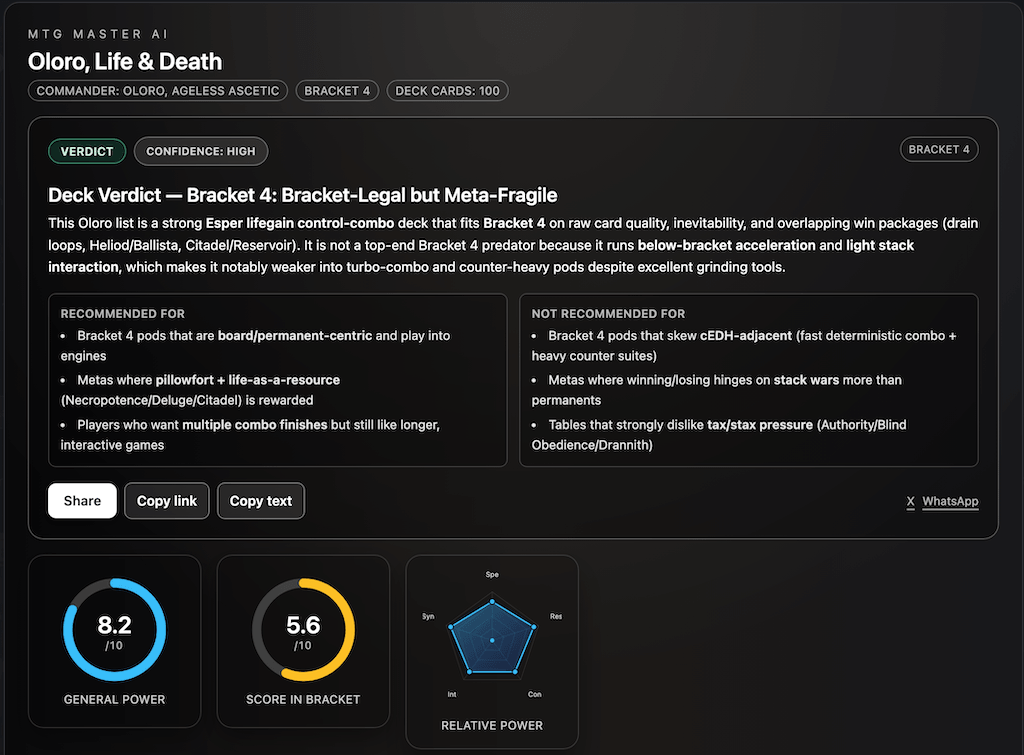
Want a structured evaluation of your deck?
Paste your Commander deck into MTG Master to review mana, ramp, draw, interaction, win conditions, bracket fit, and table expectations.
Commander Decks Should Be Evaluated as Systems
A Commander deck isn't strong because it contains good cards. It's strong because its parts work together reliably.
How scary is this deck at its best?
How does this deck function across real games?
That means looking at the same core systems experienced players naturally judge at the table.
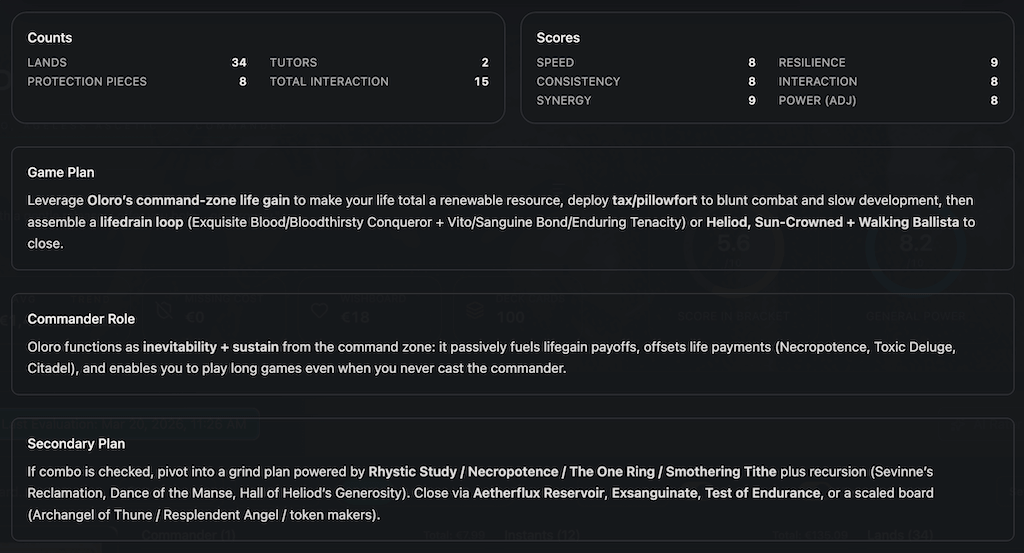
1. Mana & Early Game: Can the Deck Actually Start Playing?
Before anything else, a deck needs to function.
- Can it develop mana smoothly in the first 3–4 turns?
- Are color requirements realistic?
- How many lands or key pieces enter tapped?
- Does the deck have early plays that matter?
Decks that stumble early tend to feel lower power, even if their ceiling is high. This is why early-game stability is a foundational evaluation signal.
2. Card Flow: Does the Deck See Enough of Itself?
Card draw isn't about volume — it's about timing and access.
- How the deck refuels after committing resources
- Whether draw is repeatable or one-shot
- How dependent the deck is on the commander for cards
Decks that run out of gas often feel inconsistent — not because they're weak, but because their card flow system is underbuilt.
3. Interaction: Can the Deck Influence the Table?
Every deck exists in a multiplayer environment.
- Can this deck stop a game-ending play?
- Can it answer problem permanents?
- Does it have interaction at relevant points of the game?
This isn't about being a control deck. It's about not being a passenger. Decks with no interaction often look powerful until someone else executes their plan first.
4. Resilience & Protection: What Happens When Things Go Wrong?
Strong decks attract attention. Evaluation accounts for that.
- What happens if the commander is removed repeatedly?
- Can the deck recover from board wipes?
- Are key pieces protected or replaceable?
A deck that collapses under light pressure usually scores lower — not because it's bad, but because it lacks resilience.
5. Win Conditions: How Does the Deck Actually Close Games?
This is one of the most important — and most misunderstood — parts of evaluation.
- Clear win paths
- Reasonable setup requirements
- Redundancy or inevitability
- Alignment between game plan and finishers
- Too many win conditions with no support
- Big threats that do not advance a plan
- Reliance on a single fragile line
Decks that know how they win tend to perform more consistently — and evaluate higher for good reason.
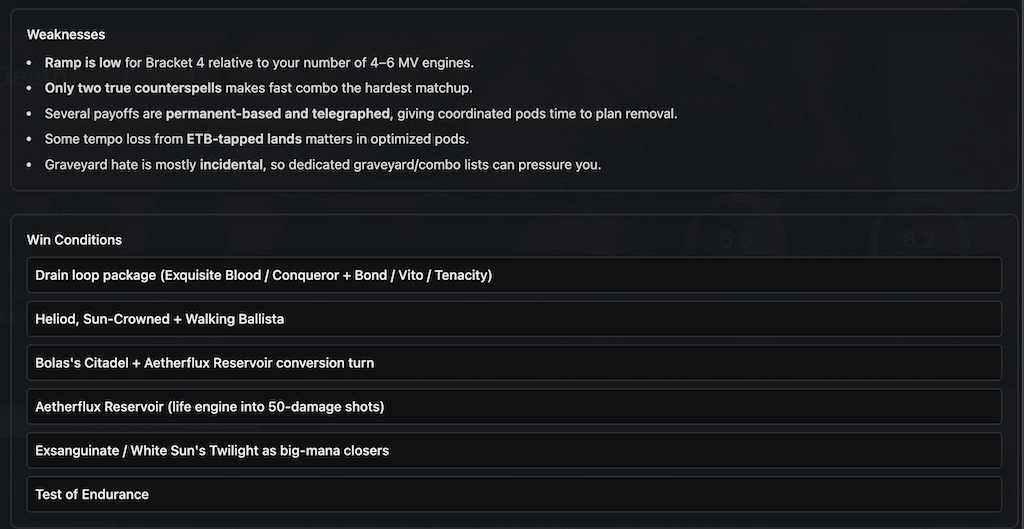
6. Commander Role: What Job Is the Commander Doing?
Not every commander should be a win condition.
- An engine (value, draw, ramp)
- A payoff (finisher or threat)
- A support piece (enabler, glue)
- The deck does not function without the commander
- The commander does not meaningfully advance the plan
- The deck and commander are misaligned
Clear roles lead to clearer evaluations.
7. Consistency Beats Ceiling
One of the biggest mistakes in casual power assessment is judging decks by their best games.
- Average performance
- Recovery from disruption
- Frequency of non-games
A deck that performs reliably every game often evaluates higher than a deck with explosive highs and frequent stalls — even if the latter looks scarier on paper.
So What Does a "Power Score" Actually Represent?
A good power or bracket result isn't a vibe check.
It's a summary of all the systems above:
- Speed
- Stability
- Interaction
- Resilience
- Win inevitability
- Commander dependency
When those systems are balanced and intentional, the deck scores higher. When they're fragile, inconsistent, or misaligned, the score reflects that too. That's how evaluations stay fair — and useful.
Turn the checklist into a report
MTG Master applies this evaluation framework to your actual decklist and highlights what to fix first.
Final Thought
Power levels don't fail because they exist. They fail when they're detached from reasoning.
When you evaluate a Commander deck as a system, the number at the end finally makes sense — and conversations at the table get a lot smoother.
That's the goal: fewer surprises, better games, and decks that do exactly what you expect them to do.