
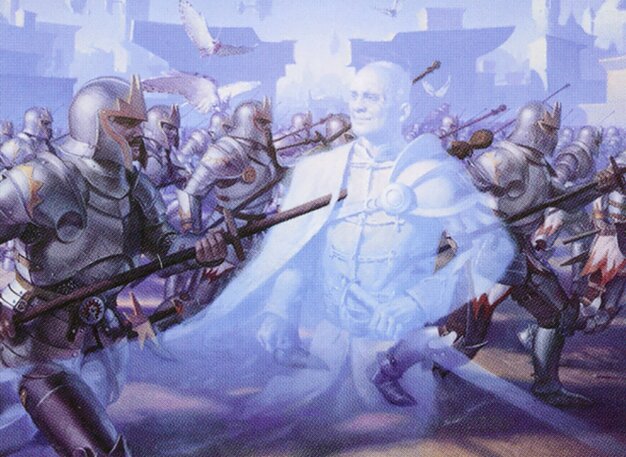
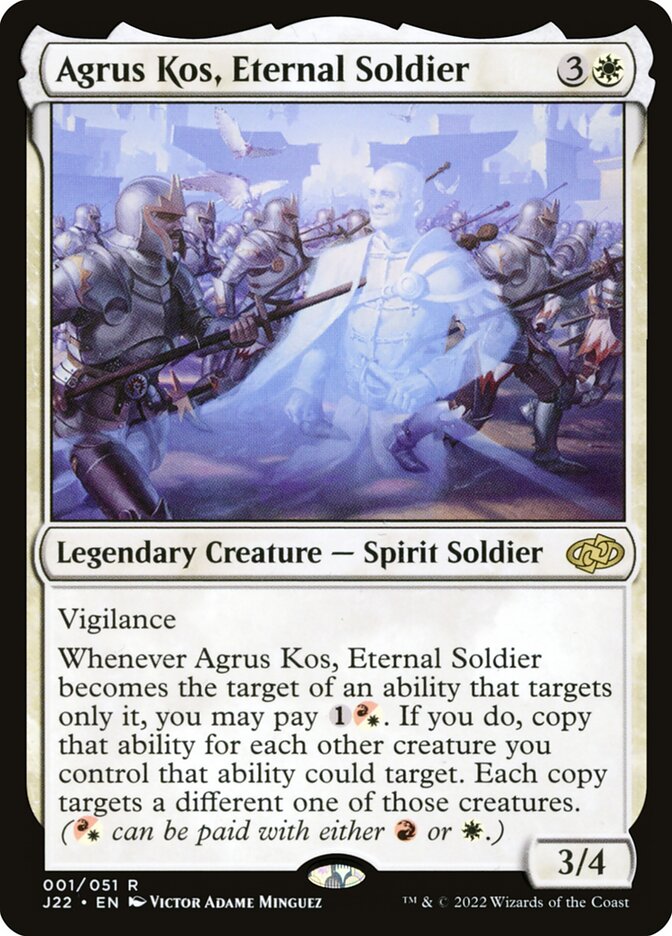
Agrus Kos, Eternal Soldier


Agrus Kos, Eternal Soldier turns single-target abilities into a whole-team effect, rewarding go-wide boards that can convert copied buffs and combat steps into a fast kill.
Public decks: 1Bracket: Varies
Overview
- Build a board of multiple creatures, then look for repeatable abilities that can target only Agrus to “spread” that effect across your team.
- Play patterns often revolve around timing: hold up {1}{R/W} so your key targeted ability becomes a pseudo-overrun or mass protection moment.
- Combat is usually the primary axis, with vigilance letting Agrus attack while still being available for targeting and for defensive postures.
- The deck tends to scale hard with creature count: every additional body increases the payoff of each copied ability.
- Example finish lines can include extra-combat pressure (e.g., Aurelia, the Warleader; Combat Celebrant; Aggravated Assault) or wide damage engines (e.g., Impact Tremors).
Common lines
- Deploy a few creatures, land Agrus, then sequence an ability that targets only Agrus with mana open to copy it onto the rest of your board.
- Use instant-speed interaction or protection to force through a decisive combat, then capitalize on vigilance to maintain shields up.
- Transition from setup turns into a “one big turn” where copied buffs plus extra combats overwhelm blockers.
Strengths
- Explosive scaling with board size: one targeted ability can represent a full-team swing in power or utility.
- Threat-dense combat plan that can punish durdly pods once you untap with a wide board.
- Good at turning modest effects into table-relevant ones, making each activation feel like a mini-engine.
- Can leverage strong red/white pressure tools and protection (example: Deflecting Swat; Flawless Maneuver).
Weaknesses
- Needs creatures on board; wraths and repeated sweepers can reset your payoff engine.
- Mana-hungry: you often want to both advance your board and keep {1}{R/W} available for key turns.
- The commander draws attention once opponents see the “copy to everyone” line coming, and removal can disrupt your snowball.
- Effects that prevent targeting or shut down activated/triggered abilities can strand your core plan.
Rule zero notes
- Call out whether you’re on extra-combat density or potential chains (examples: Aggravated Assault; Aurelia, the Warleader; Combat Celebrant).
- Mention any fast-mana acceleration if present (example: Grim Monolith) since it changes pacing dramatically.
- Clarify if your list is primarily combat-pressure or if it has any deterministic combo finishes.
- If you run heavy protection/interaction, set expectations that you may force key turns through rather than play purely fair combat.
Matchups
Best into
- Midrange creature pods where combat math and tempo matter
- Slower value tables that take time to set up engines
- Decks light on sweepers that rely on spot removal
Struggles against
- Board-wipe-heavy control pods
- Fast combo tables that end the game before combat pressure matters
- Stax or hate pieces that tax activations/targeting or suppress abilities
FAQ
What exactly does Agrus Kos copy?
Only abilities (activated or triggered) that target only Agrus. When you pay {1}{R/W}, you copy that ability for each other creature you control that it could target, with each copy targeting a different creature.
Does this work with spells that target Agrus?
Not by default—Agrus cares about abilities, not spells. You’ll generally be looking for repeatable ability sources rather than one-shot targeted spells.
Do I have to pay {1}{R/W} every time?
Yes; the payment is optional, but it’s a separate decision each time Agrus becomes the target of a qualifying ability.
How does the deck usually win?
Most games end through combat: copied effects multiply your board’s effectiveness, and extra-combat sequences (e.g., Aurelia, the Warleader; Aggravated Assault) can close quickly. Some builds can also lean on wide damage engines as a backup (e.g., Impact Tremors).
What should I prioritize when keeping opening hands?
You typically want early mana development plus a way to build a small board; Agrus is much better when you can follow it with an immediate targeted-ability turn. Hands that only do one of those two things can be clunky.