
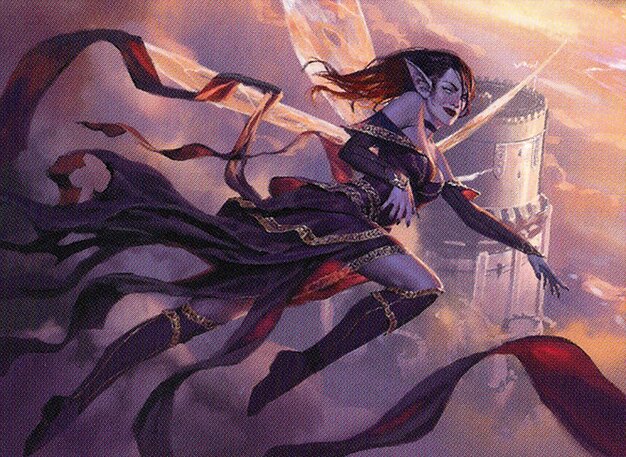
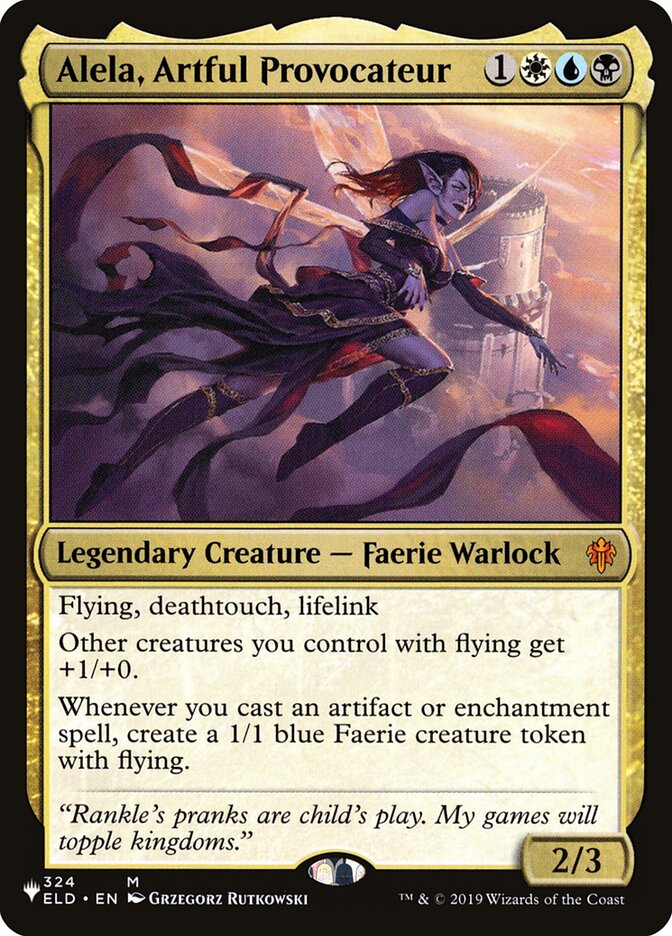
Alela, Artful Provocateur



 Commander
Alela turns every artifact or enchantment you cast into a growing swarm of evasive Faeries that can close games through the air while you play a controlling Esper shell.
Public decks: 2Bracket: Varies
Card text
Legendary Creature — Faerie Warlock
Flying, deathtouch, lifelink
Other creatures you control with flying get +1/+0.
Whenever you cast an artifact or enchantment spell, create a 1/1 blue Faerie creature token with flying.
Overview
- Prioritize getting Alela onto the battlefield, then chain artifacts and enchantments to build a board without overcommitting mana to creatures.
- Leans into evasive chip damage: Faerie tokens plus Alela’s flying anthem effect add up quickly, and lifelink helps stabilize races.
- Typically plays like a tempo-control token deck: develop a threat, then keep mana up for interaction while your board grows incidentally.
- Can pivot between wide pressure and a longer grind using token-friendly card draw and selective answers.
- Most wins come from sustained combat damage in the air, often after a single pump effect or post-wrath rebuild.
Common lines
- Ramp early (for example with Arcane Signet or Fellwar Stone), land Alela, then follow with low-cost artifacts/enchantments to start snowballing tokens.
- Attack with a small air force while holding up countermagic or removal (for example Counterspell or Despark) to protect your lead.
- Use token payoffs to turn a board of 1/1s into real clock (for example Intangible Virtue, Inspiring Leader, or Aven Wind Guide) and end the game in two clean swings.
- Rebuild after interaction by casting a couple of noncreature spells and immediately getting bodies back; some reactive plays can even make tokens (for example Access Denied).
Strengths
- Efficient board development: your engine is tied to casting spells you already want to play.
- Evasion-based pressure makes it hard for many creature decks to block profitably.
- Natural stabilizing tools: Alela’s lifelink and deathtouch discourage attacks and help win combat.
- Plays well at interactive tables thanks to access to countermagic and clean answers.
- Resilient to single-target creature removal when your damage is spread across tokens.
Weaknesses
- Reliant on Alela sticking; repeated commander removal can slow token production dramatically.
- Board wipes can reset your primary win condition, forcing you to rebuild from scratch.
- Artifact/enchantment hate can clip both your engine pieces and your token production triggers.
- Can struggle to close if opponents can repeatedly contest the air or fog combat steps.
- Hands heavy on payoffs without enough castable artifacts/enchantments can feel anemic.
Rule zero notes
- Primary plan is combat-focused token pressure generated off casting artifacts/enchantments.
- Expect a meaningful amount of interaction; examples in this snapshot include Counterspell and Despark.
- Not presenting as a dedicated stax/lock deck from the provided snapshot.
- Win conditions are mainly evasive go-wide damage; some builds may include incidental token-synergy damage engines (for example Mirkwood Bats), but that depends on the list.
- If running sweepers as a reset button (for example Martial Coup), mention how often you plan to use them.
Matchups
Best into
- Ground-based creature-heavy midrange pods that can’t efficiently block flyers
- Slow value decks that give you time to establish Alela and build a board
- Removal-light tables where a protected commander can snowball
Struggles against
- Wrath-heavy control pods that repeatedly sweep tokens
- Decks with dense artifact/enchantment interaction and efficient commander removal
- Very fast combo tables where combat clocks are too slow without early pressure
FAQ
What is Alela actually rewarding you for doing?
Casting artifact and enchantment spells while Alela is on the field, turning each one into an extra 1/1 flying Faerie that also benefits from her flying anthem.
How do Alela decks usually win?
Most games end with a wide board of evasive tokens and a pump effect, then repeated attacks through the air until the table can’t stabilize.
Do I need to play lots of Faeries?
Not necessarily; Alela makes the Faeries for you, so the creature suite can be relatively light and focused on support, protection, or additional token payoffs.
How important is protecting Alela?
Very important in many games, because the token engine is tied to her presence; keeping up interaction (for example Counterspell) often matters more than adding one extra permanent to the board.
What kinds of cards keep the deck from running out of gas?
Token-friendly draw engines help a lot; examples from this snapshot include Idol of Oblivion and Mentor of the Meek, which can convert your steady stream of bodies into cards.