

Alesha, Who Smiles at Death


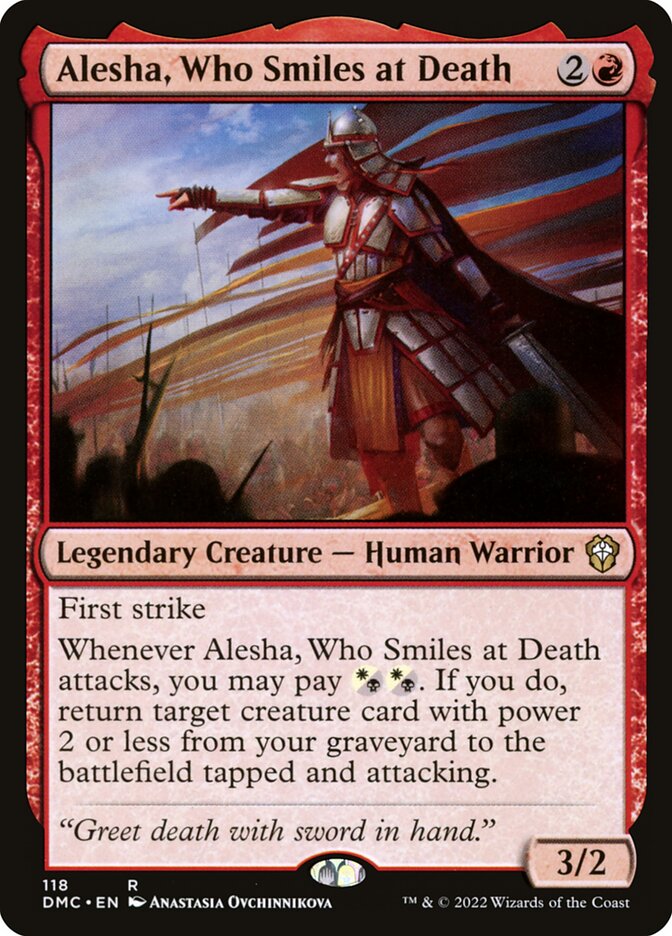
Alesha, Who Smiles at Death is a Mardu combat-recursion commander that turns every attack into a small-creature reanimation engine.
Public decks: 1Bracket: Varies
Overview
- Game plan revolves around attacking with Alesha to reanimate creatures with power 2 or less tapped and attacking.
- You typically want to stock the graveyard early, then convert combat steps into repeatable value and board presence.
- Because the trigger is on attack, the deck often plays like a proactive midrange list that keeps pressure up while rebuilding through removal.
- Common builds lean toward ETB/death-trigger creatures, sacrifice value, or low-to-the-ground tribal shells, but the exact mix can vary a lot.
- Closing the game often comes from incremental drains, repeated combat damage, and snowballing advantage from recurring the right small bodies.
Common lines
- Set up the graveyard with rummage/loot effects, then cast Alesha and start looping a key 2-power creature each combat.
- Attack in spots where first strike makes blocks awkward, reanimating a creature that either trades up, generates value, or adds to your board.
- Use removal to clear the best blocker, then force through attacks to keep the reanimation engine running.
- Pivot into a sacrifice/value loop when combat stalls, using repeatable bodies as fuel for draw and drain effects.
Strengths
- Resilient to spot removal on creatures when the graveyard is stocked, since Alesha can rebuild while attacking.
- Naturally grindy: recurring small creatures can keep your hand and board from running out of material.
- Combat pressure is real, and first strike helps Alesha attack into medium boards without immediately dying in combat.
- Access to Mardu interaction lets you answer a wide range of permanents and problem creatures.
- Flexible shell: can support sacrifice payoffs, aggressive swarms, or value-focused recursion packages.
Weaknesses
- Graveyard hate and exile-based interaction can shut off the core engine and strand your setup.
- Alesha must attack to do the thing, so pillowforts, repeated fogs, or simply clogged boards can stall your plan.
- Commander removal taxes can matter because the deck often wants Alesha online early to start generating returns.
- Creature-based value engines can be vulnerable to sweepers if you can’t immediately restart attacking.
- Reanimating tapped and attacking can be awkward into profitable blocks unless you can control combat or pick the right targets.
Rule zero notes
- This commander is fundamentally graveyard-centric; mention if your build leans heavily on recursion loops.
- Let the table know if you’re using sacrifice-drain style payoffs (for example, Bastion of Remembrance or Bleeding Effect) as a primary finisher.
- If you include lots of cheap discard/loot to sculpt the graveyard (for example, Faithless Looting), clarify whether the deck is more midrange or more combo-leaning.
- If you run many effects that make Alesha hard to block or force through attacks (for example, Key to the City), note that the deck may apply early combat pressure.
Matchups
Best into
- Creature-heavy midrange pods where trading resources is common and combat matters.
- Removal-light tables where a repeatable combat trigger can snowball quickly.
- Grindy games where incremental recursion and 2-for-1s decide the outcome.
Struggles against
- Decks packing frequent graveyard hate or lots of exile removal.
- Hard-control tables that can repeatedly remove Alesha or prevent attacks.
- Fast combo pods where spending turns on combat/value setup can be too slow.
FAQ
What does Alesha actually want in the deck?
Creatures with power 2 or less that are worth bringing back repeatedly, plus ways to fill the graveyard and keep attacks profitable.
Do I have to be all-in on sacrifice or aristocrats?
No. Alesha supports that plan well, but she can also play as combat-focused recursion/value; the key is having good 2-power targets.
How do I get the right creatures into the graveyard?
Many builds use loot/rummage effects as setup (for example, Faithless Looting or Cathartic Reunion), along with normal trading in combat.
What are typical ways this deck wins?
Often through repeated combat damage backed by recursion, or by stacking incremental drain/value engines over multiple turns (for example, Bastion of Remembrance).
What’s the biggest thing to play around?
Graveyard hate and exile effects. If opponents can keep your graveyard empty or remove key targets permanently, Alesha’s trigger loses a lot of impact.