

Alisaie Leveilleur


Alisaie Leveilleur is a tempo-leaning Partner commander that rewards disciplined sequencing by making your second spell each turn cheaper.
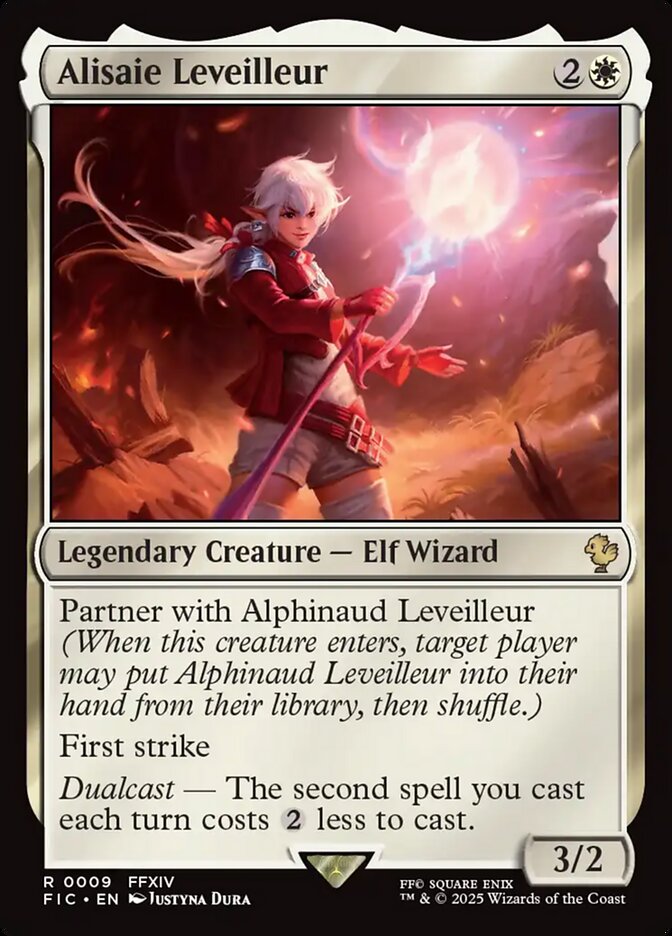
Public decks: 1Bracket: Varies
Overview
- Comes down early at three mana and immediately pressures combat with first strike while you set up two-spell turns.
- Dualcast pushes you to play at instant speed and plan turns around casting a “setup” spell into a discounted follow-up.
- Partner with Alphinaud Leveilleur gives you a built-in way to find your other commander, so your gameplan often starts by assembling the pair.
- Typically plays like a reactive deck that stabilizes the table, then turns the corner by chaining spells more efficiently than opponents expect.
- Wins tend to come from sustained value over multiple turns rather than one huge explosive turn, unless your build is tuned specifically for burst finishes.
Common lines
- Cast Alisaie, use the Partner trigger to put Alphinaud Leveilleur into hand, then plan the next turns around reliably double-spelling.
- Hold up interaction, then on the last end step cast a cheap spell and follow with a discounted second spell to stay mana-efficient.
- Use the cost reduction to “catch up” after committing mana to defense (e.g., a sweeper), rebuilding with two spells in the same turn cycle.
- Chip in with first strike while you keep mana open; Alisaie can make blocking awkward even when you’re mostly playing defense.
Strengths
- Consistent access to a Partner thanks to the built-in search trigger.
- Mana efficiency: the second spell discount adds up quickly across a long game, especially when you can use it on opponents’ turns.
- Natural play pattern for interactive pods: you’re incentivized to keep passing with options and punish overextensions.
- Alisaie being cheap makes it easier to redeploy after removal and keep your engine online.
Weaknesses
- The discount only applies to the second spell each turn, so stumbles happen if you can’t reliably cast two spells in a turn cycle.
- If the table repeatedly removes your commanders, the “value per turn” plan can fall behind dedicated engines.
- Deckbuilding tension: you want enough low-impact spells to enable Dualcast, but too many can dilute your closing power.
- As presented in the snapshot, overall patterns are uncertain due to very limited public data, so table expectations can vary a lot by pilot.
Rule zero notes
- Confirm how you’re handling Partner and color identity at the table, since Alisaie explicitly searches for Alphinaud Leveilleur.
- Share whether your build is primarily control/value or if it includes a fast combo finish.
- Call out any high density of board wipes or lockdown-style defenses if you’re leaning into that plan (examples seen in the snapshot include Cleansing Nova and Circle of Power).
- Mention whether you’re running big, game-ending drains as a main win condition (an example seen is Exsanguinate).
Matchups
Best into
- Midrange pods where games go long and incremental efficiency matters.
- Creature-heavy tables that can be punished by defensive play and well-timed reset turns.
- Interactive metas where passing with mana up is rewarded.
Struggles against
- Fast combo tables that end the game before repeated two-spell turns matter.
- Heavy tax/stax shells that make casting multiple spells per turn difficult.
- Strategies that invalidate small combat pressure (fog loops, pillow-fort extremes) if you rely on chip damage to close.
FAQ
Do I have to play this as a spellslinger deck?
Not strictly, but Dualcast strongly rewards having enough cheap spells and instant-speed plays to reliably cast two spells each turn.
How important is Alphinaud Leveilleur?
Alisaie’s ETB is designed to find Alphinaud, so many builds will treat assembling the pair as step one, even if the rest of the deck varies.
What does Alisaie actually do in combat?
First strike makes her a solid early blocker and a safe chip-damage attacker, buying time while you keep mana up for your second-spell turns.
What kinds of cards work well with Dualcast?
Effects that are good when cast on opponents’ turns and low-cost utility spells tend to fit, because they make it easier to trigger the discount consistently.
How do Alisaie decks usually close games?
Often by accumulating repeated mana and card-advantage edges until a finisher turn becomes unavoidable; some builds may also include a single big payoff spell as a closer.