
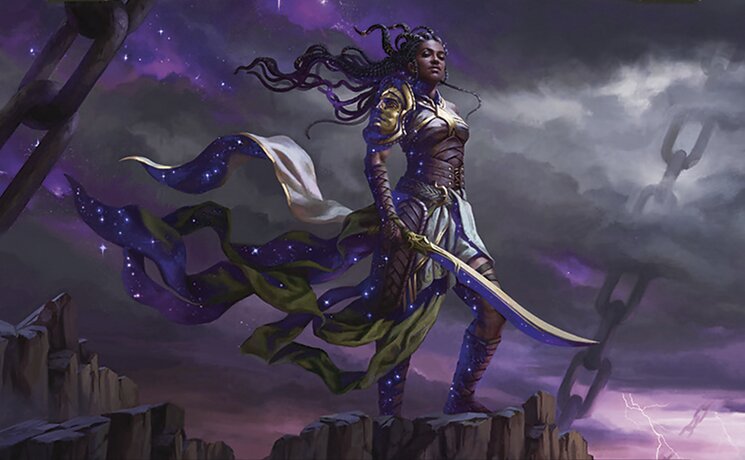
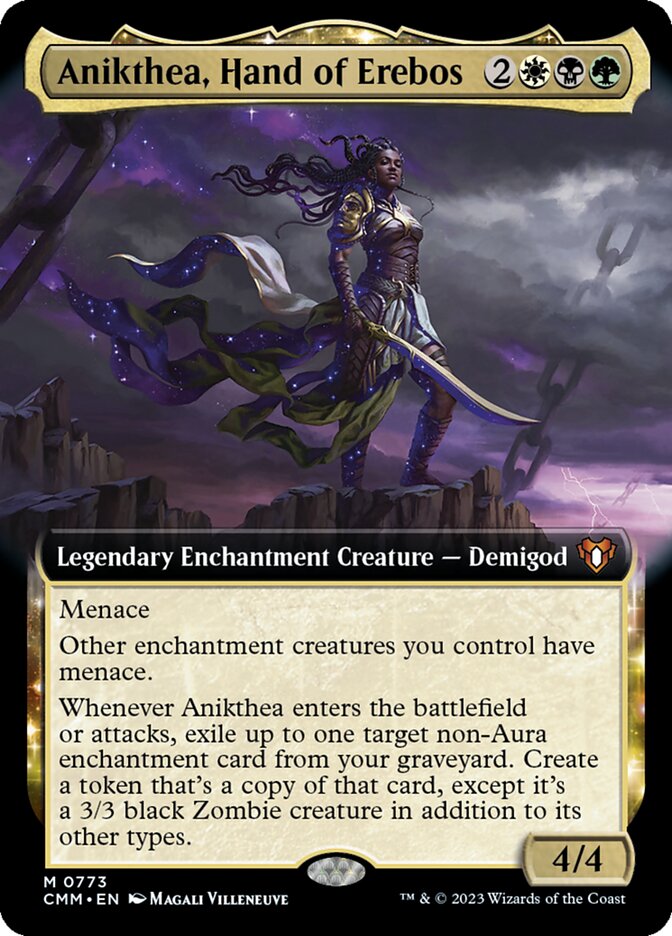
Anikthea, Hand of Erebos



 Commander
Anikthea, Hand of Erebos turns graveyarded non-Aura enchantments into attacking 3/3 Zombie copies while pressuring the table with menace.
Public decks: 1Bracket: Varies
Card text
Legendary Enchantment Creature — Demigod
Menace
Other enchantment creatures you control have menace.
Whenever Anikthea enters or attacks, exile up to one target non-Aura enchantment card from your graveyard. Create a token that's a copy of that card, except it's a 3/3 black Zombie creature in addition to its other types.
Overview
- Game plan revolves around stocking your graveyard with impactful non-Aura enchantments, then converting them into board presence via Anikthea’s enter/attack trigger.
- Anikthea doubles as an engine and a threat: every attack can represent another copied enchantment and added pressure through menace.
- Plays well as an Abzan enchantment midrange deck that accrues value over turns rather than trying to end the game immediately.
- Typically wants to protect Anikthea and keep attacks flowing, since the commander’s trigger is your main source of repeated advantage.
- Wins often come from snowballing enchantment-based value into a wide, hard-to-block board of menace creatures.
Common lines
- Set up early by developing mana and placing a few non-Aura enchantments into the graveyard through normal play, trading, or self-mill-style effects.
- Resolve Anikthea, get an immediate copy if possible, then plan to attack to keep generating more copied enchantments.
- Use the token copies as both pressure and resources, leaning on enchantment synergies and the fact they remain enchantments in addition to being creatures.
- Sequence attacks to maximize triggers while keeping Anikthea safe; losing the commander can slow the deck down significantly.
Strengths
- Repeatable recursion/value: Anikthea can convert graveyard enchantments into immediate board impact every time she enters or attacks.
- Strong combat pressure: mass menace makes blocking awkward and can turn a modest board into real damage quickly.
- Resilient to some removal patterns: getting value on entry and rebuilding from the graveyard can help recover after trades.
- Flexibility: copied enchantments can represent different roles (advantage, interaction, threats) depending on what you’ve binned.
Weaknesses
- Commander-reliant: without Anikthea on board and able to attack, the engine is slower and your plan can stall.
- Graveyard dependence: graveyard hate can shut off the signature token-copy line and force a fairer game plan.
- Attack step matters: fogs, pillow-fort style defenses, or repeated removal before combat can reduce how often you trigger.
- Token copies are creatures: they’re more vulnerable to creature sweepers and exile-based effects than a traditional enchantment-only plan.
Rule zero notes
- This commander can generate recurring value off the graveyard; mention how hard you lean into self-mill/recursion if your list does.
- If your build includes lockdown or prison-style enchantments, call out the density up front to set expectations.
- Clarify whether you’re aiming for a combat-focused menace beatdown plan or a more engine-driven inevitability plan.
- Because the commander makes token copies of enchantments, board states can get complex; confirm the table is okay with that pace.
Matchups
Best into
- Midrange pods where combat matters and incremental value engines are allowed to operate
- Creature-heavy tables that struggle to block menace effectively
- Removal-light metas where the commander can safely attack multiple turns
Struggles against
- Pods with frequent graveyard hate or incidental exile effects
- Control-heavy tables that can repeatedly answer the commander before combat
- Decks that ignore combat and race with fast combo lines
FAQ
Do the tokens Anikthea makes stay enchantments?
Yes. The token is a copy of the exiled enchantment and becomes a 3/3 black Zombie creature in addition to its other types, so it’s still an enchantment.
Can Anikthea copy Auras from the graveyard?
No. The trigger targets a non-Aura enchantment card in your graveyard.
Is this deck more of a combat deck or a value deck?
It often plays as value into combat: you build advantage by copying enchantments, then convert that into damage with menace and board presence.
What happens if Anikthea gets removed repeatedly?
The deck can slow down a lot, since the primary engine is tied to entering and attacking; having alternative value plans and protection tends to matter.
How does the deck usually close games?
It commonly closes by accumulating multiple enchantment-creature tokens and pushing through damage with menace, sometimes backed by whatever effects your copied enchantments provide.