Anowon, the Ruin Thief Commander Deck Guide


 Commander1
A Dimir Rogue tribal commander that turns evasive combat damage into milling pressure and conditional card draw.
Public decks: 0Bracket: Varies

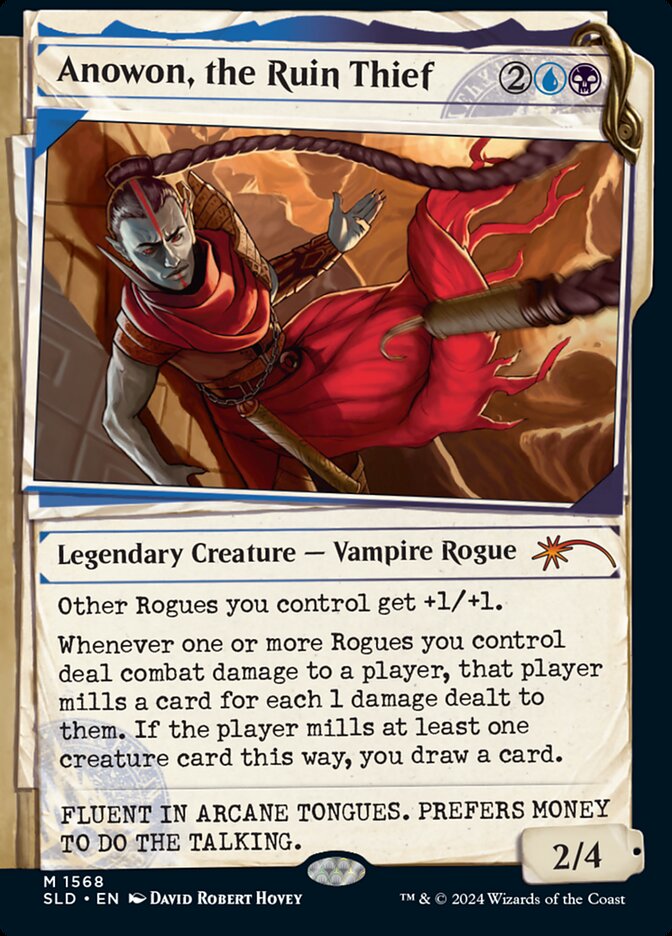
Card text
Legendary Creature — Vampire Rogue
Other Rogues you control get +1/+1.
Whenever one or more Rogues you control deal combat damage to a player, that player mills a card for each 1 damage dealt to them. If the player mills at least one creature card this way, you draw a card. (To mill a card, a player puts the top card of their library into their graveyard.)
Building around this commander?
Use MTG Master to build or analyze a Commander deck around this card, check consistency, and find weak spots before your next game.
Overview
- Plays like an evasive tribal tempo deck: develop Rogues, then start connecting in combat.
- Anowon rewards going wide with Rogues by scaling both damage (anthem) and the mill trigger off total damage dealt.
- Milling is mostly a value engine here: it can pressure libraries and occasionally fuels the draw clause when creatures get milled.
- Typically wants to keep attacks flowing while using interaction to clear blockers and protect key threats.
Common lines
- Deploy a couple of cheap Rogues, then land Anowon to immediately upgrade your board and attacks.
- Attack multiple players with evasive Rogues to spread damage and maximize triggers over the table.
- Use removal/countermagic to force through combat damage when the board starts to clog up.
- Convert the incremental card draw into more Rogues and interaction to stay ahead on resources.
Strengths
- Consistent combat-based value: anthem plus repeated triggers can snowball quickly.
- Evasive creature plan tends to pressure life totals and libraries at the same time.
- Can play a flexible Dimir game plan, pivoting between aggression and holding up interaction.
- Naturally punishes opponents who can’t block well or rely on small numbers of defenders.
Weaknesses
- Highly combat-dependent; fogs, pillow-fort effects, and clogged boards can shut off your engine.
- Conditional draw relies on milling creatures, which can be inconsistent across matchups.
- Board wipes can reset your primary advantage if you overextend into the battlefield.
- Some opponents may benefit from being milled, turning your pressure into their resource.
Rule zero notes
- Call out whether your build treats milling as a primary win condition or mainly as card-advantage glue.
- Mention if you run extra-turns, hard locks, or stax elements (this commander doesn’t inherently require them).
- Be clear about how aggressive your early curve is and whether you’re aiming to pressure life totals quickly.
- Let the table know if you’re including any fast combo finishes, since the commander’s default play pattern is combat-driven.
Matchups
Best into
- Creature-light combo/control pods that struggle to block early evasive attackers
- Slow midrange tables that give you time to build a critical mass of Rogues
- Decks that rely on a few key blockers rather than wide boards
Struggles against
- Go-wide creature decks that can flood blockers and race combat damage
- Dedicated graveyard decks that are happy to be milled
- Heavy sweeper pods that repeatedly clear the board
Recent public decks
No public decks are available yet.
FAQ
Is this a mill deck or a Rogue aggro deck?
It tends to play like Rogue tribal aggro/tempo first, with mill functioning as pressure and a way to turn combat damage into potential card draw.
Do I have to attack to get value?
Yes—Anowon’s main engine is tied to Rogues dealing combat damage, so the deck usually needs consistent attacks to keep cards flowing.
How does the draw trigger work in practice?
After your Rogues deal combat damage, the damaged player mills that many cards; if at least one of those is a creature card, you draw a card.
What’s the usual way this deck closes games?
Most games close through sustained evasive combat damage backed by interaction; milling can contribute pressure but isn’t guaranteed to finish on its own.
What should I watch out for at the table?
Be mindful of opponents who profit from milling and of board states where attacks stop connecting, since that’s when your advantage engine stalls.