

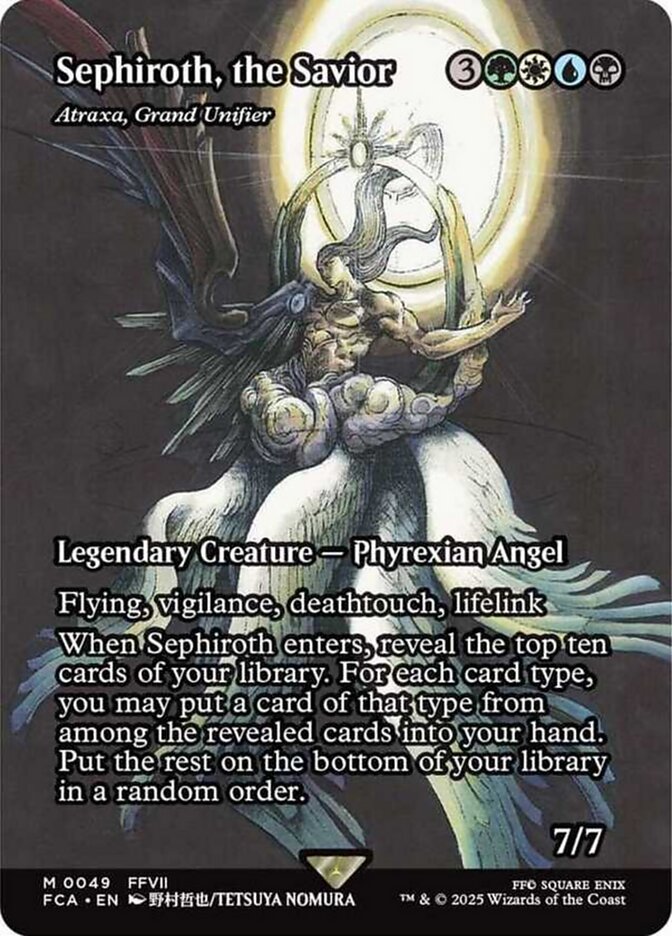
Atraxa, Grand Unifier




 Commander
Atraxa, Grand Unifier is a four-color midrange value commander that turns a single ETB into a huge reload, then leverages blink, interaction, and combat pressure to close.
Public decks: 2Bracket: 3
Card text
Legendary Creature — Phyrexian Angel
Flying, vigilance, deathtouch, lifelink
When Atraxa enters, reveal the top ten cards of your library. For each card type, you may put a card of that type from among the revealed cards into your hand. Put the rest on the bottom of your library in a random order. (Artifact, battle, creature, enchantment, instant, land, planeswalker, and sorcery are card types.)
Overview
- Prioritize early fixing and ramp so you can realistically land a 7-mana commander on time.
- Atraxa’s ETB tends to function like a one-card refuel, rewarding you for playing a spread of card types across the deck.
- Many builds will try to reuse the ETB with blink effects, turning each Atraxa entry into another burst of cards.
- Once you’re up cards, you can pivot into controlling the table with removal/counters and win through evasive commander damage or a buffed-up threat.
- Lifelink plus a big flying body often stabilizes races, buying time to assemble a protected finishing turn.
Common lines
- Develop mana with dorks/rocks and land ramp, then cast Atraxa as your first major payoff.
- Resolve Atraxa, take a multi-type grip, and immediately shift to “protect the queen” with interaction or blink-as-protection.
- Blink Atraxa (for example with Ephemerate, Cloudshift, or Essence Flux) to re-trigger the top-ten reveal and bury the table in cards.
- Use a board wipe (for example Damn or Farewell) to reset, then reload faster than opponents by recasting Atraxa.
- Set up a combat kill by making Atraxa hard to block/kill and pushing through a decisive swing (for example Akroma's Will).
Strengths
- Huge, immediate card advantage from the command zone once Atraxa resolves.
- Excellent at pivoting between roles: stabilize, grind, then pressure life totals in the air.
- Access to broad interaction across four colors, including countermagic and sweepers.
- Blink effects can double as protection while also generating more value.
- Atraxa’s keyword soup (especially flying and lifelink) naturally dominates many combat steps.
Weaknesses
- Seven mana is a real hurdle; fast pods can get under you before Atraxa matters.
- Commander tax adds up quickly if Atraxa is answered more than once.
- Decks with lots of instant-speed interaction can punish you for tapping out for your centerpiece.
- Heavy mana requirements and four-color sequencing can lead to clunky early turns without strong fixing.
- Because Atraxa looks scary and refills immediately, you often draw early table focus.
Rule zero notes
- This commander can generate very large card bursts on ETB; games can snowball quickly once Atraxa sticks.
- If you’re running multiple blink effects, mention whether the plan is repeated Atraxa ETBs for value and protection.
- Disclose whether you’re leaning into commander-damage/Voltron-style kills (for example with large Auras like Eldrazi Conscription).
- Note the presence of hard reset sweepers (for example Farewell) since they can heavily reshape table expectations.
- If you’re packing a meaningful counterspell suite (for example Counterspell and Dissipate), call out that you can play a reactive game after refueling.
Matchups
Best into
- Creature-heavy midrange pods where a 7/7 flying lifelinker can stabilize and take over combat.
- Grindy tables that trade resources; Atraxa’s ETB refuel typically breaks parity.
- Board-wipe-heavy games where rebuilding from the command zone matters.
Struggles against
- Fast combo tables that can threaten wins before you can safely deploy Atraxa.
- Pods with dense permission and tempo plays that repeatedly stop or bounce your 7-drop.
- Stax/denial strategies that constrain mana development and make commander tax backbreaking.
FAQ
What does Atraxa, Grand Unifier actually provide as a commander?
A massive ETB reload: you look at ten cards and often pick up multiple cards across different types, letting you pivot into whatever the game needs.
Do I need to build around a specific theme?
Not necessarily; Atraxa mainly asks that you play a healthy mix of card types so the ETB consistently converts into a full grip.
How do these decks usually win?
Often by turning the card advantage into a controlled board state, then closing via evasive pressure and commander damage, sometimes aided by big combat finishers.
Is blink important here?
It can be; even a few blink spells can function as both protection and additional Atraxa triggers, which compounds your advantage quickly.
What should I expect from table politics with Atraxa?
You’ll commonly be treated as the looming late-game threat; if you resolve Atraxa once, expect opponents to prioritize removing or countering her thereafter.