
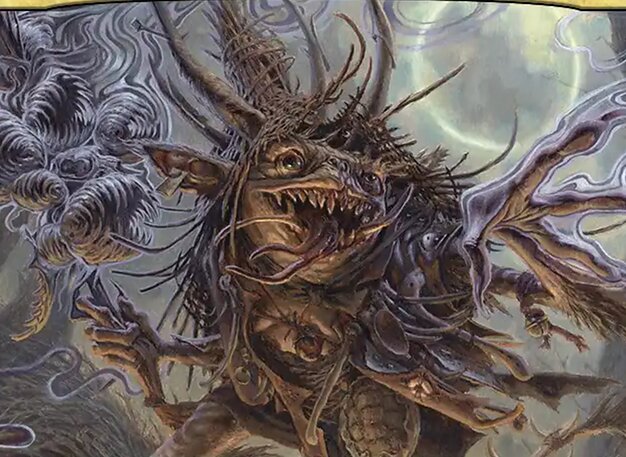
Auntie Ool, Cursewretch



 Commander
Auntie Ool, Cursewretch is a Jund value engine that rewards you for spreading -1/-1 counters across the table while turning every counter event into cards or chip damage.
Public decks: 7Bracket: 3


Card text
Legendary Creature — Goblin Warlock
Ward—Blight 2. (To blight 2, a player puts two -1/-1 counters on a creature they control.)
Whenever one or more -1/-1 counters are put on a creature, draw a card if you control that creature. If you don't control it, its controller loses 1 life.
Building around this commander?
Use MTG Master to build or analyze a Commander deck around this card, check consistency, and find weak spots before your next game.
Overview
- Build around repeatedly placing -1/-1 counters on both your own creatures (for cards) and opponents’ creatures (for life loss).
- Plays like a grindy midrange/control deck that wants the board to stay creature-dense so your counter effects keep triggering.
- Ward—Blight 2 makes interacting with Auntie Ool awkward for opponents who rely on creatures to pay the ward cost.
- Typically wins by accumulating card advantage, shrinking opposing boards, and converting steady life loss into inevitability.
- Works best when your list has many ways to place counters at instant speed or in repeatable small bursts.
Common lines
- Deploy Auntie Ool, then start chaining counter placement so each turn cycle produces extra cards and incidental drains.
- Use counters defensively to blunt attackers and pick off utility creatures while keeping your hand full.
- Turn your own counter placement into a resource engine by ensuring you have creatures that can afford to take counters.
- Leverage table politics by aiming counters at the biggest threats while still advancing your long-game plan.
Strengths
- Consistent card advantage when you can place -1/-1 counters on your own creatures on demand.
- Naturally pressures creature-based strategies by shrinking boards and weakening combat.
- Incremental life loss adds up quickly in longer games without needing to fully commit to all-in combo.
- Ward tax is especially punishing for opponents whose interaction comes attached to creatures or combat steps.
Weaknesses
- Relies on access to creatures and counter-enablers; low-creature pods can reduce your trigger volume.
- Can struggle to close quickly if the table stabilizes behind noncreature engines or life gain.
- Board wipes can reset your setup and force you to rebuild your counter infrastructure.
- Graveyard and recursion strategies may outpace your removal-by-shrinking unless you also bring broader answers.
Rule zero notes
- This deck is centered on repeated -1/-1 counter placement and may feel like soft creature suppression at some tables.
- Expect a grindy game plan with lots of small triggers (cards drawn and incremental life loss).
- Interaction density can be higher than average if the list leans into controlling boards via counters.
- If the build includes any loop-based finishes involving counter placement, call that out before the game (power level can swing a lot).
Matchups
Best into
- Creature-heavy midrange pods where shrinking and picking off bodies matters
- Combat-focused metas that need creatures to pressure life totals
- Toolbox creature decks relying on small utility creatures
Struggles against
- Low-creature spell/combo tables that don’t give you good counter targets
- Heavy board-wipe environments that repeatedly clear your supporting creatures
- Strategies that go over the top with big noncreature engines
Recent public decks
- 1 -1
Sep 1, 2026
A
Alcor
Bracket 1
Auntie
May 25, 2026
P
Play1030...
Bracket 3Deck Power 6.4
New Deck
May 19, 2026
P
Play1184...
Bracket 3
New Deck
May 19, 2026
P
Play1184...
Bracket 3
Blight Curse (Upgraded Precon)
Aug 29, 2026

Edlimir
Bracket 4Deck Power 6.3
New Deck
Jan 30, 2026
P
Play1754...
Bracket 1Deck Power 5.1
New Deck
Jan 30, 2026
P
Play9886...
Bracket 3
Staples
Browse all public decksFAQ
Do the triggers care who put the -1/-1 counters on the creature?
No; whenever one or more -1/-1 counters are put on a creature, Auntie Ool checks who controls that creature to decide whether you draw or that controller loses 1 life.
What counts as “one or more” -1/-1 counters for the trigger?
A single event of placing counters triggers once, even if multiple -1/-1 counters are placed at the same time on that creature.
Is it better to put -1/-1 counters on my own creatures or opponents’ creatures?
It depends: your own creatures convert counters into cards, while opponents’ creatures convert them into life loss; many builds try to do both, depending on board state.
How does Ward—Blight 2 change gameplay?
Opponents can still target Auntie Ool, but they must put two -1/-1 counters on a creature they control, which can be a real cost if their board is small or built around fragile creatures.
How does this deck usually win without big bursts of damage?
It often closes by outdrawing the table, keeping boards small through repeated counters, and letting steady life loss plus combat from whatever creatures you keep in play finish the job.