
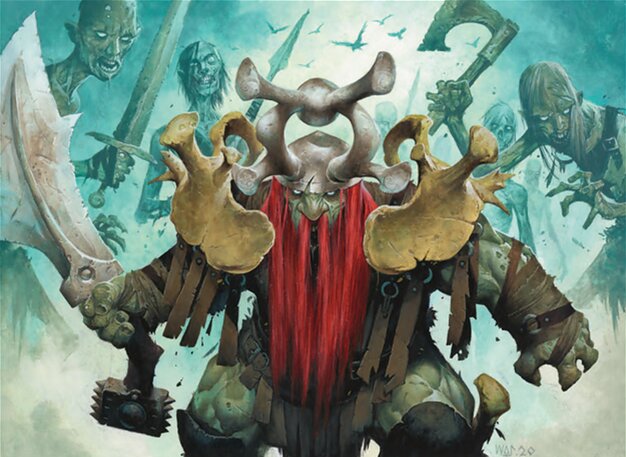
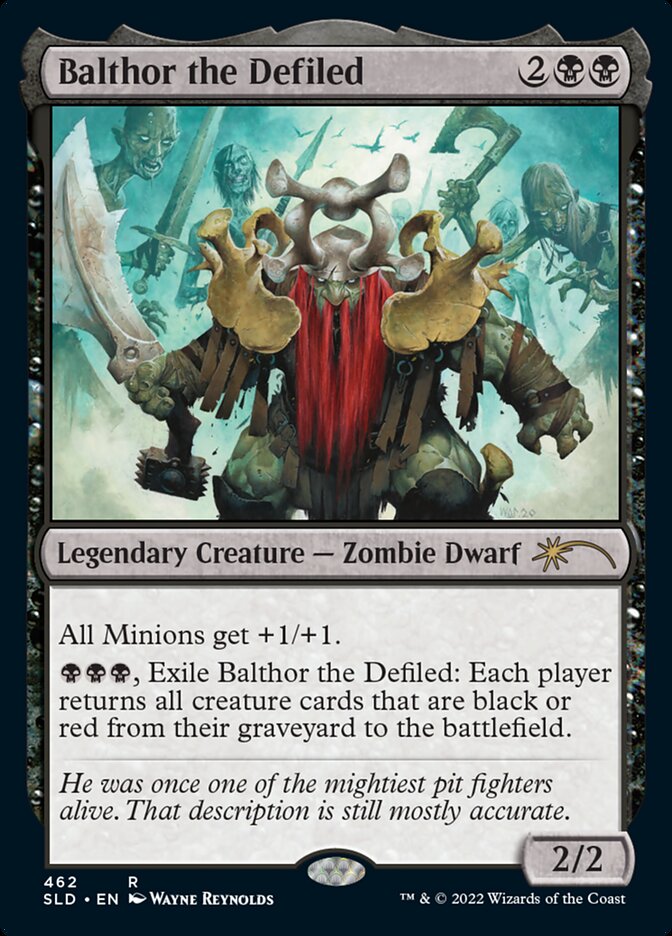
Balthor the Defiled


A mono-black graveyard swing commander that turns one activation into a table-warping mass reanimation, with the catch that opponents get creatures back too.
Public decks: 1Bracket: Varies
Overview
- Plays like a graveyard-centric midrange deck that sets up one big turn where Balthor exiles itself to reanimate a pile of creatures.
- Typically spends early turns ramping and interacting while stocking the graveyard via self-mill, tutoring, or discard effects.
- Because the reanimation is symmetrical, timing matters: you often want to fire it off when opponents’ graveyards are light or when you can immediately capitalize harder than they can.
- Your best games end with a single reanimation turn that produces overwhelming board presence and/or stacked ETB/drain triggers.
- Graveyard hate and instant-speed interaction aimed at Balthor or your yard can force you to play a slower, more incremental reanimation plan.
Common lines
- Ramp and stabilize with removal, then intentionally load your graveyard with high-impact creatures.
- Deploy Balthor and hold up the triple-black activation until you can convert the reanimation into immediate damage, drain, or a decisive combat step.
- If opponents are also filling yards, you may need to delay the activation, clear key threats, or use graveyard disruption before going for it.
- After the big turn, pressure life totals quickly so the table doesn’t get multiple turns to untap and answer your rebuilt board.
Strengths
- Explosive comeback potential: a single activation can rebuild from a mostly empty battlefield.
- Naturally resilient to conventional removal by leveraging the graveyard as a second hand.
- Mono-black interaction and tutoring can help you assemble the right mix of threats and answers.
- Can win through multiple angles: combat, drain/ETB stacks, or attrition into a finisher.
Weaknesses
- Symmetrical reanimation can backfire if opponents have meaningful black/red creatures in their graveyards.
- Highly sensitive to graveyard hate and effects that exile graveyards in response to the activation.
- Balthor is a one-shot engine (it exiles itself), so mis-timing the activation can be costly.
- Triple-black activation and setup requirements can make the deck feel slower if disrupted early.
- Board wipes after you reanimate can be brutal if you overextend without follow-up.
Rule zero notes
- This commander’s main payoff is a symmetrical, mass reanimation effect that can create huge board states at once.
- Games can hinge on a single “big turn,” especially if the list leans into ETB/drain triggers as finishers (for example, Gray Merchant of Asphodel).
- Expect heavy graveyard focus; opponents who dislike graveyard-centric play patterns may want to discuss expectations.
- If the build includes multiple reanimation spells (for example, Animate Dead, Exhume, or Incarnation Technique), it may play more explosively than it looks from the command zone.
Matchups
Best into
- Creature-heavy midrange pods where a mass reanimation swing can outscale fair boards.
- Removal-heavy tables where trading resources favors the player with a stocked graveyard.
- Slower metas that give you time to set up a critical mass of creatures in the yard.
Struggles against
- Pods with frequent graveyard exile effects or instant-speed graveyard interaction.
- Fast combo tables where you don’t have time to set up and your payoff turn is too late.
- Decks that can immediately exploit the symmetrical reanimation with their own stocked graveyard.
FAQ
Do I have to build around Minions?
Not necessarily. The Minion anthem is minor compared to the reanimation ability, so many builds mostly treat it as incidental text.
How do I stop the symmetrical reanimation from helping opponents too much?
Timing is your main tool: activate when opposing graveyards are small or after you’ve disrupted key creatures. Some lists also run targeted graveyard disruption (for example, Crypt Incursion) to mitigate blowouts.
What does a typical win look like?
Often it’s one big reanimation turn that creates overwhelming board presence and closes via combat and/or stacked drains and ETBs (for example, Gray Merchant of Asphodel or Ayara, First of Locthwain).
Is Balthor a combo commander?
It can be, but it doesn’t have to be. The ability supports bursty finishes, yet many builds play it as a grindy reanimator deck with a single decisive payoff turn.
What’s the biggest risk when activating Balthor?
Getting your graveyard exiled in response or giving opponents back more impactful creatures than you return. If you can’t immediately capitalize, it’s often better to wait.