

Beledros Witherbloom



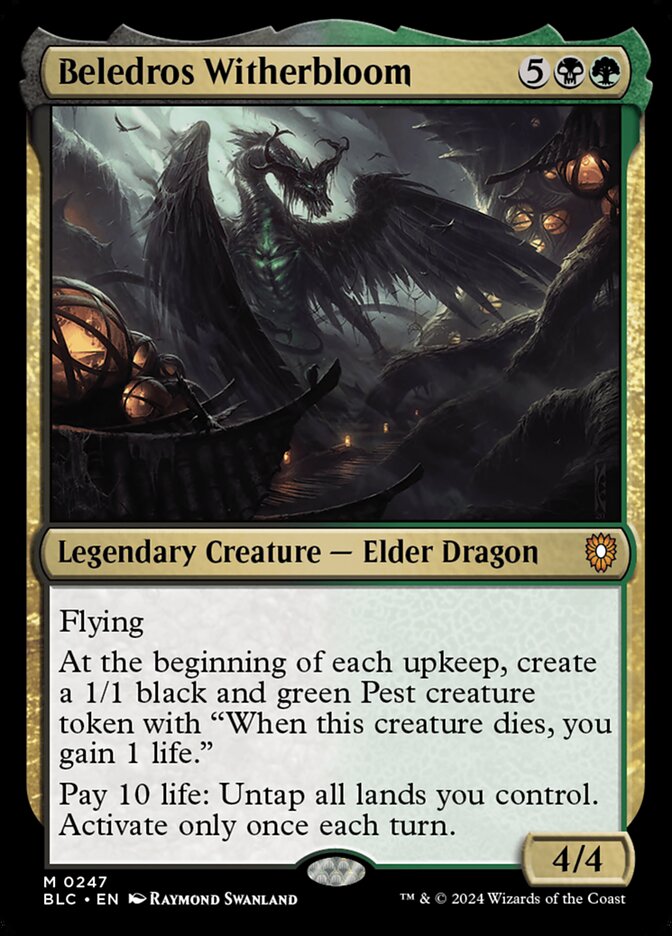
Beledros Witherbloom is a grindy Golgari engine that turns life into huge mana swings while steadily stocking the board with Pest fodder.
Public decks: 1Bracket: Varies
Overview
- Play a slower early game with ramp and setup, then land Beledros to start generating value every upkeep.
- Pest tokens give you bodies to block, sacrifice, and incidentally pad your life total over time.
- The 10-life land-untap activation often functions like a personal “extra main phase,” letting you double-spell or hold up interaction after advancing your board.
- Games tend to pivot around life management: you’re powerful when you can spend life safely, and fragile when you’re under pressure.
- Typically closes by leveraging big-mana turns into overwhelming boards, repeated recursion, or a decisive swing backed by interaction.
Common lines
- Ramp in the first few turns, then deploy Beledros with some ability to protect it or immediately extract value.
- Use Pest tokens to stabilize combat and convert them into incremental life to keep the 10-life activation online.
- Take one explosive turn by untapping lands to cast multiple threats, then pass with mana up to avoid getting blown out.
- In longer games, keep recycling creatures and resources until opponents run out of answers.
Strengths
- Strong inevitability in slower pods thanks to free tokens every upkeep and repeated access to big mana.
- Excellent at converting life into tempo, enabling turns that outscale typical midrange pacing.
- Naturally resilient to creature combat with constant disposable blockers and life buffering.
- Plays well into attrition games where resources trade repeatedly.
Weaknesses
- Life total is a real constraint; aggressive starts or chip damage can shut off your best turns.
- Commander-centric: removing or countering Beledros can significantly slow your engine.
- Can stumble if pressured before you have time to ramp and stabilize.
- Effects that restrict untapping, punish life payment, or tax mana can blunt your main advantage.
Rule zero notes
- Mention whether your list is built for explosive “big mana” turns versus a slower token-grind plan.
- Call out any intentional combo finishes or infinite lines if you included them, since the land-untap ability can support that style.
- Be upfront about how interactive your build is (spot removal vs sweepers vs recursion-based attrition).
- Explain how hard you lean on life payment as a resource, since it can make turns feel swingy.
- If you run lots of recursion loops or repeated board wipes, flag that as an expected game texture.
Matchups
Best into
- Slower midrange and battlecruiser tables where games go long
- Creature-combat pods that struggle to push through endless blockers
- Grindy metas where repeated value engines decide games
Struggles against
- Fast combo tables that end the game before your engine matters
- Low-to-the-ground aggro that keeps your life total under constant pressure
- Stax-heavy pods that constrain mana or untaps and force fair pacing
FAQ
What is Beledros Witherbloom trying to do?
It aims to build incremental value with free Pest tokens while using life as a resource to generate huge mana turns via untapping lands.
How do these decks usually win?
Often by turning a big-mana turn into a dominant board state and then closing through combat, attrition, or recursion-fueled overwhelm, depending on the build.
Is this commander a combo commander?
It can be, but it doesn’t have to be; the untap ability enables explosive turns and can support combo lines if you choose to include them.
How do I manage the 10-life activation without dying?
Treat it like a finisher or a turning point: use it when it meaningfully changes the game state and when you can afford to take heat on your life total afterward.
Do the Pest tokens matter beyond blocking?
Yes; they commonly function as sacrifice fodder and a slow life buffer that helps you keep spending life over the course of the game.