

Breya, Etherium Shaper



 Commander
A four-color artifact commander that turns disposable artifacts into flexible removal, reach, and life padding while building toward a sacrifice-based endgame.
Public decks: 3Bracket: 1

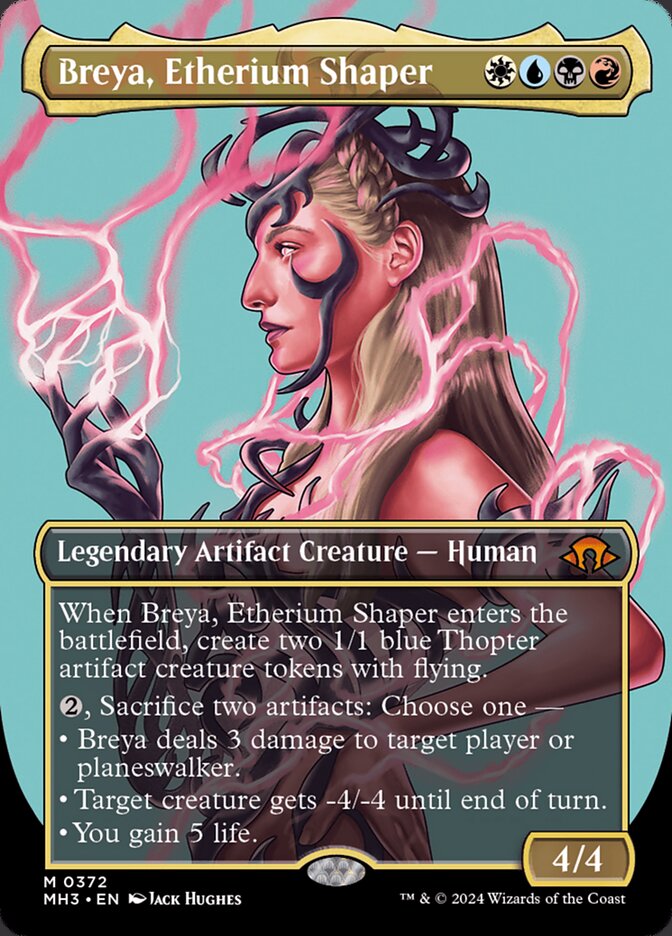
Card text
Legendary Artifact Creature — Human
When Breya enters, create two 1/1 blue Thopter artifact creature tokens with flying.
 , Sacrifice two artifacts: Choose one —
• Breya deals 3 damage to target player or planeswalker.
• Target creature gets -4/-4 until end of turn.
• You gain 5 life.
Building around this commander?
Use MTG Master to build or analyze a Commander deck around this card, check consistency, and find weak spots before your next game.
Overview
- Leans on artifact density: Breya brings bodies immediately and turns extra artifacts into a repeatable effect.
- Plays like an interactive midrange engine, using sacrifice as both value and control.
- Typically wants steady artifact production so the {2}, sacrifice-two ability stays online without shrinking your board too much.
- Can pivot roles: pick off key creatures, pressure planeswalkers/players, or stabilize with life gain depending on the table.
- Closing games often involves converting a wide artifact board into direct damage over multiple activations or a larger artifact-based payoff line.
Common lines
- Deploy Breya to generate two artifacts, then use the tokens as immediate fodder to answer an early threat or protect your life total.
- Build a board of small artifacts, then start trading two at a time for -4/-4 to keep opponents from sticking impactful creatures.
- In slower games, repeatedly cash in artifacts for 3-damage shots to finish weakened players or clean up planeswalkers.
- When ahead, keep mana up to threaten Breya activations, forcing opponents to play into your instant-speed interaction windows.
Strengths
- Built-in flexibility: removal, reach, and life gain from the command zone.
- Creates its own artifact fodder on entry, enabling immediate impact.
- Strong at policing creature-centric plans with repeatable -4/-4.
- Color identity supports a broad mix of interaction and engines (depending on build choices).
- Can play long games by turning excess permanents into actionable effects.
Weaknesses
- Activation is mana- and resource-hungry; sacrificing two artifacts can be a real cost without a steady supply.
- Reliant on artifacts staying on the battlefield; heavy artifact hate can slow the deck dramatically.
- Four-color mana demands can make early turns awkward without careful sequencing.
- Breya’s damage mode is incremental; closing can be slow if you can’t scale artifact production.
- Commander-centric play can be taxed by repeated removal and commander tax.
Rule zero notes
- Share whether your build is more value/control or aiming to assemble a fast combo finish.
- Clarify how much artifact sacrifice/lock-style gameplay you’re running, since it can feel oppressive with the right support pieces.
- Mention if your list is tuned for higher-speed pods despite the commander reading like midrange.
- Call out if you rely on repeated commander activations as the primary control plan, since it affects pacing and threat assessment.
Matchups
Best into
- Creature-heavy midrange pods where -4/-4 trades efficiently
- Planeswalker-focused decks that rely on a few key walkers sticking
- Slower tables where incremental advantage and repeatable activations matter
Struggles against
- Heavy artifact-hate pods that repeatedly sweep or exile artifacts
- Fast combo tables that can win before incremental control matters
- Decks that go extremely wide with disposable creatures, straining single-target control
Recent public decks
Staples
Browse all public decksFAQ
Is Breya more of an aggro commander or a control commander?
Breya typically plays as interactive midrange/control, using artifacts as fuel to answer threats and grind value, then converting that advantage into damage over time.
How do I avoid running out of artifacts to sacrifice?
You generally need consistent artifact production or recursion so Breya’s activations don’t cannibalize your own board faster than you can rebuild.
What’s the main way Breya closes games?
Many games end by turning a large artifact board into repeated 3-damage activations, sometimes paired with a bigger artifact payoff depending on how you built the deck.
How important is casting Breya early?
It depends on the table, but casting Breya is often impactful because it brings immediate fodder and threatens interaction; sometimes you hold it until you can activate right away.
What should I prioritize in mulligans?
Hands that can develop mana smoothly and produce early artifacts tend to perform best, since Breya’s strength comes from having fuel for activations and time to leverage them.