
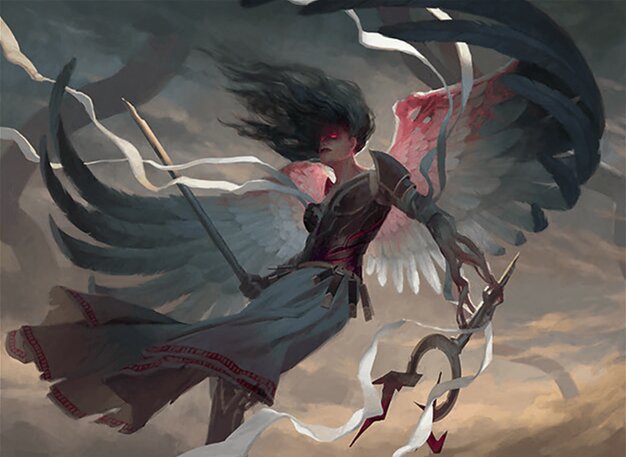
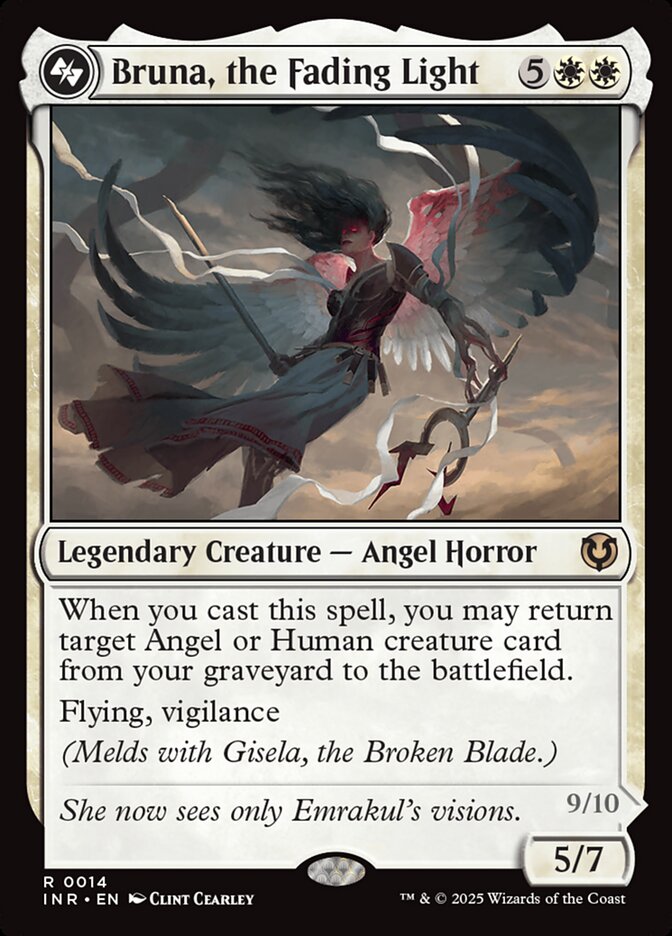
Bruna, the Fading Light


A mono-white Angel top-end commander that turns a seven-mana cast into immediate board presence by reanimating an Angel or Human.
Public decks: 2Bracket: Varies
Overview
- Plays like a midrange-to-late-game Angels deck that wants creatures in the graveyard before committing Bruna.
- Bruna’s value is front-loaded: the reanimation happens when you cast her, so you can often stabilize even if she doesn’t stick around.
- Typically closes with repeated big flying attacks, backed by vigilance to keep shields up.
- Often benefits from incidental lifegain and token-making payoffs to widen the board alongside the large threats (examples in this snapshot include Angelic Accord, Court of Grace, and Griffin Aerie).
- Can pivot into a grindy plan by reassembling threats after removal and resetting the board with sweepers (example: Cleansing Nova).
Common lines
- Ramp early with mana rocks (example: Arcane Signet; Everflowing Chalice) to get to seven mana on time.
- Trade creatures and removal early, then cast Bruna to return a key Angel/Human and immediately swing the board back in your favor.
- Lean on flying bodies to pressure planeswalkers and life totals while leaving vigilance blockers behind.
- Use spot protection to keep your key threat alive through a critical turn cycle (example: Gods Willing; Dawn Charm).
Strengths
- Cast-trigger reanimation gives immediate value and can blunt counterplay that relies on removing Bruna after she resolves.
- Naturally strong at stabilizing against combat decks thanks to large flyers and life-buffering subthemes.
- Good at rebuilding after trades or sweepers by making each Bruna cast a two-for-one.
- Mono-white interaction suite can cover multiple permanent types (examples: Dismantling Wave; Cleansing Nova).
Weaknesses
- Seven mana is a real ask; stumbling on ramp can leave you behind faster pods.
- Graveyard hate and exile-based answers reduce Bruna’s primary payoff and can strand expensive threats in hand.
- Winning is usually combat-based, so fogs, pillowforts, and repeated board wipes can slow you down significantly.
- Mono-white can be pressured on sustained card advantage if the table can answer your first wave.
Rule zero notes
- This commander tends to play a longer, battlecruiser-leaning game where the turning point is a big seven-mana cast plus a reanimation.
- The build can include some tax/pillowfort elements (examples in this snapshot include Authority of the Consuls and Archangel of Tithes), but it isn’t inherently a hard-lock commander.
- Most wins are through combat damage from large flyers and token swarms rather than deterministic combos.
- If you’re aiming to meld with Gisela, the Broken Blade, call that out up front since it changes how you sequence and how opponents should interact.
Matchups
Best into
- Creature-heavy midrange pods where big vigilant flyers dominate combat
- Slower tables that trade resources and give you time to set up a high-impact Bruna cast
- Decks that rely on incremental creature value you can outsize in the air
Struggles against
- Fast combo tables that don’t care about combat pressure until they win
- Blue-heavy control pods that can repeatedly counter or exile your expensive plays
- Decks packing frequent graveyard exile effects
FAQ
Do you get Bruna’s reanimation if Bruna is countered?
Yes, the ability triggers when you cast Bruna, so it will resolve independently of whether Bruna resolves.
What should you usually reanimate with Bruna?
Typically your most impactful Angel or Human for the board state: a stabilizer if you’re behind, or a high-pressure threat if you’re ahead.
How does the meld with Gisela, the Broken Blade play out in games?
If you’re building toward meld, you often treat Gisela as the premium reanimation or protection target and prioritize keeping both pieces available through removal and graveyard interaction.
Is this deck more aggressive or controlling?
It generally plays midrange: you interact and defend early, then pivot into a big-flyer clock once Bruna starts generating two bodies per cast.
What’s the main way the deck actually wins?
Most games end with repeated combat steps from Angels and other evasive threats, sometimes backed by token makers that scale with lifegain (examples in this snapshot include Angelic Accord and Court of Grace).