
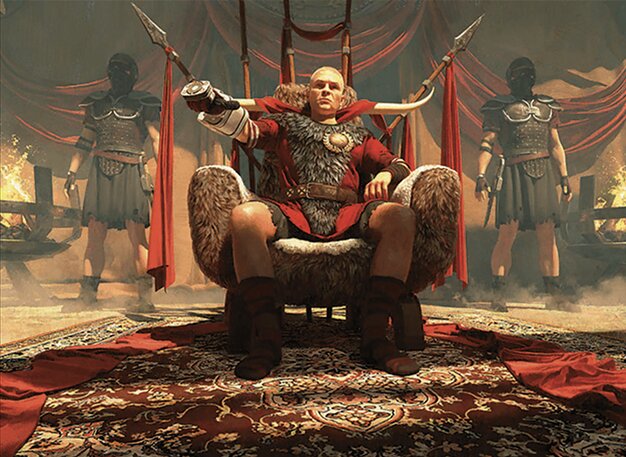
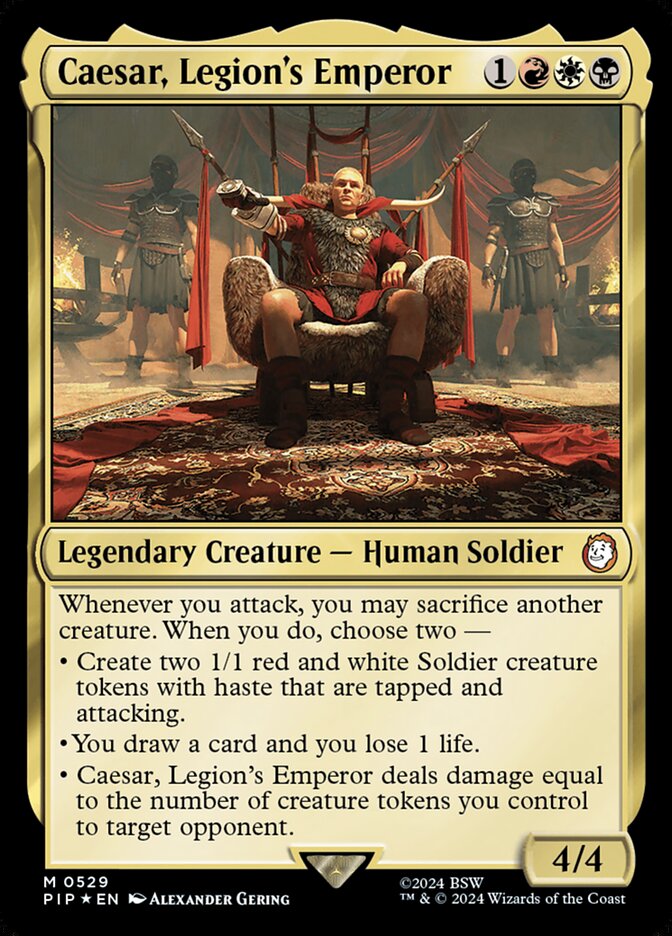
Caesar, Legion's Emperor



 Commander
A Mardu attack trigger that turns spare bodies into cards, more attackers, or a token-count burn finisher.
Public decks: 0Bracket: Varies
Card text
Legendary Creature — Human Soldier
Whenever you attack, you may sacrifice another creature. When you do, choose two —
• Create two 1/1 red and white Soldier creature tokens with haste that are tapped and attacking.
• You draw a card and you lose 1 life.
• Caesar deals damage equal to the number of creature tokens you control to target opponent.
Overview
- Game plan revolves around attacking with Caesar and converting a disposable creature into two powerful attack-step options.
- Typically plays as an aggressive token-and-sacrifice shell: keep bodies on board so the attack trigger is always live.
- Chooses between snowballing the board (more hasty attackers), refueling (draw), or closing (damage based on token count).
- Rewards sequencing combat: you can pressure life totals while also setting up a late-game burn finish without needing to connect in combat.
- Often wins by going wide and then turning token density into direct damage to finish the table.
Common lines
- Develop a board of small creatures/tokens, then attack with Caesar and cash in a creature to keep the engine running.
- Early attacks usually favor making more hasty attackers to build momentum and maximize future token-count damage.
- When resources run low, pivot attack triggers into card draw to maintain pressure through removal and trades.
- Once you control a large token count, use the damage mode to threaten lethal chunks without relying on combat damage alone.
Strengths
- Flexible attack trigger: can pressure, refuel, or convert board presence into reach.
- Naturally good at turning expendable creatures into meaningful advantage each combat.
- Creates immediate pressure with haste tokens, which can punish slower starts and planeswalker-heavy setups.
- Can close games through direct damage to an opponent once token count gets high.
Weaknesses
- Heavily tied to attacking; fog effects, pillowfort, or repeated combat disruption can blunt the engine.
- Needs other creatures to sacrifice; a low-board state can turn off the commander’s value.
- Vulnerable to sweepers that reset tokens and sacrifice fodder, slowing both damage and draw plans.
- Might struggle into decks that consistently remove the commander or prevent profitable attacks.
Rule zero notes
- This commander strongly encourages frequent attacking and creature sacrifice; clarify if your build leans more aggressive or more value-oriented.
- Games can end via direct damage based on token count; mention if your list is tuned to set up large burst turns.
- Expect lots of combat steps and a wide board presence; ask the table about comfort with go-wide pressure.
- If you’re running heavy disruption to force attacks through, it’s worth a quick pregame note.
Matchups
Best into
- Slower, value-oriented pods that give you time to build a token count and attack repeatedly.
- Creature-combat tables where your extra attackers and reach can outpace incremental blockers.
- Decks that rely on single-target removal more than sweepers (you can rebuild with repeated attack triggers).
Struggles against
- Board-wipe-heavy metas that repeatedly clear tokens and sacrifice fodder.
- Pillowfort and combat-tax strategies that make attacking inefficient or impossible.
- Combo decks that race past combat and don’t care about incremental pressure.
Recent public decks
No public decks are available yet.
FAQ
Do I have to sacrifice a creature when I attack?
No. The trigger is a may; you only sacrifice if you want the two chosen effects.
What kind of board does Caesar want before attacking?
You typically want at least one expendable creature to sacrifice and enough bodies/tokens to make the token and damage modes meaningful.
How does the deck usually win?
It often wins by going wide with repeated attack triggers and then converting a large token count into direct damage to finish opponents.
Is this more of an aggro commander or a value commander?
It can play as either; the haste tokens push aggression, while the draw option lets you grind if the game slows down.
What’s the biggest thing that stops Caesar’s plan?
Repeated sweepers and effects that make attacking unprofitable are the most common ways to shut off the engine and keep token counts low.