
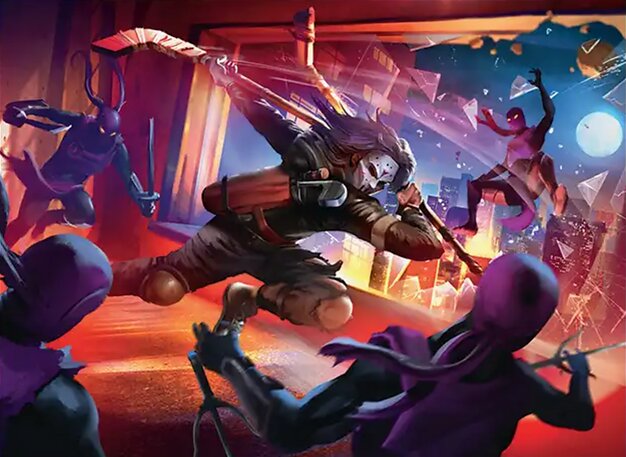
Casey Jones, Jury-Rig Justiciar Commander Deck Guide

 CommanderPauper Commander4
A mono-red haste commander that smooths your draws by digging for artifacts on entry, rewarding lists with a high artifact density and ways to reuse ETB value.
Public decks: 1Bracket: Varies

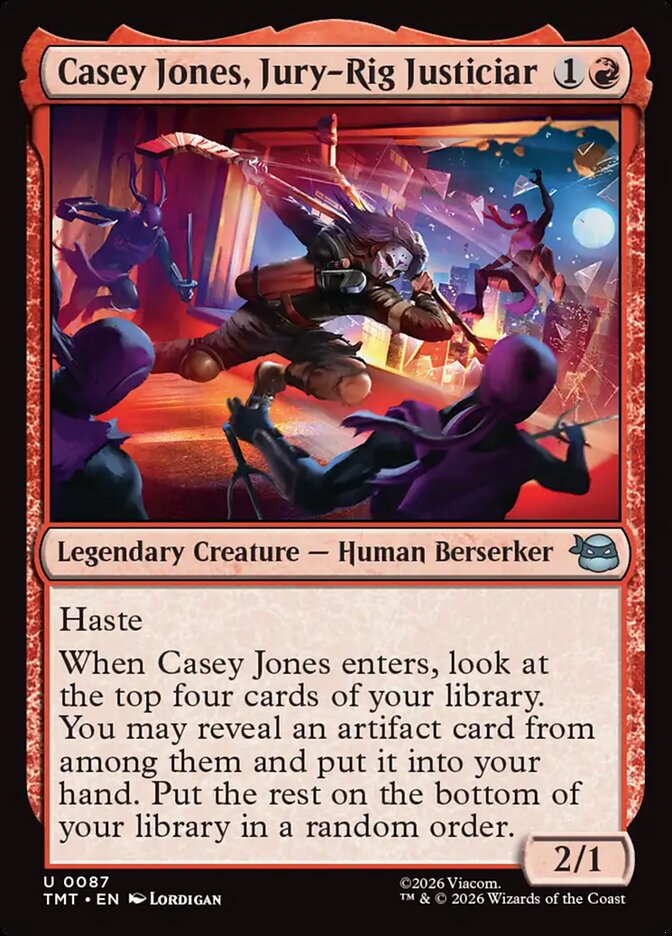
Card text
Legendary Creature — Human Berserker
Haste
When Casey Jones enters, look at the top four cards of your library. You may reveal an artifact card from among them and put it into your hand. Put the rest on the bottom of your library in a random order.
Building around this commander?
Use MTG Master to build or analyze a Commander deck around this card, check consistency, and find weak spots before your next game.
Overview
- Cast Casey early to apply pressure immediately with haste while fixing your next turns via the top-four artifact look.
- Build with enough artifacts that Casey’s ETB is close to a cantrip-plus selection most games.
- Use the ETB to keep hitting mana rocks and key artifact pieces so you can keep pace in longer pods despite being mono-red.
- Recasting Casey over the game can function like a steady source of card quality, but it does ask you to keep mana open for commander tax.
- Wins tend to come from turning your artifact advantage into board presence and closing through combat, backed by red interaction.
Common lines
- Turn 2 Casey, connect for early chip damage, and use the ETB to pick up an artifact to develop your next turn.
- Play a mana artifact (for example Arcane Signet, Fellwar Stone, or Commander's Sphere) to keep Casey recasts and higher-cost plays online.
- When boards get cluttered, lean on a reset (for example Blasphemous Act) to clear blockers and reopen attacks.
- Hold up flexible answers (for example Chaos Warp) to protect tempo when a single permanent would brick your combat plan.
Strengths
- Cheap commander with haste makes it easy to get on board and start attacking without setup.
- ETB selection helps mitigate mono-red inconsistency, especially when you prioritize artifacts.
- Naturally supports a proactive game plan while still finding utility artifacts as needed.
- Scales reasonably into the midgame because recasting the commander can continue to find resources.
Weaknesses
- ETB whiffs are a real cost if your artifact count is too low or your key artifacts get removed.
- Commander tax can turn the value engine off if Casey is answered repeatedly.
- Often leans on artifacts for velocity and mana, making you more sensitive to artifact hate.
- Combat-forward plans can struggle into pillow-fort style defenses or repeated fog effects.
Rule zero notes
- This commander is mostly a consistency tool; the deck’s real power level depends on how explosive your artifacts and finishers are.
- Call out whether you’re running any infinite loops or deterministic combos involving artifacts, since Casey can help find pieces.
- Mention how reliant you are on mana rocks, as that can affect how the table evaluates artifact sweepers and land destruction.
Matchups
Best into
- Creature-heavy midrange pods where early haste damage and board resets matter
- Tables that give you time to accrue incremental value rather than racing to deterministic wins
- Decks that rely on a few key permanents you can answer with broad interaction
Struggles against
- Fast combo tables that don’t care about combat pressure
- Heavy artifact-hate metas that can keep your mana and payoff artifacts off the table
- Control pods with lots of cheap removal that can repeatedly tax your commander
FAQ
How many artifacts do I need for Casey to feel consistent?
Enough that the top-four check hits often; if you find yourself missing repeatedly, increase cheap artifacts and utility pieces.
Is Casey more aggro or more value-oriented?
It can be either, but the card naturally plays like proactive tempo: attack early and let the ETB keep your hand stocked with artifacts.
Do I have to recast Casey multiple times per game?
Not always; you can treat the ETB as early smoothing, but the option to recast later is a big part of how you keep up on resources.
What kinds of cards does Casey actually help you find?
Any artifact, from mana development to utility pieces; for example, hitting a mana rock like Arcane Signet can stabilize your curve.
How does this deck usually close games?
Typically by converting artifact-fueled development into superior board presence and finishing through combat, using red’s flexible interaction to keep lanes open.