

Clavileño, First of the Blessed


 Commander
Clavileño, First of the Blessed turns your attacking Vampires into card-draw death triggers that replace themselves with flying Demon-Vampire bodies.
Public decks: 3Bracket: 4

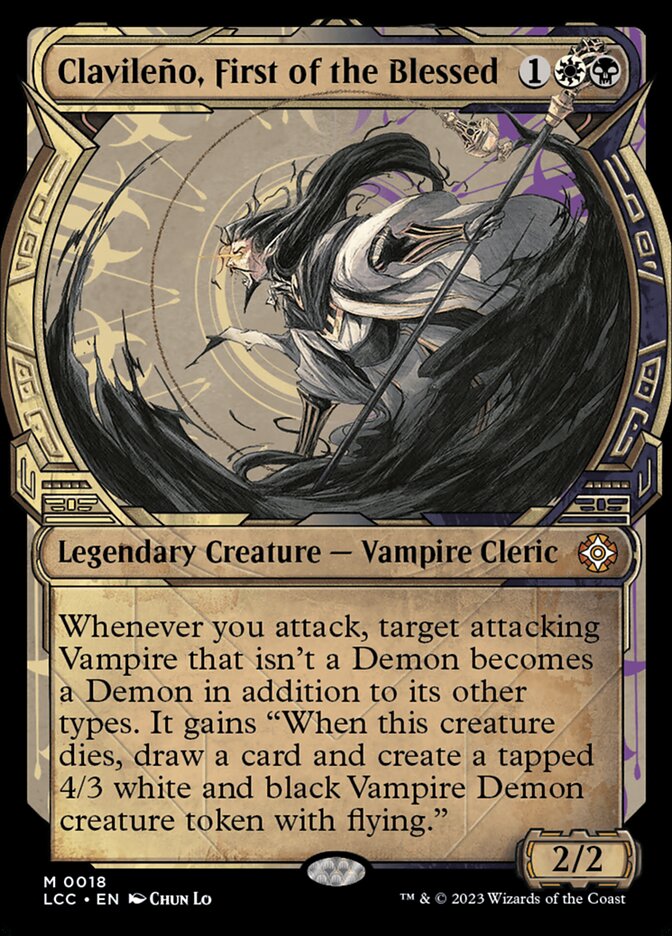
Card text
Legendary Creature — Vampire Cleric
Whenever you attack, target attacking Vampire that isn't a Demon becomes a Demon in addition to its other types. It gains "When this creature dies, draw a card and create a tapped 4/3 white and black Vampire Demon creature token with flying."
Building around this commander?
Use MTG Master to build or analyze a Commander deck around this card, check consistency, and find weak spots before your next game.
Overview
- Attack to "bless" an attacking Vampire, making it a Demon and giving it a death trigger that draws and makes a tapped 4/3 flying token.
- Leans into sacrifice and death triggers so your upgraded attackers can die profitably and still leave behind evasive power.
- Plays well as an Orzhov (white/black) aristocrats-style game plan: chip in, trade creatures, and grind value.
- Token production from deaths helps rebuild after sweepers and keeps pressure on in the air.
- Because only Vampires get upgraded, most lists will want a solid Vampire count before leaning hard on sacrifice payoffs.
Common lines
- Develop early Vampires, then start attacking to grant the Demon death trigger to the best attacker each turn.
- Use sacrifice outlets and death payoffs to convert trades/removal into cards plus 4/3 flying tokens.
- After a board wipe, recast a few creatures and resume attacking to restock on cards and bodies.
- Stack multiple death-trigger payoffs so each "blessed" creature death swings life totals and refills your hand.
Strengths
- Reliable value engine: attacks turn into delayed card draw and a sizable evasive token when things die.
- Naturally resilient to removal and trading in combat thanks to built-in replacement bodies.
- Strong synergy with sacrifice and drain effects, letting you win without needing big combat steps.
- Can pivot between aggression (air pressure) and attrition (grind and drain) depending on the table.
Weaknesses
- Needs to attack to start the engine; fogs, pillowfort effects, and tapped-down combat can slow you.
- Depends on having Vampires on board; low creature density or repeated exile can stall the plan.
- The granted trigger is on death, so exile-based removal can reduce the payoff.
- Tokens enter tapped, so you may not have blockers immediately after cashing in a creature.
Rule zero notes
- Disclose if you run multiple tutors (example: Demonic Tutor) to assemble engines quickly.
- Mention if the deck has significant life-drain/aristocrats finishes (examples: Blood Artist, Cruel Celebrant).
- Call out any stax/tax pieces that slow the table (examples: Blind Obedience, Authority of the Consuls).
- Be clear about how sweepers are used (examples: Damn, Austere Command) since the deck can rebuild well.
Matchups
Best into
- Creature-heavy midrange pods where trades happen often and death triggers generate steady advantage.
- Removal-heavy tables where replacing threats with tokens and cards can outlast one-for-one answers.
- Slow, grindy games where incremental drain and card flow matters.
Struggles against
- Fast combo tables that ignore combat and end the game before the attack/death engine ramps up.
- Exile-centric control shells that minimize death triggers and invalidate recursion-style plans.
- Heavy pillowfort or combat-denial strategies that prevent attacks from connecting or happening at all.
Recent public decks

Staples
Browse all public decksFAQ
Do I have to attack with Clavileño to trigger it?
No; the trigger happens whenever you attack, and you choose a target attacking Vampire that isn’t already a Demon.
What exactly does the upgraded Vampire get?
It becomes a Demon in addition to its other types and gains a death trigger that draws a card and creates a tapped 4/3 white and black Vampire Demon token with flying.
Can I target the same Vampire every turn?
Only if it isn’t a Demon; once it’s been made a Demon, it no longer qualifies for Clavileño’s targeting condition.
Does the token enter untapped and ready to block?
No; the created 4/3 token enters tapped, so it generally won’t block the turn it’s made.
Is this deck more about combat or sacrifice?
Typically it uses combat to turn on the engine, then leverages sacrifice/trading and death payoffs to convert those triggers into wins.