

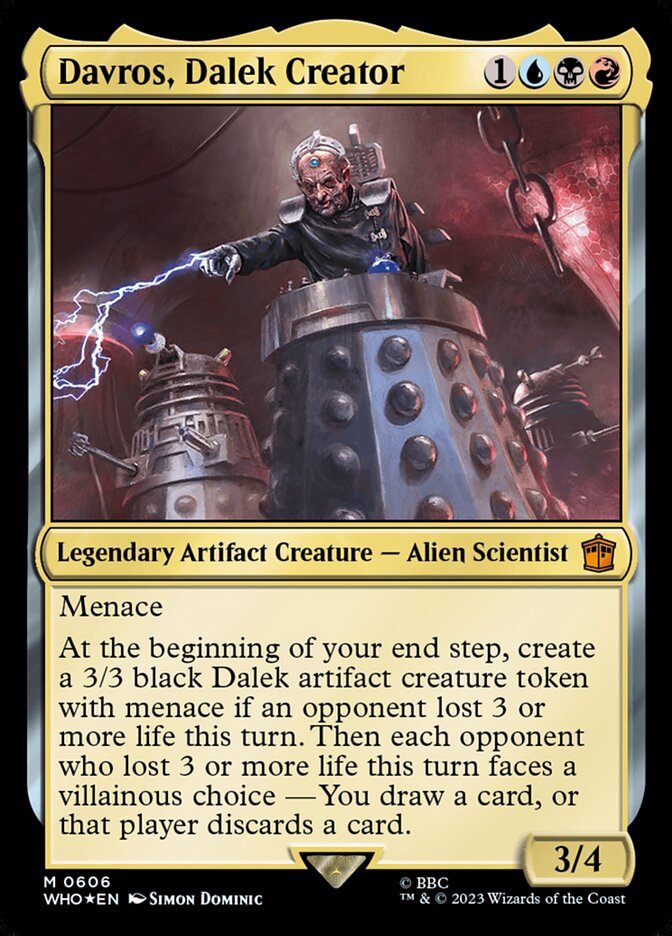
Davros, Dalek Creator



 Commander
A Grixis menace commander that rewards consistent chip damage with Dalek tokens and a steady stream of cards or forced discards.
Public decks: 0Bracket: Varies
Card text
Legendary Artifact Creature — Alien Scientist
Menace
At the beginning of your end step, create a 3/3 black Dalek artifact creature token with menace if an opponent lost 3 or more life this turn. Then each opponent who lost 3 or more life this turn faces a villainous choice — You draw a card, or that player discards a card.
Overview
- Your main goal is to make sure at least one opponent loses 3+ life each turn cycle so Davros reliably triggers on your end step.
- Each successful turn converts damage into a 3/3 menace artifact body, then turns that pressure into either extra cards for you or cards out of opponents’ hands.
- Games often play like a slow squeeze: keep life totals moving down in small chunks, build a board of menace tokens, and tax hands with repeated villainous choices.
- You typically want to spread damage early, then pivot into focusing the player least able to absorb discard or board pressure.
- Closing the game usually comes from a critical mass of menace attackers plus incremental advantage overwhelming removal and blockers.
Common lines
- Set up a way to consistently nick opponents for 3+ total life, then let your end step convert that into a Dalek token and an advantage trigger.
- Use menace bodies to force awkward blocks and keep damage flowing so the engine stays online turn after turn.
- When opponents start running low on cards, the villainous choice tends to translate into either more gas for you or fewer options for them.
- Lean on artifact creature density to keep presenting threats without overcommitting your noncreature resources.
Strengths
- Repeatable end-step value engine that scales with how reliably you can deal 3+ damage.
- Produces its own army over time, giving you board presence without needing to draw into threats.
- Menace on multiple bodies makes combat math and blocking unfavorable for opponents.
- Villainous choice pressures hands while also giving you a steady flow of cards when opponents protect their grip.
- Plays well into longer games where incremental advantage matters.
Weaknesses
- If you can’t consistently make an opponent lose 3+ life, the commander’s output drops sharply.
- Vulnerable to board wipes that reset your token buildup and buy the table time.
- Can struggle into heavy lifegain or damage prevention that blunts your ability to turn on the end-step trigger.
- May draw table attention once the discard pressure starts snowballing.
- Combat-based closes can be slowed by pillowfort-style defenses or large numbers of disposable blockers.
Rule zero notes
- This commander can create recurring discard pressure; confirm whether that’s welcome at the table.
- Games can snowball from repeated end-step token generation if left unchecked.
- Even without dedicated stax pieces, the play pattern can feel like a slow resource squeeze (cards plus board presence).
- Clarify whether your build is aiming for a grindy combat win or a faster, more explosive finish.
Matchups
Best into
- Creature-light control pods that give you time to assemble repeatable chip damage and accrue tokens
- Midrange tables where incremental advantage and combat pressure decide games
- Pods with limited board wipe density, where your token engine can compound
Struggles against
- Lifegain-heavy decks that can make the 3+ life threshold harder to maintain as a reliable trigger
- Wipe-heavy metas that repeatedly reset token boards
- Fast combo tables where incremental combat pressure may not race effectively
Recent public decks
No public decks are available yet.
FAQ
Do I need to hit all opponents for 3+ to get value?
No. You get the Dalek token if an opponent lost 3+ life that turn, and only the opponents who met the threshold face the villainous choice.
How do I usually turn on Davros each turn?
Most builds will prioritize consistent, repeatable chip damage so the 3+ life condition happens naturally without spending a full card each turn.
What does Davros do when opponents choose discard?
You don’t draw in that case, but you effectively convert your damage into hand pressure, which can make it harder for opponents to answer your growing board.
Is this more of a combat deck or a value deck?
It often plays as both: a value engine that steadily builds a menace-based combat threat while also generating cards or stripping resources.
What’s the typical way to close the game?
Most games end with a wide menace board that forces through damage over multiple combats after you’ve built enough advantage from repeated triggers.