

Dina, Essence Brewer


 Commander
A Golgari sacrifice engine that turns one creature each turn into cards, life bursts, and scaling +1/+1 counters.
Public decks: 5Bracket: Varies

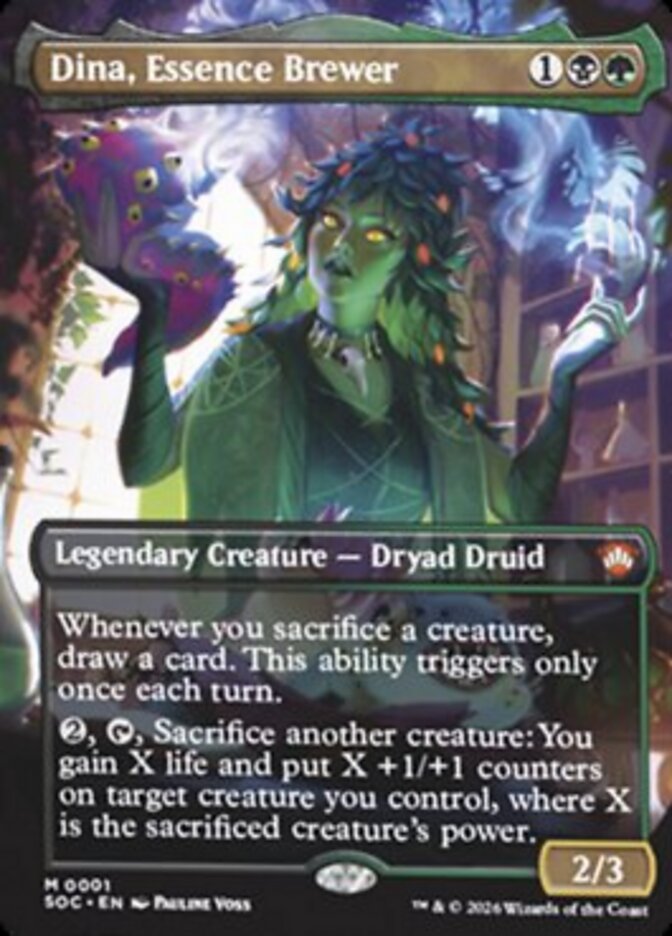
Card text
Legendary Creature — Dryad Druid
Whenever you sacrifice a creature, draw a card. This ability triggers only once each turn.
 ,
,  , Sacrifice another creature: You gain X life and put X +1/+1 counters on target creature you control, where X is the sacrificed creature's power.
Building around this commander?
Use MTG Master to build or analyze a Commander deck around this card, check consistency, and find weak spots before your next game.
Overview
- Plays like a sacrifice-value midrange deck: keep fodder flowing, cash it in, and grind.
- Wants a steady stream of creatures to sacrifice so Dina can draw once each turn cycle whenever possible.
- Uses Dina's activated ability to convert power into life gain and permanent stats on a key attacker or utility creature.
- Often pivots between going tall with counters and winning through incremental advantage from repeated sacrifices.
- Tends to reward playing at instant speed so you can trigger the draw on opponents' turns too.
Common lines
- Develop board with expendable creatures, then plan to sacrifice on your turn for the draw trigger and value.
- Hold up mana and a sacrifice outlet to sacrifice on an opponent's turn, turning the once-per-turn draw into a full table-cycle engine.
- Sacrifice a high-power creature to gain a large chunk of life and pile counters onto a single threat, then pressure life totals in combat.
- Use small sacrifices for steady cards, saving bigger bodies for Dina's activated burst when it will swing combat math.
Strengths
- Consistent card flow if you can sacrifice at least once per turn.
- Flexible win posture: can grind with attrition or focus counters onto a finisher.
- Life gain from the activated ability can buy time against chip damage and racing decks.
- Naturally resilient to spot removal if your plan is distributed across many small creatures.
Weaknesses
- Heavily dependent on having creatures to sacrifice; empty boards can stall the engine.
- The draw trigger being once each turn caps raw velocity compared to dedicated combo engines.
- Graveyard hate and exile-based removal can be awkward if your build leans on recurring fodder.
- Board wipes can set you back significantly if you overcommit creatures without a rebuild plan.
- Activated ability costs mana and tapping Dina, so it can be slow to convert power into a fast kill.
Rule zero notes
- Clarify whether your list is mostly midrange value or built to set up deterministic sacrifice loops.
- Mention how often you plan to sacrifice on opponents' turns (table-cycle draw can feel like a big engine).
- Disclose if your win condition is primarily combat via +1/+1 counters or if you have non-combat finishes.
- If you run high amounts of recursion, note how reliant you are on the graveyard so opponents can calibrate interaction.
Matchups
Best into
- Creature-heavy midrange pods where trading resources favors your sacrifice value plan.
- Combat-focused tables where life gain and growing a blocker/attacker matter.
- Removal-heavy games where repeated low-cost sacrifices keep your hand stocked
Struggles against
- Fast combo pods that end the game before your incremental engine matters.
- Heavy stax or mana denial that prevents you from holding up sacrifice activations across turns.
- Decks that repeatedly wipe the board while pressuring your life total
Recent public decks

Staples
Browse all public decksFAQ
How do I maximize Dina's draw trigger?
You typically want a reliable way to sacrifice a creature on each player's turn, since Dina draws only once each turn.
Should I focus on the sacrifice draw or the life-and-counters ability?
Most games you use the draw trigger to keep resources flowing, then cash in a bigger creature with the activated ability when it changes combat or closes the game.
What kind of creature package does Dina want?
She tends to prefer expendable bodies for steady sacrifices plus some higher-power creatures that make the life-and-counters activation impactful.
How does this deck usually win?
It often wins by turning one creature into a large, counter-stacked threat and finishing through combat while the sacrifice engine keeps your hand full.
What interaction hurts Dina the most?
Effects that prevent you from keeping creatures on board, shut off sacrifice outlets, or punish graveyard-based rebuilding can all slow the engine dramatically.