

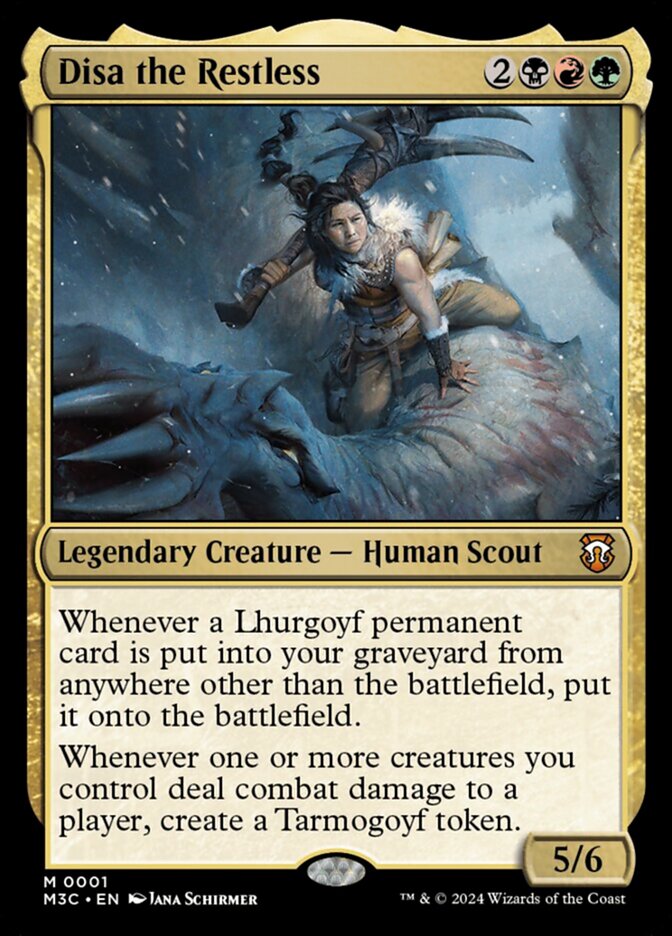
Disa the Restless



 Commander
A Jund combat commander that snowballs value by turning graveyarded Lhurgoyfs into board presence and rewarding successful attacks with growing token pressure.
Public decks: 1Bracket: 1
Card text
Legendary Creature — Human Scout
Whenever a Lhurgoyf permanent card is put into your graveyard from anywhere other than the battlefield, put it onto the battlefield.
Whenever one or more creatures you control deal combat damage to a player, create a Tarmogoyf token.
Overview
- Wants to attack early and often: any combat damage to a player turns into a Tarmogoyf token, scaling your threat density over time.
- Builds around getting Lhurgoyf permanent cards into your graveyard from zones other than the battlefield so Disa can immediately put them onto the battlefield.
- Plays like a midrange combat deck that can pivot into a grindy engine if your graveyard and board keep getting exchanged.
- Typically closes by overwhelming the table with large, scaling bodies and repeated combat steps, rather than a single deterministic line.
Common lines
- Deploy Disa, then start connecting with any creature to begin generating Tarmogoyf tokens each turn cycle.
- Set up ways to move Lhurgoyf permanents into your graveyard from hand/library, then let Disa convert that into free battlefield placement.
- Pressure one player at a time while accumulating tokens, then turn the corner once your board is too large to profitably block.
Strengths
- Snowballs from combat: one successful attack can start a steady stream of scaling threats.
- Punishes attrition: if you can keep feeding Lhurgoyf permanents to the graveyard from non-battlefield zones, you get bodies without spending mana again.
- Natural midrange plan with both proactive pressure and late-game staying power.
- Creates multiple large bodies over time, which can strain single-target removal suites.
Weaknesses
- Needs combat damage to players to fully function; fog effects, pillow-fort play patterns, and dense blockers can slow the engine.
- Graveyard interaction can disrupt the Lhurgoyf recursion angle and reduce your ability to rebuild.
- Relies on the commander for the core engine; repeated commander removal can stall momentum.
- Board wipes can reset token progress and force you to re-establish attacks.
Rule zero notes
- Call out how much your list depends on the graveyard and whether you expect long, grindy games.
- Clarify whether you’re aiming for straightforward combat wins or include faster, more explosive lines.
- Mention your expected table pace, since the commander rewards repeated attack steps over time.
Matchups
Best into
- Creature-light combo/control pods where connecting in combat is easier
- Midrange tables that trade resources and give you time to snowball
- Decks that lean on spot removal over frequent sweepers
Struggles against
- Pillow-fort or heavy-blocker strategies that deny combat damage to players
- Graveyard-hate-heavy pods
- Wrath-dense control tables that repeatedly reset wide boards
FAQ
What does Disa usually try to do each game?
Get into combat quickly, keep connecting with creatures, and let the steady stream of Tarmogoyf tokens turn into an overwhelming board.
How do you actually trigger the Lhurgoyf recursion ability?
You need Lhurgoyf permanent cards to go to your graveyard from a non-battlefield zone (like hand or library); when that happens, Disa puts them straight onto the battlefield.
Do I need to attack with Disa specifically to make tokens?
No. Any creatures you control dealing combat damage to a player will create a Tarmogoyf token.
How does the deck typically win?
Most wins come from building a wide-and-tall board of scaling bodies and closing through repeated combat damage over several turns.
What kinds of interaction are most annoying for Disa?
Effects that prevent combat damage to players, frequent board wipes, and graveyard hate tend to be the biggest obstacles to your engine.