
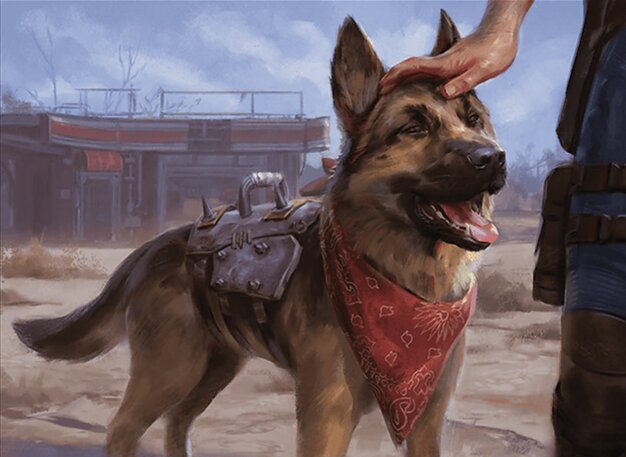
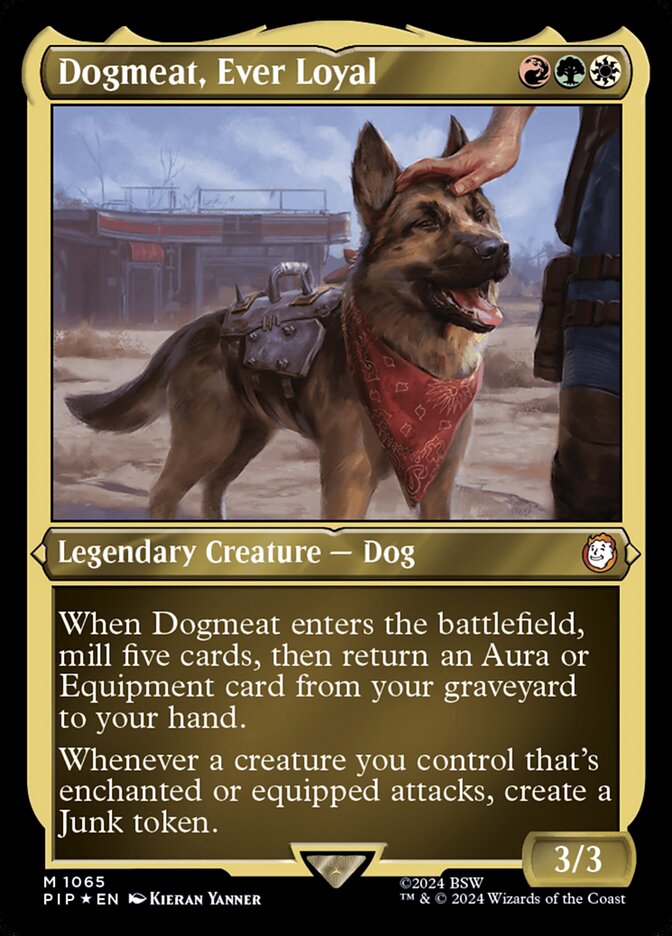
Dogmeat, Ever Loyal



A Naya Aura/Equipment value engine that turns suited-up attackers into Junk-fueled card access and keeps key pieces coming back from the graveyard.
Public decks: 0Bracket: Varies
Overview
- Dogmeat gives immediate setup: mill five, then pick back an Aura or Equipment to reload your hand.
- Leans on attacking with enchanted/equipped creatures to generate Junk tokens for extra cards each turn cycle.
- Typically plays a proactive combat game, using graveyard recursion to stay stocked through removal and trades.
- Junk tokens convert into short-burst advantage, encouraging main-phase sequencing and careful land drops.
- Can pivot between going tall on one threat or spreading Auras/Equipment across multiple attackers, depending on your build and table.
Common lines
- Develop a creature, suit it up, then attack to start producing Junk and snowball into more plays.
- Let Auras/Equipment trade off early, then recast Dogmeat to rebuy a key piece and rebuild.
- Use Junk on your turn to “see” an extra card, then decide whether to commit more gear or hold up interaction.
- Chip in with multiple suited attackers to scale Junk production and keep pressure on life totals.
Strengths
- Built-in card recovery for Aura/Equipment strategies, which are normally vulnerable to removal.
- Repeatable advantage from combat: attacking converts into Junk, which can keep your turns fueled.
- Naturally resilient in grindy games thanks to milling and recursion creating a second hand.
- Flexible threat profile: can spread power across a board or concentrate it onto a single attacker.
Weaknesses
- Heavily incentivized to attack; fog effects, pillow-fort, or clogged boards can stall your engine.
- Graveyard hate can shut off the enters-the-battlefield rebuy and reduce your staying power.
- Junk requires sorcery-speed activation, so the extra cards often can’t be used as instant-speed answers.
- Aura/Equipment plans can be tempo-negative if key creatures get removed before you get value.
Rule zero notes
- This commander encourages a combat-focused Aura/Equipment plan with recurring pieces from the graveyard.
- Expect some self-mill and graveyard interaction; if your table is sensitive to graveyard value, mention it.
- Junk tokens act like temporary card access on your turn; clarify if your build leans hard into artifact-token synergies.
- Power level will hinge on how quickly you can present lethal combat damage versus how grindy you plan to play.
Matchups
Best into
- Midrange creature pods where combat happens and removal trades are common
- Slower tables that give you time to set up suit-up threats and convert Junk into extra spells
- Grindy games where recurring a key Aura/Equipment repeatedly matters
Struggles against
- Dedicated combo pods that can win without engaging with combat
- Heavy graveyard-hate tables that incidentally exile yards often
- Pillow-fort or repeated fog strategies that blank attacks and stop Junk production
Recent public decks
No public decks are available yet.
FAQ
Is Dogmeat more Voltron or go-wide?
It can support either: going tall makes closing faster, while spreading Auras/Equipment across multiple attackers tends to maximize Junk production.
How do you usually close games?
Most wins come from sustained combat pressure, leveraging suited-up threats and Junk-driven card access to keep presenting attackers until someone can’t stabilize.
Do I need a graveyard theme beyond Auras/Equipment?
Not necessarily; Dogmeat’s mill and rebuy are already meaningful, but the deck typically improves if you can tolerate self-mill and occasional recursion lines.
When should I activate Junk tokens?
Usually on your main phase when you can still play the exiled card; treat it like short-term card flow and sequence lands/spells to avoid stranding value.
What’s the biggest thing that slows Dogmeat down?
Effects that prevent profitable attacks or exile graveyards can cut off both halves of the engine: Junk generation and the enter-the-battlefield rebuy.