

Dr. Eggman



 Commander
A Grixis value engine that turns end-step cards into either steady discard pressure or big Constructs/Robots/Vehicles hitting the table for free.
Public decks: 3Bracket: Varies

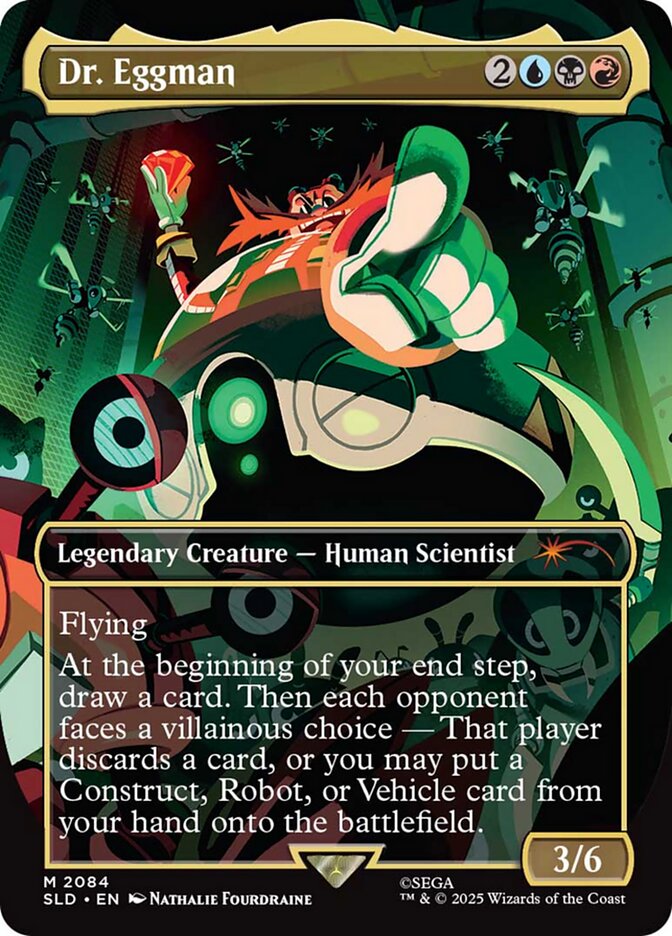
Card text
Legendary Creature — Human Scientist
Flying
At the beginning of your end step, draw a card. Then each opponent faces a villainous choice — That player discards a card, or you may put a Construct, Robot, or Vehicle card from your hand onto the battlefield.
Building around this commander?
Use MTG Master to build or analyze a Commander deck around this card, check consistency, and find weak spots before your next game.
Overview
- Land Dr. Eggman, then start every turn cycle with an end-step draw that also pressures opponents to discard or lets you deploy a themed threat from hand.
- Leans on hand quality: you want high-impact Constructs/Robots/Vehicles to punish opponents who choose not to discard.
- Plays well as an artifact-leaning midrange/control deck, using interaction to protect the commander and keep the table honest.
- Over time, the villainous choice tends to tax resources: either opponents bleed cards, or your board snowballs with free permanents.
- Games often close by sticking one or two large artifact threats and riding repeated end-step value to stay ahead through removal.
Common lines
- Curve into Dr. Eggman, pass with mana up, then convert the first end step into either a “free” board addition or a discard that sets opponents back.
- Sandbag a key Construct/Robot/Vehicle until you can safely cash in an end step for it, rather than spending a full main phase casting it.
- Use artifact ramp and cost reduction to double-spell while keeping interaction available, letting Eggman’s trigger be pure upside.
- If you’re ahead on board, lean into the discard mode to keep opponents from assembling answers; if you’re behind, prioritize the free permanent to stabilize.
Strengths
- Reliable card advantage from the command zone that doesn’t require attacking.
- Built-in, repeatable pressure on opposing hands that can disrupt slower, reactive plans.
- Cheats mana by putting specific card types directly onto the battlefield, enabling swingy tempo turns.
- Naturally supports artifact synergies and resilient late-game positioning.
- Good at turning “pass with mana up” play patterns into real progress every turn.
Weaknesses
- Relies on having Constructs/Robots/Vehicles in hand; without them the trigger can devolve into “draw + mild discard pressure.”
- Six-mana commander that can be clunky if repeatedly removed or if the table is very fast.
- Artifact-centric plans can fold to concentrated artifact hate and exile-based answers.
- Opponents can sometimes choose discard strategically (or empty their hand) to minimize the impact of the trigger.
- Can draw table attention once the free-permanent mode starts generating large threats.
Rule zero notes
- This commander generates ongoing value and can create steady discard pressure; mention if your list leans hard into hand denial.
- If you’re running any infinite or near-infinite engine lines (for example involving Isochron Scepter and Dramatic Reversal), flag that up front.
- If your build includes oppressive sacrifice/punisher elements (for example effects like Grave Pact), set expectations on how controlling it plays.
- Call out if you’re aiming for “big artifact threat” games (for example cards like Cityscape Leveler) versus a more interactive, slower plan.
- Mention your interaction density if you’re on splashy resets (for example Cyclonic Rift) so tables can match power level expectations.
Matchups
Best into
- Grindy midrange pods where incremental advantage and hand pressure matter.
- Creature-based decks that struggle to answer repeated large fliers/artifact bodies efficiently.
- Reactive control tables that depend on holding up multiple answers in hand.
Struggles against
- Fast combo pods that can win before repeated end-step value matters.
- Decks with heavy artifact removal and exile effects aimed at your key permanents.
- Low-to-the-ground aggro or token strategies that go wide under your slower setup.
Recent public decks
Staples
Browse all public decksFAQ
What is Dr. Eggman actually doing each turn?
At your end step you draw, then each opponent either discards a card or lets you put a Construct/Robot/Vehicle from your hand onto the battlefield. The plan is to make both choices painful over time.
Do I want opponents to discard, or to let me put something in?
It depends on the game state: if you already have a strong board, discard keeps opponents from finding answers; if you need to catch up, the free permanent is often the better outcome.
How do I make the “put it onto the battlefield” mode consistent?
You generally need a high enough density of Constructs/Robots/Vehicles and ways to keep your hand stocked so your end step can convert into a real threat instead of a whiff.
Is this a combo commander or a midrange commander?
The commander reads like a value/midrange engine, but a given list can include combo finishes; for example, some builds may use Isochron Scepter plus Dramatic Reversal as a dedicated plan.
What kind of interaction does this deck want?
You typically want enough removal/countermagic to protect the commander and your key artifacts, because repeated end-step triggers are where your advantage comes from.