

Dyadrine, Synthesis Amalgam


 Commander
Dyadrine is a scalable Selesnya counters-and-combat commander that turns attacking into steady cards and extra bodies by cashing in +1/+1 counters.
Public decks: 1Bracket: 4
Card text
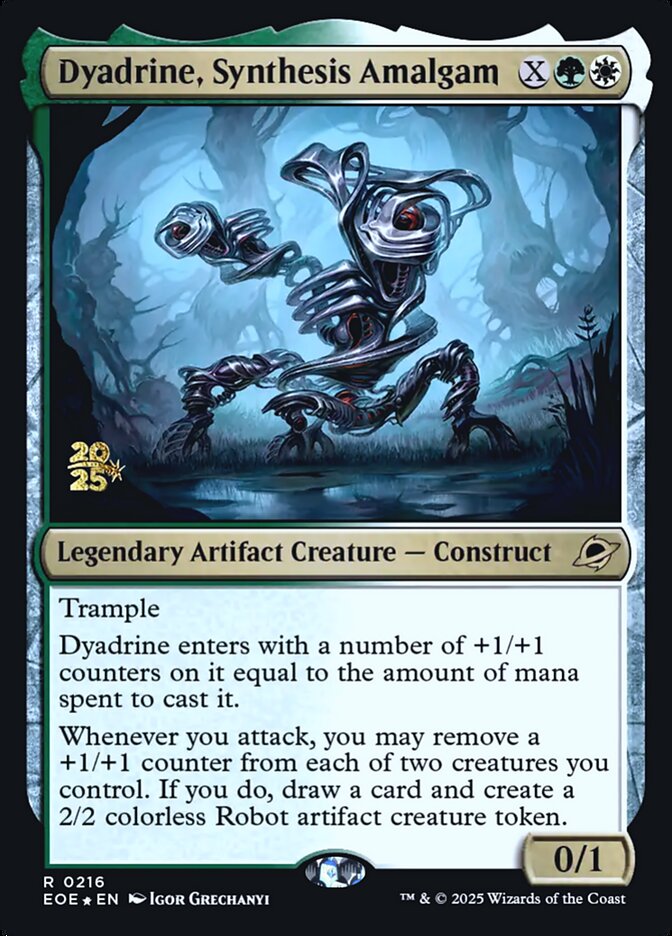
Legendary Artifact Creature — Construct
Trample
Dyadrine enters with a number of +1/+1 counters on it equal to the amount of mana spent to cast it.
Whenever you attack, you may remove a +1/+1 counter from each of two creatures you control. If you do, draw a card and create a 2/2 colorless Robot artifact creature token.
Building around this commander?
Use MTG Master to build or analyze a Commander deck around this card, check consistency, and find weak spots before your next game.
Overview
- Cast Dyadrine for a meaningful X so it enters as a real threat with trample and a pile of +1/+1 counters.
- Build a board of creatures that can hold counters so your attack step converts spare counters into card draw and 2/2 Robot tokens.
- Keep pressure on the table: the engine asks you to attack, so the deck tends to play proactively rather than durdle.
- Use counter multiplication and counter payoffs (as examples, Hardened Scales, Abzan Falconer, Abzan Battle Priest) to make every counter matter before you spend them.
- Close games by snowballing board presence and scaling your biggest threats, often winning through combat damage.
Common lines
- Ramp early (for example, Birds of Paradise, Farseek, Cultivate) to cast Dyadrine for a larger X and still deploy follow-up threats.
- Attack with a board that already has counters; remove counters from two creatures to draw a card and add a Robot, then keep attacking to repeat.
- Leverage one big attacker plus a second counter-bearer to keep the trigger online even through spot removal.
- When ahead, turn token creation into a board-wide scaling plan (for example, Cathars' Crusade) and force the table to answer your battlefield.
Strengths
- Commander scales with the game: X lets you choose between early deployment and late-game power.
- Repeatable card advantage tied to a plan you already want (attacking).
- Board development is self-reinforcing: each attack can replace spent power with fresh material (Robot tokens).
- Naturally rewards +1/+1 counter infrastructure and creature-based ramp.
- Trample on the commander helps translate size into real damage and threatens commander damage lines.
Weaknesses
- Engine is combat-dependent; fogs, pillowfort effects, or unfavorable boards can stall your draw/token loop.
- Repeatedly spending counters can shrink your board over time if you don’t have enough counter generation to replenish.
- Creature- and combat-centric plans are vulnerable to sweepers resetting your momentum.
- Needs at least two creatures with counters to fully turn on the attack trigger; rebuilding after interaction can be clunky.
- As an artifact creature, Dyadrine can be exposed to both creature removal and artifact-specific interaction.
Rule zero notes
- Power level: this snapshot sits in bracket 4, and the deck can present fast snowballing board states if unchecked.
- If you run anti-artifact hate (for example, Collector Ouphe), call it out so artifact-mana decks aren’t surprised.
- Let the table know if you’re leaning into big-mana X-casts that can create sudden commander-damage pressure.
- Mention whether your build uses one-sided or counter-friendly sweepers (for example, Damning Verdict) to preserve your board while clearing others.
- Clarify if your list includes “must-answer” high-impact engines that can take over quickly (for example, Cathars' Crusade, Defense of the Heart).
Matchups
Best into
- Creature-heavy midrange pods where attacks are naturally happening and blockers can be outscaled
- Slower, value-oriented tables where incremental draw plus token pressure can snowball
- Decks light on sweepers that struggle to repeatedly reset a growing board
Struggles against
- Fast combo tables where combat engines don’t get enough time to matter
- Heavy board-wipe metas that repeatedly undo your counters and token buildup
- Pillowfort or defensive control shells that make profitable attacks difficult
FAQ
How much should I cast Dyadrine for?
Typically you want X high enough that Dyadrine survives combat and can afford to spend counters over multiple attacks; later in the game, a large X can make Dyadrine an immediate must-answer threat.
Do the creatures I remove counters from need to be attacking?
No; the trigger happens when you attack, and you may remove a +1/+1 counter from each of two creatures you control, whether they attacked or not.
What happens if I can only remove a counter from one creature?
You need to remove a counter from each of two creatures to get the draw and the Robot, so keeping two reliable counter carriers on board is important.
What are the most common ways this deck wins?
Most wins come from combat: a growing board of countered creatures and Robot tokens overwhelms blockers, and a large trampling Dyadrine can also end games via commander damage.
How do I avoid running out of counters while still using the trigger?
Treat counters like a resource: spend them when the card and token will meaningfully advance your position, and prioritize effects that add or multiply counters so your board stays threatening.