
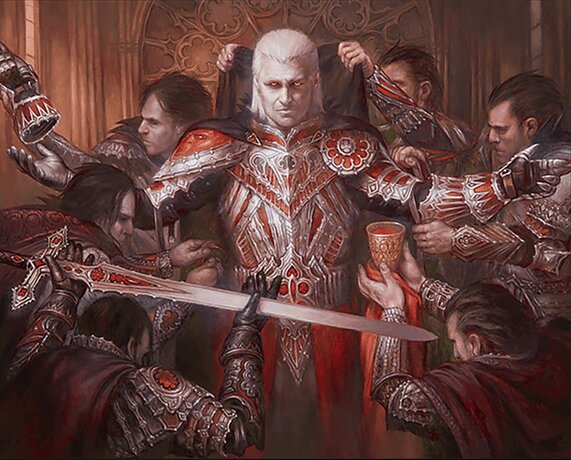
Edgar Markov



 Commander
Edgar Markov rewards casting Vampires by building a wide board from the command zone, then turning attacks into team-wide growth.
Public decks: 10Bracket: 3

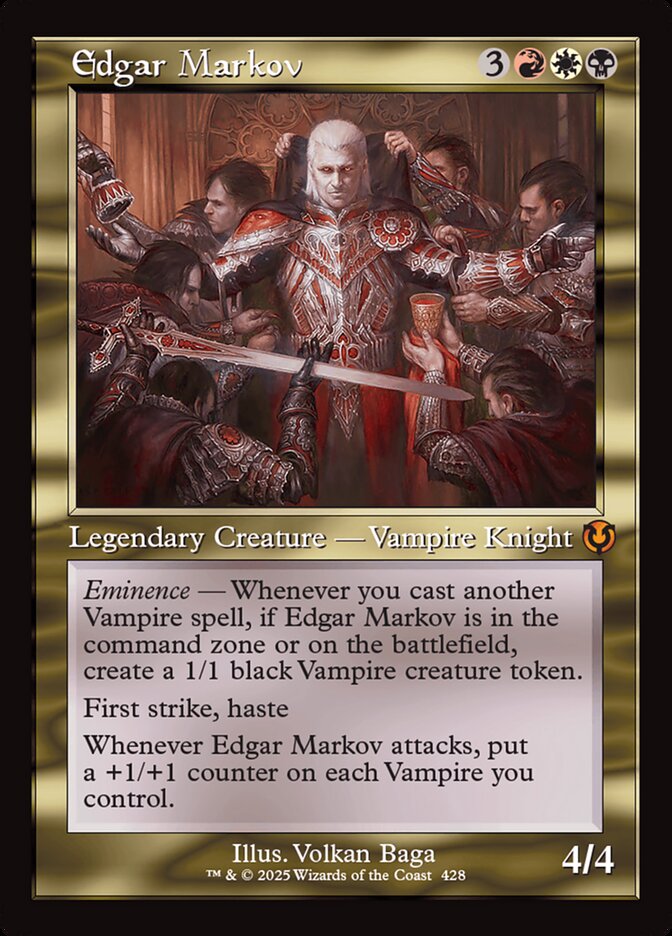
Card text
Legendary Creature — Vampire Knight
Eminence — Whenever you cast another Vampire spell, if Edgar is in the command zone or on the battlefield, create a 1/1 black Vampire creature token.
First strike, haste
Whenever Edgar attacks, put a +1/+1 counter on each Vampire you control.
Building around this commander?
Use MTG Master to build or analyze a Commander deck around this card, check consistency, and find weak spots before your next game.
Overview
- Play Vampires early to generate extra 1/1 Vampire tokens via Eminence without needing to cast Edgar.
- Transition from setup to pressure by attacking and snowballing +1/+1 counters across your whole Vampire team.
- Lean into go-wide combat, with optional sacrifice-and-drain subthemes (for example, Blood Artist or Cruel Celebrant).
- Use Mardu interaction to clear blockers and protect your momentum (for example, Anguished Unmaking or Feed the Swarm).
- Edgar itself is often a midgame finisher: haste enables immediate attacks and counter distribution.
Common lines
- Curve Vampires for a few turns to build a board that is larger than it looks (tokens add up quickly).
- Cast Edgar and immediately attack to put +1/+1 counters on every Vampire you control, turning a token swarm into real threats.
- Use removal to open profitable attacks, then keep redeploying Vampires to rebuild after wipes.
Strengths
- Consistent board development from the command zone thanks to Eminence.
- Explosive go-wide turns that punish slow starts and light defense.
- Strong synergy density: most Vampire casts advance both board and future attacks.
- Access to flexible Mardu interaction (spot removal and enchantment/artifact answers).
Weaknesses
- Vulnerable to sweepers that reset wide boards, especially repeated board wipes.
- Can struggle into heavy pillow-fort, fogs, or decks that invalidate combat.
- Token-heavy plans can be checked by effects that punish going wide or shrink small creatures.
- Mana can be pressured if the deck leans too hard on low curves without enough ramp/fixing.
Rule zero notes
- Eminence creates extra tokens from the command zone; confirm the table is comfortable with constant value engines.
- Clarify whether your build is primarily combat go-wide, or if it includes significant sacrifice-and-drain plans (for example, Blood Artist effects).
- Disclose any fast mana or burst starts (for example, Dark Ritual) if your group calibrates to speed.
- If you run non-combat finishers (for example, Aetherflux Reservoir or Bolas's Citadel), mention them up front.
Matchups
Best into
- Creature-light combo/control pods that give you time and space to attack.
- Midrange decks that rely on single blockers rather than sweeping the board.
- Tables that under-prepare for early go-wide pressure.
Struggles against
- Board-wipe-dense control shells that can reset you repeatedly.
- Pillow-fort or fog strategies that stall combat damage for many turns.
- Decks that out-scale combat quickly with large lifegain or bigger battlefield presence.
Recent public decks
New Deck
Sep 29, 2026
V
Volcro
Bracket 2
Crimson Blood
Jul 21, 2026
P
Play2227...
Bracket 4
Vamps
Jul 18, 2026
P
Play2227...
Bracket 3
Edgar
Jun 4, 2026
P
Play0149...
Bracket 3
demo
WIPMay 17, 2026
P
Play7438...
test
May 17, 2026
P
Play7438...
Bracket 3
Edgar Markov
May 4, 2026
P
Play6538...
Bracket 5Deck Power 7.9
New Deck
Apr 21, 2026
P
Play3890...
Bracket 3Deck Power 6.8
New Deck
Apr 2, 2026
P
Play9047...
Bracket 1Deck Power 7.1
Edgar Bracket 3
Jan 21, 2026

TheBest
Bracket 3
Staples
Browse all public decksFAQ
Do I need to cast Edgar Markov for the deck to work?
Not necessarily; Eminence lets you generate tokens just by casting other Vampires. Edgar often comes down when you can safely attack to convert a wide board into a lethal clock.
Is this deck more aggressive or more grindy?
It typically leans aggressive because attacking spreads +1/+1 counters to the whole team. It can also play a longer game if you include drain and recursion pieces.
How do I win most games?
Most wins come from building a wide Vampire board and turning one or two attack steps into overwhelming damage. Some lists may also close with life-drain engines or non-combat payoffs as backups.
What should I mulligan for?
Hands that can cast early Vampires and develop mana tend to be strong because every Vampire spell also makes a token. Avoid slow hands that do nothing until turn 4+.
What are the biggest risks to plan around?
Board wipes and combat-stalling effects are the main problems. Plan for rebuilds and keep interaction available to force through key attacks.