

Eirdu, Carrier of Dawn // Isilu, Carrier of Twilight Commander Deck Guide

 Commander1
Eirdu // Isilu is a creature-centric Orzhov commander that toggles between convoke-fueled development and persist-based attrition to keep threats coming through removal.

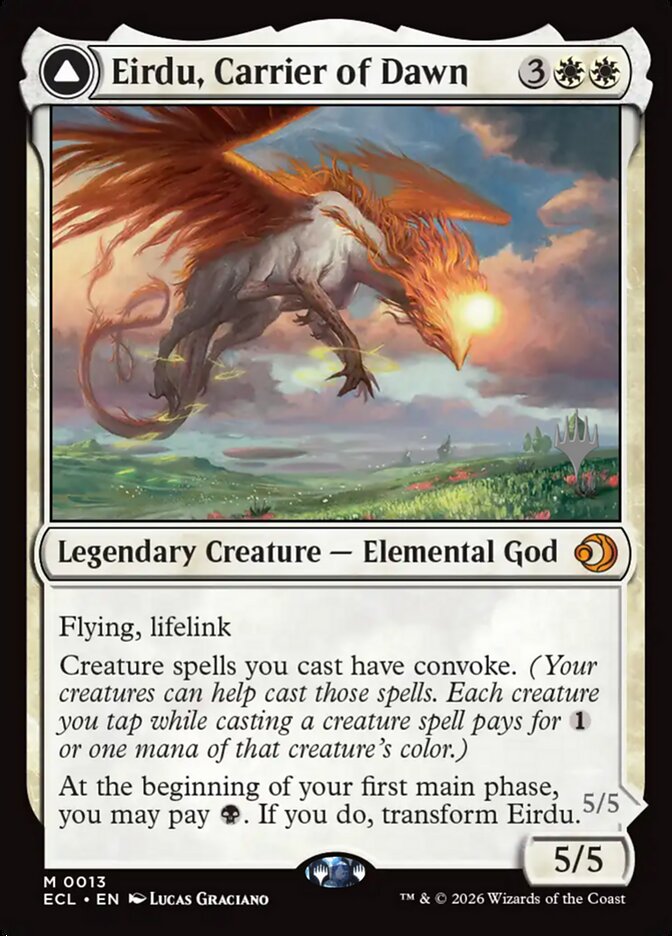
Card text
Flying, lifelink
Creature spells you cast have convoke. (Your creatures can help cast those spells. Each creature you tap while casting a creature spell pays for  or one mana of that creature's color.)
At the beginning of your first main phase, you may pay  . If you do, transform Eirdu.
//
Flying, lifelink
Each other nontoken creature you control has persist. (When it dies, if it had no -1/-1 counters on it, return it to the battlefield under its owner's control with a -1/-1 counter on it.)
At the beginning of your first main phase, you may pay . If you do, transform Isilu.
Building around this commander?
Use MTG Master to build or analyze a Commander deck around this card, check consistency, and find weak spots before your next game.
Overview
- Front side rewards going wide by giving your creature spells convoke, letting bodies function as acceleration.
- You can pay {B} at the start of your first main phase to flip into a grind mode where your other nontoken creatures come back once via persist.
- The back side naturally encourages value creatures and sacrifice-friendly play patterns, since deaths translate into more board presence.
- Flying lifelink makes the commander a real stabilizer, buying time while you assemble a board and grind.
- Games often revolve around choosing when to flip: cast-up turns on Eirdu, survival and rebuild turns on Isilu.
Common lines
- Develop a small creature base, land Eirdu, then use convoke to double-spell creature threats sooner than your mana would normally allow.
- When you expect a sweeper or heavy trading, flip to Isilu so your key nontoken creatures can persist back and keep pressure up.
- Use combat plus lifelink to race, forcing opponents to spend removal on your commander while your board keeps refilling.
- After stabilizing with Isilu and getting value from deaths, flip back to Eirdu to convert that rebuilt board into convoke mana for another push.
Strengths
- Strong midgame momentum: convoke can turn extra bodies into real mana.
- Attrition resilience: persist makes spot removal and combat trades less effective against your nontoken creatures.
- Flexible gameplan: transformation lets you pivot between proactive development and defensive grinding.
- Commander contributes to racing and stabilization thanks to flying lifelink.
Weaknesses
- Exile-based interaction cleanly answers persist creatures and can strand you without the grind engine.
- Token-heavy builds get less from Isilu, since only other nontoken creatures gain persist.
- Graveyard hate and effects that prevent recursion can blunt the back side’s main payoff.
- Creature-light hands can feel clunky: convoke and persist both want a steady stream of nontoken bodies.
Rule zero notes
- Call out that the commander can create very sticky boards thanks to mass persist on nontoken creatures.
- If your list leans into sacrifice loops or repeated death triggers, mention that games may involve lots of recursion and repeated actions.
- Be clear about how quickly you plan to flip each turn; the commander can change roles turn-by-turn depending on mana.
- If you run extra protection for the commander (example: Swiftfoot Boots), mention that your plan may hinge on keeping it in play.
Matchups
Best into
- Removal-heavy, combat-oriented pods where trading creatures is common
- Midrange tables that try to win by incremental board advantage
- Decks relying on damage-based racing (lifelink can swing those games)
Struggles against
- Exile-centric control shells and bounce-heavy interaction
- Graveyard-hate-heavy pods that incidentally shut off recursion
- Hard pillowfort or repeated fog effects that invalidate combat closes