

Elas il-Kor, Sadistic Pilgrim

 CommanderPauper Commander
A low-cost Orzhov engine that turns your creature traffic into steady lifegain and table-wide life drain.
Public decks: 1Bracket: 4

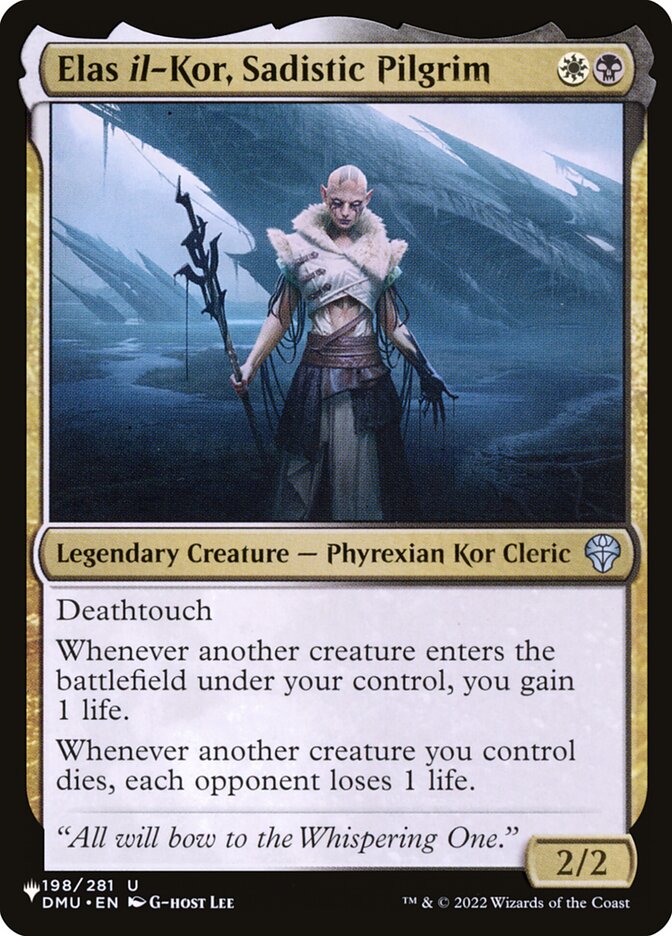
Card text
Legendary Creature — Phyrexian Kor Cleric
Deathtouch
Whenever another creature you control enters, you gain 1 life.
Whenever another creature you control dies, each opponent loses 1 life.
Building around this commander?
Use MTG Master to build or analyze a Commander deck around this card, check consistency, and find weak spots before your next game.
Overview
- Play lots of cheap creatures and token makers so every enter-the-battlefield trigger pads your life total.
- Lean into sacrifice and death triggers to convert board churn into incremental damage on all opponents.
- Use your life total as a resource to draw cards or fuel big swings, then close with a finisher drain effect.
- Elas’s deathtouch makes early attacks awkward and can discourage chip damage while you set up.
Common lines
- Deploy Elas early, then follow with multiple small creatures to start stacking life gain triggers.
- Set up repeatable sacrifice outlets or attrition pieces, turning trades and wipes into opponent life loss.
- After stabilizing, pivot from incremental drain to a single large life-swing spell to end the game.
- Use removal to protect your engine and keep problematic permanents from shutting off your creature loop.
Strengths
- Strong inevitability in longer games: creatures entering and dying keeps advancing your plan.
- Naturally good at racing through life gain while still pressuring the table via drain.
- Plays well through board wipes when your deaths are also damage.
- Commander is cheap to cast, so rebuilding after interaction is often manageable.
Weaknesses
- Relies on keeping creature volume high; low-creature draws can feel anemic.
- Graveyard hate and exile-based removal can blunt death-trigger value.
- Incremental drain can be slow into high-lifegain tables or heavy life-buffer strategies.
- Can struggle against decks that ignore combat and win quickly on a non-creature axis.
Rule zero notes
- Call out whether the deck is built as grindy aristocrats-style attrition or a more casual lifegain creature deck (very low public data).
- Mention if you’re running big one-shot life-drain finishers as primary win conditions (for example, Exsanguinate).
- Disclose any plans to use life as a resource for explosive turns (for example, Bolas's Citadel) versus slow value.
- If you include pillow-fort or combat-limiting pieces (for example, Crawlspace), let the table know up front.
Matchups
Best into
- Creature-heavy midrange pods where trades and wipes happen often
- Combat-focused decks that give you time to assemble engines
- Tables light on graveyard hate and exile sweepers
Struggles against
- Fast combo pods that end games before your incremental plan matters
- Heavy control tables packed with exile wipes and repeated commander removal
- Decks that repeatedly shut off ETB/death synergies or heavily tax creatures
FAQ
What is Elas il-Kor trying to do each game?
Get Elas down early, then turn a steady stream of creature ETBs and deaths into life gain for you and life loss for the whole table.
How does this deck usually win?
Often by stacking many small drain triggers over time, then finishing with a large life-swing or drain spell once opponents are within range.
Do I need tokens and sacrifice outlets?
They tend to amplify Elas the most, but you can also play a simpler creature-heavy plan where normal combat and trading still advances your drains.
Is Elas a combat commander?
Not usually; deathtouch helps defensively, but the primary pressure typically comes from engine triggers rather than commander damage.
What kind of interaction matters most against Elas?
Effects that exile creatures, limit recursion, or repeatedly remove Elas can reduce your ability to convert creature churn into damage.