
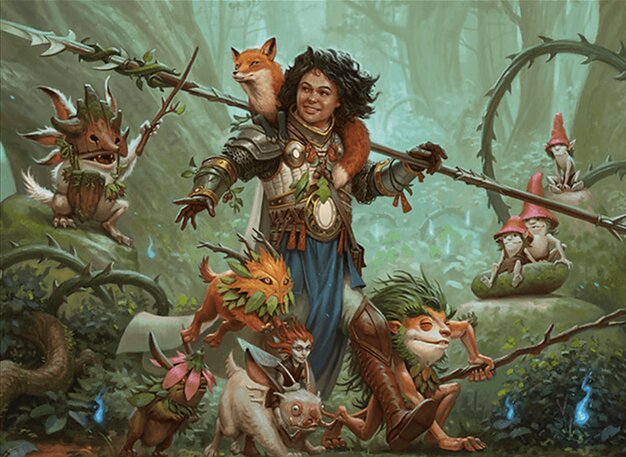
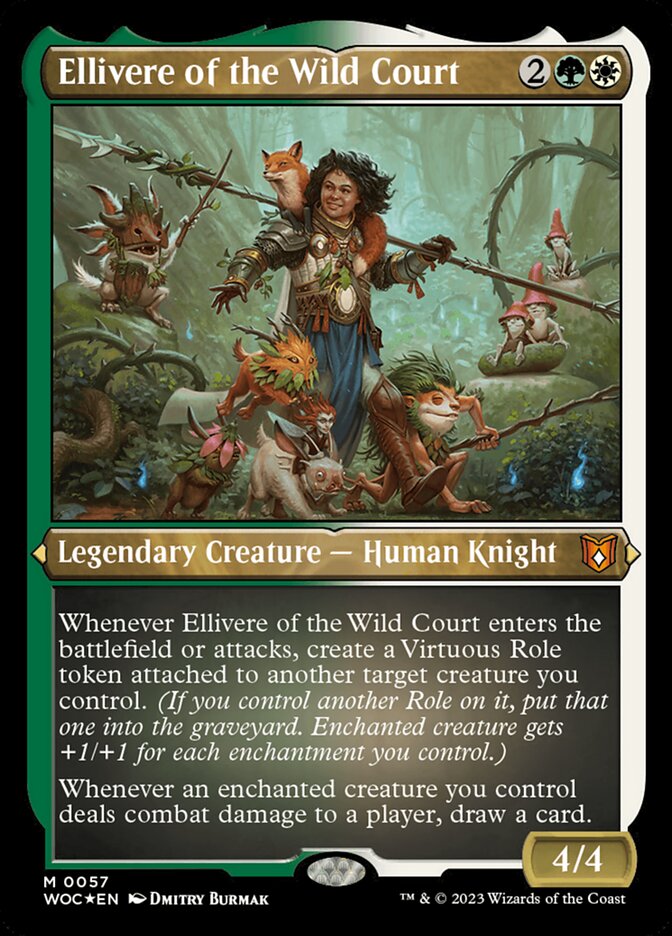
Ellivere of the Wild Court


 Commander
A Selesnya combat commander that grows your board with Role auras and turns enchanted attackers into repeatable card draw.
Public decks: 1Bracket: 1
Card text
Legendary Creature — Human Knight
Whenever Ellivere enters or attacks, create a Virtuous Role token attached to another target creature you control. (If you control another Role on it, put that one into the graveyard. Enchanted creature gets +1/+1 for each enchantment you control.)
Whenever an enchanted creature you control deals combat damage to a player, draw a card.
Overview
- Wants to attack early and often: Ellivere makes a Virtuous Role on ETB and each attack to scale a creature’s power with your enchantment count.
- Leans on building a wide-ish creature board so you always have a good Role target and multiple potential draw triggers.
- Turns combat damage from enchanted creatures into card advantage, letting you keep deploying threats and buffs.
- Typically plays like a snowballing board deck: establish creatures, suit up selectively, then pressure life totals while refilling your hand.
- Often closes by stacking large, enchantment-scaling power on one or two evasive/trampling bodies or by overwhelming with repeated attacks.
Common lines
- Develop creatures early, then land Ellivere and immediately attach a Virtuous Role to your best attacker.
- Attack with Ellivere to create another Virtuous Role, spreading power across multiple bodies to diversify threats and draw sources.
- Use the extra cards from combat damage to keep your board full after trades or removal.
- Pivot from “go wide” to “go tall” if the table starts answering your board by concentrating Roles on a resilient threat.
Strengths
- Reliable engine from the command zone: generates an aura on ETB/attack and rewards combat damage with cards.
- Scales naturally with enchantment density; Roles can represent meaningful power without spending extra cards.
- Strong at pressuring planeswalkers and life totals while still keeping a full hand.
- Can distribute buffs across multiple creatures, making it harder for single-target removal to completely shut you down.
Weaknesses
- Needs combat to function at full capacity; fogs, pillow-fort effects, and stalled boards reduce draw and momentum.
- Board wipes can be punishing, especially if your plan is creature-heavy and your draw is tied to connecting in combat.
- Removal on key enchanted attackers can interrupt both damage and card draw, forcing rebuilds.
- Less interactive by default if most slots are devoted to creatures and enchantment synergies rather than stack interaction.
Rule zero notes
- Clarify whether your build is primarily combat/value or includes any dedicated combo finishes.
- Mention how many sweepers and how much interaction you run, since the commander naturally encourages proactive board development.
- Set expectations around table pace: this commander typically wants to turn creatures sideways and keep the game moving through combat.
- Call out any prison/pillow-fort pieces if you use them, since they can change how interactive combat is for the table.
Matchups
Best into
- Creature-heavy midrange pods where combat matters and you can profitably attack and trade.
- Slower tables that give you time to build an enchantment count and snowball value through combat damage.
- Decks light on sweepers that struggle to reset a growing battlefield.
Struggles against
- Heavy board-wipe metagames that repeatedly clear creatures and reset your main engine.
- Pillow-fort or fog-heavy strategies that prevent combat damage and shut off your card draw.
- Fast combo tables where your combat clock may be too slow without specific disruption.
FAQ
Do I have to build heavily around enchantments?
Not strictly, but Ellivere’s Virtuous Role scales with enchantment count, so you typically want enough enchantments for the Role to be a real threat.
How does the Virtuous Role work with other Roles?
If a creature already has another Role you control, the old one goes to the graveyard when a new Role would be attached.
What’s the main way this deck wins?
Most games are won through combat by growing attackers via Roles and leveraging the draw engine to keep applying pressure.
What’s the biggest thing to play around?
Mass removal and combat denial effects are the most disruptive because they stop both your board presence and your damage-based card draw.