

Elmar, Ulvenwald Informant Commander Deck Guide


 Commander1
Elmar is a haste-enabled Gruul value engine that rewards sequencing a second spell each turn with Clues and creature untaps.
Public decks: 1Bracket: Varies

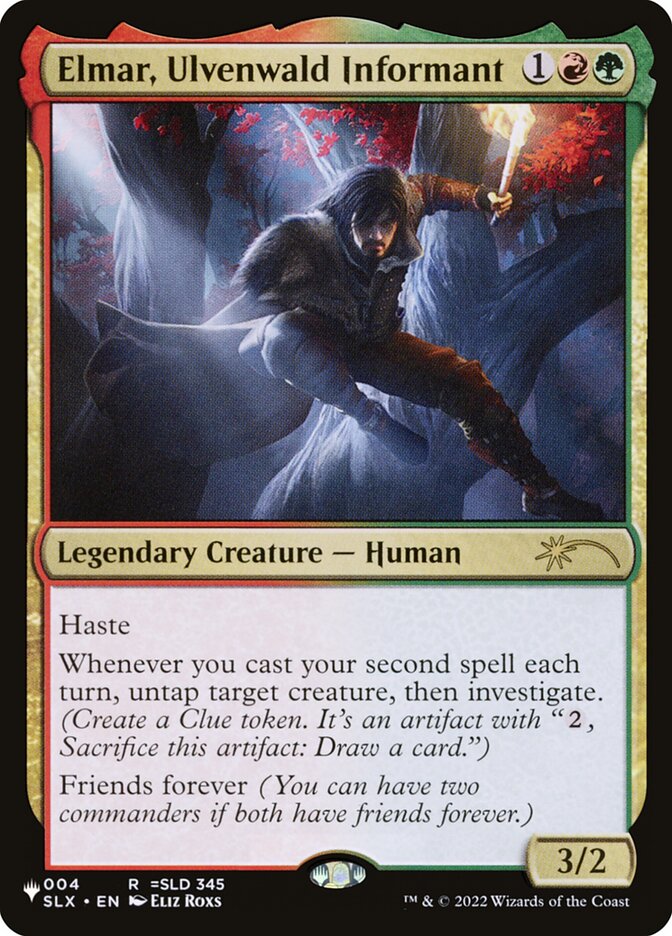
Card text
Legendary Creature — Human
Haste
Whenever you cast your second spell each turn, untap target creature, then investigate. (Create a colorless Clue artifact token with " , Sacrifice this artifact: Draw a card.")
Partner—Friends forever (You can have two commanders if both have this ability.)
Building around this commander?
Use MTG Master to build or analyze a Commander deck around this card, check consistency, and find weak spots before your next game.
Overview
- Cast Elmar early, then plan turns around reliably casting a second spell.
- Each second spell creates a Clue, giving the deck a steady source of delayed card draw.
- The untap trigger can reuse a creature that has already attacked or tapped for an ability.
- Haste lets Elmar contribute immediately, but the commander is primarily an engine rather than a standalone threat.
- Friends forever allows a second commander, so the final color identity and game plan depend heavily on the chosen partner.
Common lines
- Develop mana and low-cost plays so a second spell is available on key turns.
- Use the second-spell trigger to untap a useful creature, then bank the Clue until cards are needed.
- Sequence spells across opponents' turns when possible to create additional trigger opportunities.
- Turn accumulated Clues into cards and convert the extra resources into a board-based finish or a larger late-game turn.
Strengths
- Produces incremental card advantage without needing to attack or deal combat damage.
- Can generate value on each player's turn when the deck supports instant-speed play.
- Untapping a creature adds flexibility to combat, activated abilities, and mana development.
- Haste reduces the delay between casting Elmar and getting value.
- Partner access gives considerable room to tailor the deck's colors and role.
Weaknesses
- Needs two spells in a turn to trigger, which can strain mana and hand resources.
- Clues require additional mana before they become cards.
- The untap effect depends on having a worthwhile creature target.
- Elmar is a small creature that can be removed before the engine gets going.
- With only one public deck in this snapshot, there is not enough evidence for an established build pattern.
Rule zero notes
- Disclose your chosen Friends forever partner, since it determines the deck's color identity and ceiling.
- This commander has only one public deck represented in the snapshot, so the list should be treated as a personal or experimental build rather than a known template.
- Discuss whether the deck uses compact combos, as the commander itself does not establish a specific win condition.
- Discuss the intended power level and speed of the deck, especially if it is built to trigger on multiple players' turns.
Matchups
Best into
- Slower midrange tables that give time to accumulate Clues and resources.
- Creature-focused pods where untapping a creature can create repeated tactical value.
- Interactive games where casting spells on opponents' turns is practical.
Struggles against
- Fast combo tables that can end the game before incremental Clue value matters.
- Heavy removal environments that repeatedly answer Elmar or key creatures.
- Mana-denial strategies that make casting a second spell and cracking Clues difficult.

FAQ
What does Elmar want to do?
Elmar wants you to cast a second spell each turn. That turns ordinary sequencing into Clues and a creature untap.
Can Elmar trigger on opponents' turns?
Yes. The trigger checks each turn, so casting your second spell during an opponent's turn can create another Clue and untap a creature.
Is Elmar an artifact commander?
Elmar creates artifact Clue tokens, but the commander text does not require an artifact-focused deck. Clues chiefly provide card draw and can support whatever plan the partner adds.
How does Friends forever affect deckbuilding?
Elmar can have a second commander with Friends forever. That choice can expand the deck's color identity and provide a separate payoff or role.
How does this deck usually win?
The snapshot does not establish a typical win condition. Elmar supplies resources and tempo, while the chosen partner and the rest of the deck determine how those advantages close the game.