

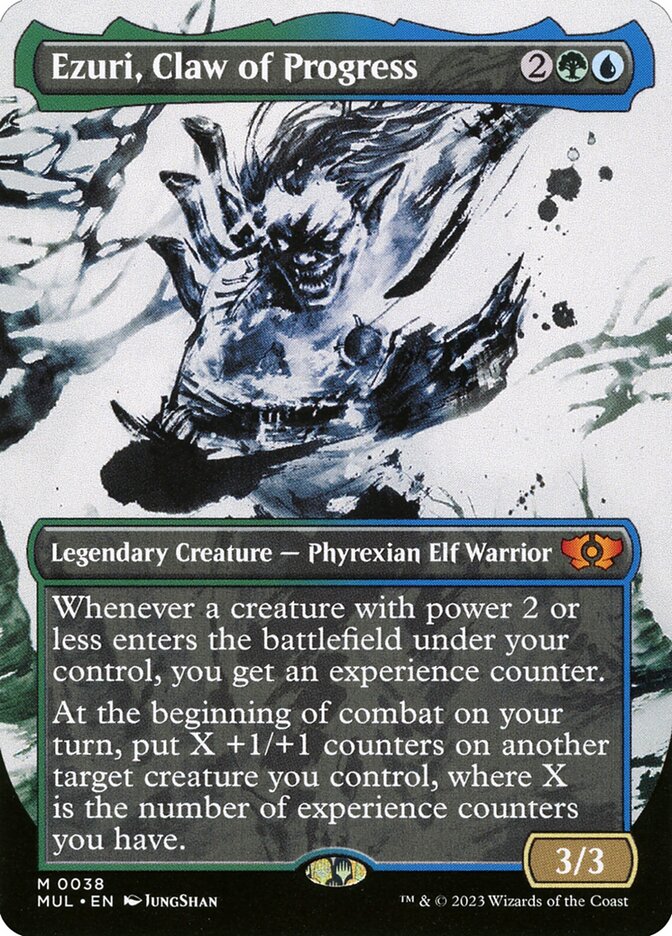
Ezuri, Claw of Progress


 Commander
A Simic snowball commander that turns a stream of small creatures into a single oversized combat threat every turn.
Public decks: 2Bracket: Varies
Card text
Legendary Creature — Phyrexian Elf Warrior
Whenever a creature you control with power 2 or less enters, you get an experience counter.
At the beginning of combat on your turn, put X +1/+1 counters on another target creature you control, where X is the number of experience counters you have.
Overview
- Build experience counters by repeatedly playing or making creatures with power 2 or less.
- Convert experience into a huge pile of +1/+1 counters at the beginning of combat, letting you shift pressure turn to turn.
- Typically plays like tempo-midrange: develop board early, then start presenting must-answer attackers.
- Often prefers evasive or resilient creatures as counter targets so the combat trigger translates into real damage.
- Wins mainly through combat, but can also pivot into value-centric board states where every small creature scales your next threat.
Common lines
- Early turns: deploy multiple small bodies to start stacking experience counters quickly.
- Midgame: protect the commander and choose a safe counter target; move counters to whatever attacker is best positioned that turn.
- If the main threat gets removed, rebuild by continuing to play small creatures and reloading a new counter target on the next combat.
Strengths
- Scales naturally as the game goes long; experience counters persist through most interaction.
- Turns low-cost creatures into meaningful topdecks by converting them into future power.
- Can concentrate power on a single creature, enabling fast clocks without needing a wide board.
- Flexible combat: you can change which creature receives counters each turn based on blockers and removal.
Weaknesses
- Commander-dependent for the main payoff; repeated removal can stall your progress.
- Can be vulnerable to sweepers that clear your small-creature engine and your built-up threat.
- Combat-focused plan can struggle through fog effects, pillow-fort style defenses, or repeated chump blocking if you lack evasion.
- If your counter target gets answered after investment, you may lose tempo even if experience remains.
Rule zero notes
- This commander tends to snowball quickly once it starts chaining small creatures into experience counters.
- Most builds are primarily combat-based, but the table should expect a fast-growing single threat and pressure starting midgame.
- Games can hinge on commander uptime; discuss expectations around repeated commander removal and recasting.
- If your list includes extra combat steps, infect-style kills, or hard lock pieces, disclose that clearly (not implied by the commander alone).
Matchups
Best into
- Creature-based midrange pods where combat dominance matters.
- Slower tables that give you time to accumulate experience and set up protected attacks.
- Decks light on instant-speed interaction for your combat-step payoff
Struggles against
- Heavy control pods with lots of commander removal and counterspells.
- Frequent board-wipe environments that reset both your engine creatures and your payoff body.
- Dedicated combo tables that race past combat-centric pressure
FAQ
How does Ezuri, Claw of Progress usually win?
Most games end via combat by piling +1/+1 counters onto an attacker over multiple turns until it represents lethal damage in one or two swings.
Do I need to go wide to make Ezuri work?
You often want multiple small creatures early to build experience, but the payoff usually goes tall by concentrating counters on one creature each combat.
What kind of creatures fit the plan best?
Creatures with power 2 or less help build experience, and creatures that are evasive, resilient, or otherwise hard to block tend to be strong counter targets.
How do I play around board wipes?
Try not to overextend your engine creatures into known sweepers, and lean on the fact that experience counters stick around to rebuild a threat after the wipe.
Is this deck more casual or competitive?
It can range widely, but the commander reads as a combat snowball engine; its ceiling depends on how fast you can generate experience and how much protection and interaction you run.