

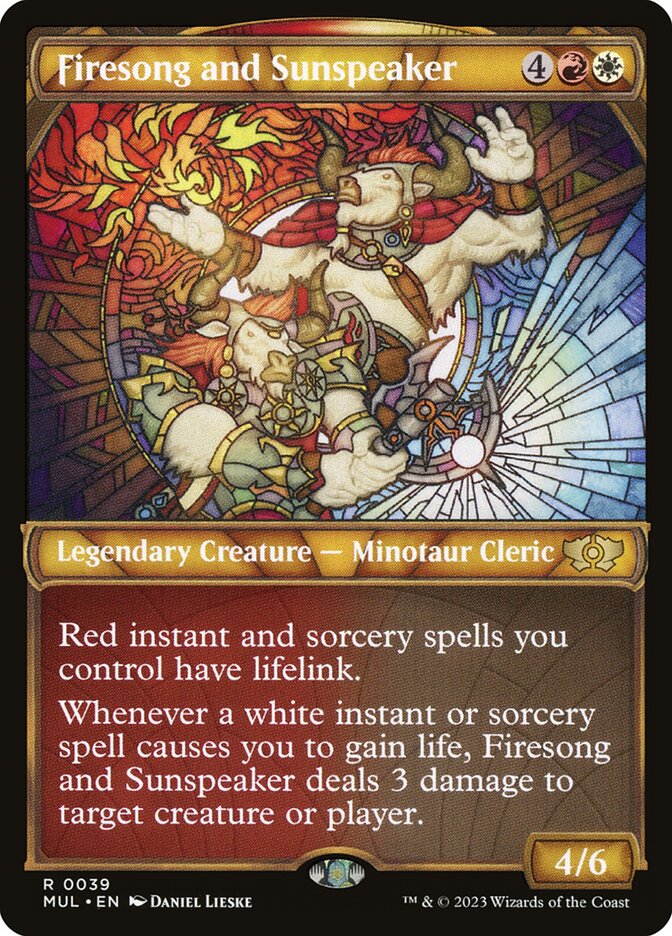
Firesong and Sunspeaker



A Boros spellslinger commander that turns burn into lifegain and turns lifegain back into targeted damage.
Public decks: 1Bracket: Varies
Overview
- Leans on red instants and sorceries as both removal and life-padding, since they gain lifelink with your commander out.
- Looks to convert life gained from white instants/sorceries into repeatable 3-damage shots to pick off creatures or pressure life totals.
- Often plays a control-leaning game: survive early, trade resources, then take over with big damage-based sweepers and payoffs.
- Can pivot from stabilizing to closing quickly once your life total is high and you have a burst-damage turn lined up.
- Example finishers and payoffs from the snapshot include Aetherflux Reservoir, big X-spells like Earthquake, and damage multipliers like Gisela, Blade of Goldnight.
Common lines
- Ramp early (for example with Arcane Signet or Boros Signet), then land Firesong and Sunspeaker and start casting removal that incidentally gains life.
- Use damage-based sweepers (for example Blasphemous Act or Chain Reaction) to reset creature boards while gaining a large chunk of life if your commander is online.
- Convert life gain from a white spell into the commander trigger to pick off utility creatures or finish a player at low life.
- Set up a big swing turn by copying or doubling key spells (for example with Double Vision) or by forcing through a key combat step (for example with Aurelia's Fury).
Strengths
- Excellent stabilization potential: your removal can double as life gain once the commander sticks.
- Naturally punishes wide creature boards with damage sweepers that can swing your life total back up.
- Flexible interaction suite in red/white, with options for artifacts and combat tricks (for example Abrade, Boros Charm, and Deflecting Palm).
- Has multiple angles to close games: chip damage from triggers, large burst-damage spells, or a life-total payoff (for example Aetherflux Reservoir).
Weaknesses
- Commander is expensive at six mana; falling behind before it resolves can be a real risk.
- Heavily reliant on the commander for lifelink and for converting lifegain into damage; repeated removal can slow the whole plan.
- Can struggle to end the game without a payoff drawn, especially if opponents keep their boards small or spread out threats.
- Damage-based interaction can be awkward into decks that go over the top with big toughness, protection, or noncreature win lines.
- Boros card flow can be swingy; you may need to spend turns rebuilding after trading and sweeping.
Rule zero notes
- This deck can gain large amounts of life off damage-based spells once Firesong and Sunspeaker is in play.
- It may include life-total win pressure via Aetherflux Reservoir as an example finisher from the snapshot.
- Expect multiple board wipes that deal damage (for example Blasphemous Act, Chain Reaction, and Earthquake).
- There may be some “gotcha” interaction that redirects or blanks big hits (for example Deflecting Palm or Deflecting Swat).
Matchups
Best into
- Creature-heavy midrange pods that commit bodies to the board
- Token and go-wide strategies that fold to damage sweepers
- Combat-centric tables where lifegain buys extra turns
Struggles against
- Fast combo tables that ignore combat and don’t care about sweepers
- Blue-heavy control pods that can repeatedly answer a six-mana commander
- Decks that win through engines you can’t efficiently interact with via damage
FAQ
How does Firesong and Sunspeaker actually win games?
It typically wins by turning repeated spell-casting into inevitability: your red spells gain life, your white spells convert life gain into damage, and a payoff like Aetherflux Reservoir can end the game once you’re far ahead.
Do I need to cast lots of white spells to get value?
You need some number of white instants/sorceries that cause you to gain life to consistently trigger the 3-damage ability, but the commander still provides value by giving lifelink to your red spells.
Is this deck more control or more burn?
It often plays like a control deck early with removal and sweepers, then pivots into a burn-style close once you can chain spells or leverage a life-total finisher.
What should I protect the most?
Your commander is the key engine, so protecting it and timing when you commit it to the board matters a lot; pieces that help you translate life gain into a win (for example Aetherflux Reservoir) are also high priority.
What kind of table is this best for?
It tends to fit best in mid-power pods where creatures and combat matter, because damage-based interaction and lifegain swings can meaningfully shape the game.