

Gaddock Teeg

 Commander
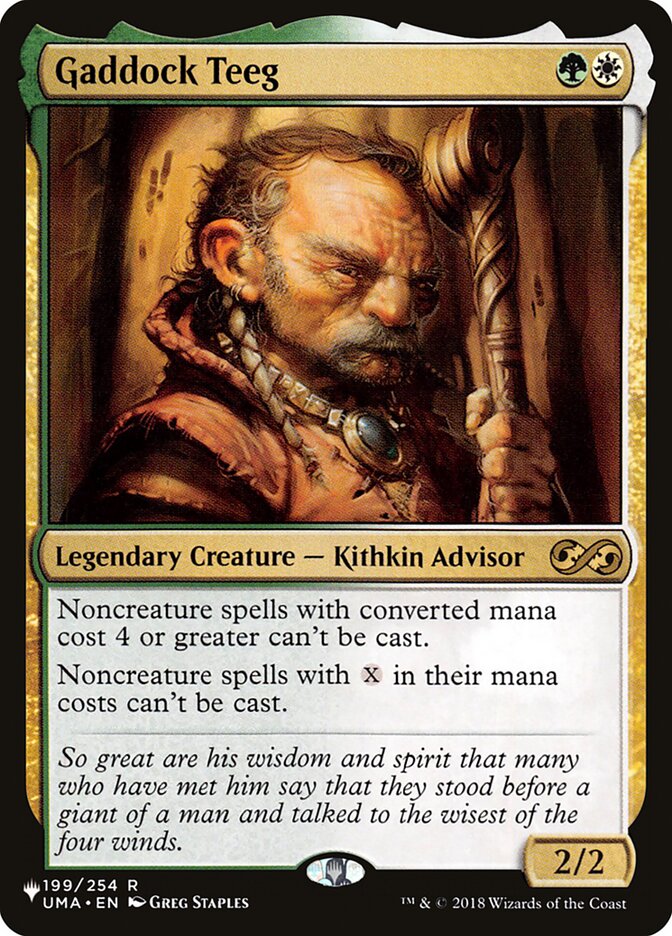
Gaddock Teeg is a low-cost hatebear commander that pressures high-mana and X-spell game plans by keeping many big noncreature spells off the stack.
Public decks: 1Bracket: 4
Card text
Legendary Creature — Kithkin Advisor
Noncreature spells with mana value 4 or greater can't be cast.
Noncreature spells with  in their mana costs can't be cast.
Overview
- Deploy Teeg early to immediately tax whole categories of noncreature spells: mana value 4+ and any spell with X in its cost.
- Play a creature-forward, board-centric game while opponents are forced to rely on smaller spells and permanents.
- Use the table slowdown to build a stable battlefield and convert incremental advantage into a win through combat or a compact finisher package.
- Expect games to revolve around protecting Teeg, replaying him through removal, and choosing when to extend into sweepers you may not be able to cast yourself.
Common lines
- Turn-two Teeg to shut off many big sorceries/planeswalkers and most X-based interaction, then start developing creatures and mana.
- Hold up protection and timing: Teeg tends to eat removal, so your sequencing often assumes you’ll recast him at least once.
- Once the table is constrained, commit to the board in waves and force opponents to answer with smaller, narrower tools.
Strengths
- Strong at constraining spell-based decks that lean on expensive noncreature payoffs.
- Naturally punishes many X-spell engines and scalable removal/countermagic lines.
- Comes down early and starts impacting the whole table without extra setup.
- Encourages a proactive battlefield plan that can pressure life totals while opponents stumble.
Weaknesses
- Draws early attention; Teeg is a high-priority removal target and can be costly to keep in play.
- Can be awkward for your own deckbuilding, since you must limit (or avoid) noncreature spells at mana value 4+ and X spells.
- Less effective against creature-centric strategies that don’t rely on big noncreature spells to function.
- Vulnerable to opponents answering via creatures and low-cost interaction that slips under Teeg.
Rule zero notes
- Teeg is a table-wide restriction piece; clarify up front that the commander prevents many noncreature spells from being cast.
- Mention how heavily your list leans into additional hatebears/taxes versus a lighter, more midrange build (if applicable).
- Be clear about your intended win condition (combat-focused vs. any fast/compact finishes), since Teeg can create lock-like play patterns.
- Discuss how much protection and recursion you run for Teeg, as that often determines how oppressive the game feels.
Matchups
Best into
- Spell-heavy control and midrange shells that lean on expensive noncreature haymakers.
- Decks that plan to stabilize or win using X spells as a core resource sink.
- Pods where slowing the game down lets combat-centric plans matter more.
Struggles against
- Creature-heavy aggro and creature-combo strategies that can operate mostly through creature spells.
- Low-to-the-ground interactive pods where removal and pressure are concentrated at cheap mana values.
- Tables that can repeatedly remove a key creature and keep you off a stable board.
FAQ
What exactly does Gaddock Teeg stop?
He stops noncreature spells with mana value 4 or greater, and he stops any noncreature spell with X in its mana cost.
Does Teeg stop creature spells that cost 4 or more?
No—his restriction only applies to noncreature spells, so large creatures can still be cast normally.
How do Teeg decks usually win if big noncreature spells are off-limits?
They typically lean into creatures and board presence, aiming to turn the slowed-down game into a combat win or a creature-based finisher.
Why does Teeg draw so much removal?
Because he impacts multiple opponents at once and can blank entire categories of answers and win conditions, removing him often becomes a priority.
Is this commander appropriate for casual tables?
It can be, but it’s a good idea to check expectations since a commander that prevents many spells from being cast can feel restrictive depending on the pod.