

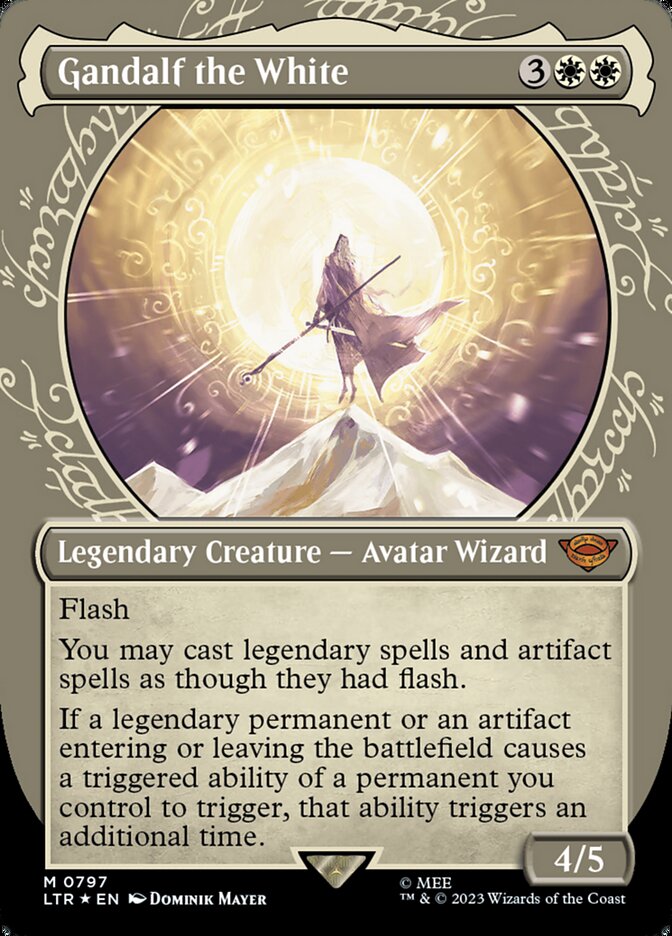
Gandalf the White

 Commander
A mono-white flash/value commander that rewards playing at instant speed with legendary and artifact synergies plus doubled triggers on key battlefield events.
Public decks: 3Bracket: 3
Card text
Legendary Creature — Avatar Wizard
Flash
You may cast legendary spells and artifact spells as though they had flash.
If a legendary permanent or an artifact entering or leaving the battlefield causes a triggered ability of a permanent you control to trigger, that ability triggers an additional time.
Building around this commander?
Use MTG Master to build or analyze a Commander deck around this card, check consistency, and find weak spots before your next game.
Overview
- Plays a reactive game: hold up mana, then deploy legendary permanents and artifacts on opponents’ turns thanks to built-in flash permissions.
- Leans on triggered-ability value when your legends or artifacts enter or leave the battlefield, with Gandalf doubling those triggers.
- Often gravitates toward artifact bodies and ETB/LTB-centric permanents, sometimes paired with blink effects to repeat triggers.
- Can pivot between table-policing (removal/wipes) and building an engine that snowballs card advantage and board presence.
- Wins tend to come from overwhelming incremental advantage, artifact-centric payoffs, or assembling a compact synergy loop if your list supports it.
Common lines
- Pass with mana up, then flash in an artifact/legend at the last safe moment to dodge sorcery-speed interaction and maximize information.
- Set up a value permanent with strong triggers, then use blink or sacrifice outlets to make it enter/leave repeatedly for doubled triggers.
- Use a reset button to stabilize, then rebuild quickly with flash deployment and recursion-style effects.
- Tutor for a specific artifact/legend when needed, then keep developing while still representing interaction.
Strengths
- Excellent at playing on other players’ turns, which improves threat assessment and makes your board development harder to punish.
- Doubled triggers can turn modest ETB/LTB effects into real engines, especially around artifacts and legendary permanents.
- Mono-white access to efficient answers and sweepers helps you survive to the mid/late game.
- Can shift roles smoothly: control early, engine midgame, then close once value is entrenched.
Weaknesses
- Commander-centric: without Gandalf, the flash plan and trigger-doubling pressure drop noticeably.
- Mana-hungry play patterns (holding up interaction and flashing threats) can fall behind faster tables if your ramp isn’t online.
- Graveyard hate and artifact hate can clip common value lines if you rely on recursion or artifact engines.
- If your win condition is mostly incremental, you can struggle to end games quickly against dedicated combo pods.
Rule zero notes
- Call out whether the deck is primarily a fair flash/value build or if it includes any deterministic loops with artifact/legend enter/leave triggers.
- Mention if you’re running a high density of tutors (for example, Enlightened Tutor) and what they typically find.
- Flag how interactive the list is (board wipes like Austere Command/Final Showdown, protection like Flare of Fortitude) so the table can calibrate expectations.
- If you lean into blink chains (for example, Ephemerate/Eerie Interlude-style play), note that turns can involve many triggers, especially with Gandalf and effects like Elesh Norn, Mother of Machines.
Matchups
Best into
- Creature-heavy midrange pods where instant-speed deployment and sweepers swing tempo
- Slower, battlecruiser tables where repeated trigger value can take over
- Interactive pods where playing at flash speed lets you pick safer windows to commit
Struggles against
- Fast combo tables that pressure the game before your engines matter
- Heavy artifact-hate pods that can keep your key permanents off the board
- Dedicated stax/prison shells that constrain mana and make holding up interaction awkward
Recent public decks
Staples
Browse all public decksFAQ
What does Gandalf the White actually reward you for doing?
Casting legendary spells and artifacts at flash speed and extracting extra value when your legendary/artifact permanents entering or leaving the battlefield would trigger something you control.
Do I need to be an artifact deck to build this commander?
Not strictly, but artifacts naturally line up with the flash permission and the enter/leave trigger doubling, so many builds tend to include a meaningful artifact package.
What kinds of effects pair well with the trigger-doubling clause?
Permanents with strong triggered abilities that care about your legendary or artifact permanents entering/leaving, plus blink and sacrifice tools to repeat those events.
How does this deck usually win?
Often by snowballing repeated value into an overwhelming board and closing with efficient threats, though some lists can also set up a compact synergy loop depending on card choices.
Is this a control commander or a value commander?
It commonly plays like both: you can hold up interaction and flash in threats, then transition into a value engine once the table is stabilized.