
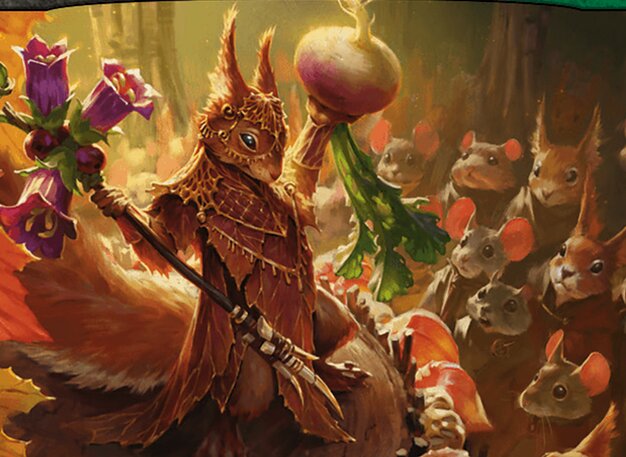
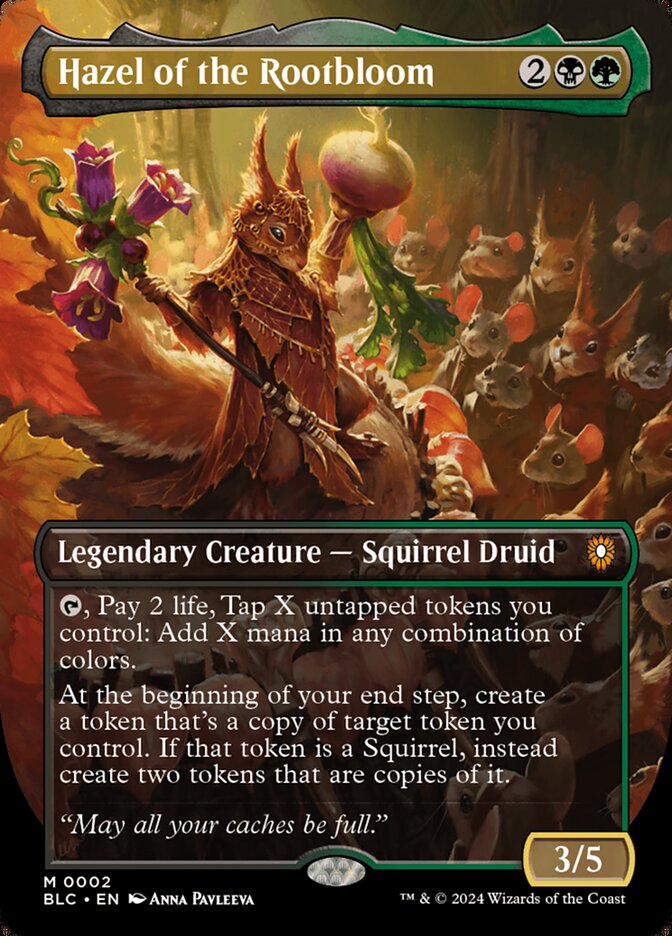
Hazel of the Rootbloom


 Commander
A Golgari token engine that turns spare tokens into burst mana and then snowballs by copying your best token every end step.
Public decks: 0Bracket: Varies
Card text
Legendary Creature — Squirrel Druid
 , Pay 2 life, Tap X untapped tokens you control: Add X mana in any combination of colors.
At the beginning of your end step, create a token that's a copy of target token you control. If that token is a Squirrel, instead create two tokens that are copies of it.
Overview
- Build a wide token board so Hazel can convert quantity into flexible mana.
- Use the mana ability as a midgame accelerator: tap tokens, pay life, and jump ahead on spells in the same turn.
- End step copying pushes incremental advantage, letting your best token scale over time without more cards.
- Squirrel tokens are a special payoff, since copying them can double the output at end step.
- Often plays like a value engine that can pivot into big turns once you have enough tokens to “ritual” with Hazel.
Common lines
- Develop tokens early, then keep Hazel untapped until you can cash them in for a big main-phase play.
- Float mana with Hazel by tapping a batch of tokens, then use that mana to deploy more token makers or payoff spells.
- End step: copy the highest-impact token you have (or a Squirrel token when available) to keep growing without spending mana.
- When opponents represent removal, you can sometimes activate Hazel first to get value before she leaves.
Strengths
- Explosive mana generation once you have a token density on board.
- Scales well in longer games thanks to repeatable end-step token copying.
- Flexible mana colors can help support multi-pip or splashy spells despite being in two colors.
- Can convert otherwise low-impact tokens into meaningful resources.
Weaknesses
- Heavily dependent on having untapped tokens; board wipes and token hate can set you back significantly.
- The mana ability costs life, which can matter against aggressive pods or chip-damage tables.
- Needs Hazel to tap, so summoning sickness and removal can delay the first big turn.
- If your best token is answered, the end-step copying plan can become low impact.
Rule zero notes
- This commander can generate large bursts of mana from tokens; mention if your list is built to chain very big turns.
- Clarify how often you expect to win via combat with a wide board versus noncombat finishes powered by the mana engine.
- Let the table know if you lean into token-doubling style scaling (including Squirrel-focused play) to set expectations on board growth.
- Because the plan is board-centric, note whether you run many reset effects yourself or mostly try to keep the board intact.
Matchups
Best into
- Slower midrange pods where you have time to assemble a wide board.
- Removal-light tables that struggle to clear tokens repeatedly.
- Creature-combat metas where extra bodies both defend and fuel your engine.
Struggles against
- Frequent sweepers that reset tokens and punish board-based engines.
- Fast combo pods where incremental token growth doesn’t race well without interaction.
- Strategies that pressure life totals early, making the life payment a real constraint.
Recent public decks
No public decks are available yet.
FAQ
What does Hazel want most on the battlefield?
Untapped tokens. They fuel both the mana ability and give you good targets to copy at end step.
Is the end-step copy or the mana ability the main plan?
Typically both: the copy effect grows your token quality over time, while the mana ability lets you convert that board into a decisive turn.
Why do Squirrel tokens matter here?
Hazel’s end-step trigger makes two copies if the chosen token is a Squirrel, which can accelerate your board growth faster than normal.
How do you usually close games?
Often by using Hazel’s burst mana to power a big swing turn and leveraging a wide board of tokens to overwhelm the table.
What should I watch out for when piloting Hazel?
Don’t ignore the life payment and don’t tap out your entire defense unless you’re converting it into a game-winning advantage that turn.