
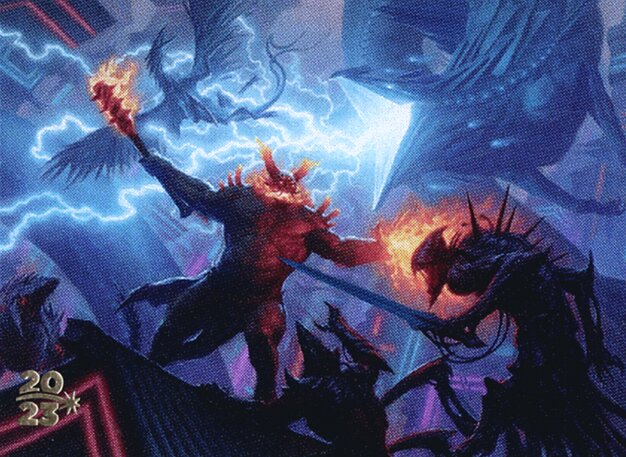
Hidetsugu and Kairi


 Commander
A Dimir value-engine that stacks its own topdeck on entry, then turns its death trigger into a burst of life loss and a free spell.
Public decks: 1Bracket: 3
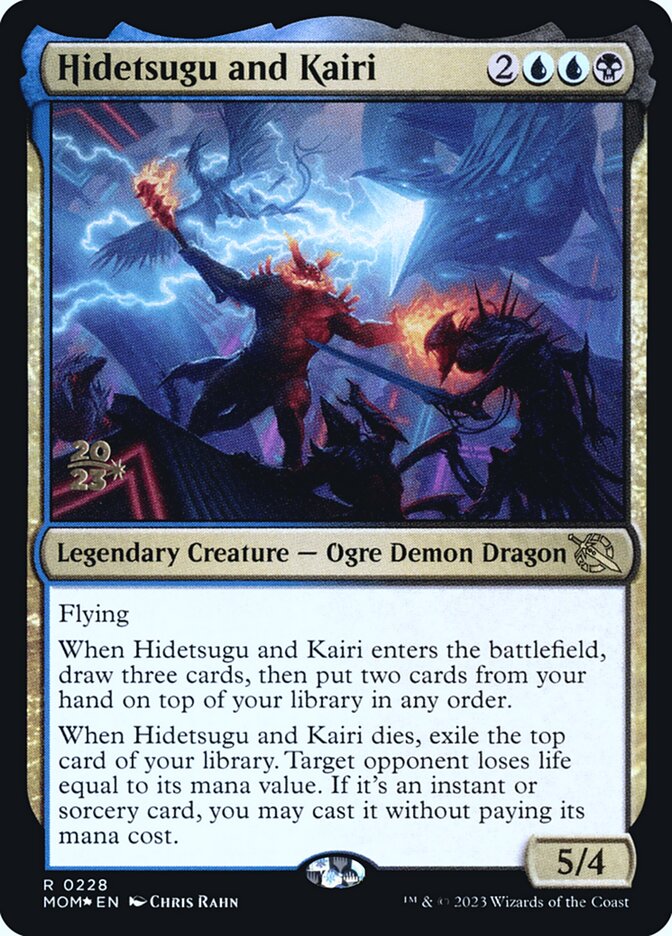
Card text
Legendary Creature — Ogre Demon Dragon
Flying
When Hidetsugu and Kairi enters, draw three cards, then put two cards from your hand on top of your library in any order.
When Hidetsugu and Kairi dies, exile the top card of your library. Target opponent loses life equal to its mana value. If it's an instant or sorcery card, you may cast it without paying its mana cost.
Overview
- Uses the ETB to draw three, then deliberately set up the top of your library for the next big payoff.
- Plays like a midgame control/value deck early, then pivots into commander-centric burst turns once Hidetsugu and Kairi is online.
- Often wants its commander to die on purpose after stacking the top card, converting that death into damage plus a free instant or sorcery.
- Can leverage clones, reanimation, and death-trigger doubling effects to repeat the ETB/death loop for compounding advantage.
- Typically closes by chaining high-mana-value flips into big spells, draining one player at a time or creating a decisive swing turn.
Common lines
- Ramp into Hidetsugu and Kairi, ETB draw three, then put a high-impact card (often an instant or sorcery) back on top to “load” the death trigger.
- Hold up interaction, then choose a moment where your commander dying is beneficial (your own sacrifice effect, combat, or a removal exchange).
- After the death trigger casts a free spell, follow up with recursion or a copy effect to re-establish the commander and repeat the setup.
- Use cheap library manipulation to keep the top card predictable so the death trigger is more plan than gamble.
Strengths
- High ceiling on swing turns: death trigger can be both a large life-loss hit and a free spell.
- ETB immediately refuels your hand, helping you rebuild after trading resources.
- Naturally supports a reactive posture with countermagic while you assemble your “loaded” topdeck.
- Resilient to some spot removal when you can turn commander deaths into value instead of setbacks.
- Can scale into longer games by repeatedly looping ETB/dies value.
Weaknesses
- Relies heavily on the commander sticking around long enough to ETB and then dying on your terms; commander tax adds up quickly.
- Top-of-library disruption and forced shuffles can undercut your setup turns.
- Exile-based removal or effects that prevent casting from exile can reduce the payoff of the death trigger.
- Graveyard hate can blunt recursion-heavy plans if you’re leaning on reanimation lines.
- Often feels mana-hungry: you want to both deploy the commander and still represent interaction.
Rule zero notes
- This commander often plays best when it can intentionally kill its own commander to trigger the dies ability; mention if your list is built around repeated sacrifice loops.
- Damage can come in large chunks from a single trigger depending on what’s on top; games can end abruptly if the topdeck is set up.
- If you run a dense suite of countermagic (for example Arcane Denial, Negate, or An Offer You Can't Refuse), call out the interaction level up front.
- If you include tutors that set the top of the library (for example Mystical Tutor), mention how consistently you can “load” the trigger.
- Note any recursion focus (for example Dread Return-style reanimation) if your games tend to revolve around repeating the commander.
Matchups
Best into
- Creature-heavy midrange pods where repeated value swings decide the game
- Slower battlecruiser tables that give you time to set up topdeck and recursion loops
- Removal-heavy metas where “my commander dying helps me” can flip exchanges in your favor
Struggles against
- Fast combo pods that punish a five-mana commander plan
- Heavy stax shells that tax casting spells or restrict free-casting
- Decks that consistently pressure your library setup (frequent shuffles, topdeck denial) or pack lots of exile interaction

FAQ
Do I want Hidetsugu and Kairi to die?
Often yes, but on your terms. The deck tends to treat the dies trigger as a payoff you set up with the ETB, not as an unfortunate outcome.
How do I make the death trigger reliable instead of random?
You typically use the ETB to put specific cards back on top, then reinforce that plan with cheap topdeck manipulation (for example Brainstorm) or top-setting effects.
What kinds of cards should be on top when it dies?
High-mana-value cards maximize the life loss, and instants/sorceries give you the extra benefit of casting for free. Many builds try to align both incentives at once.
Is this deck more control or more combo?
It can lean either way, but it often plays like control in the early turns (ramp plus interaction) and then becomes a commander-centric engine that can chain big turns.
What’s the cleanest way to actually win?
Common wins come from repeated commander deaths that translate into large life-loss chunks plus free spells, eventually chaining into a turn where opponents can’t recover.