
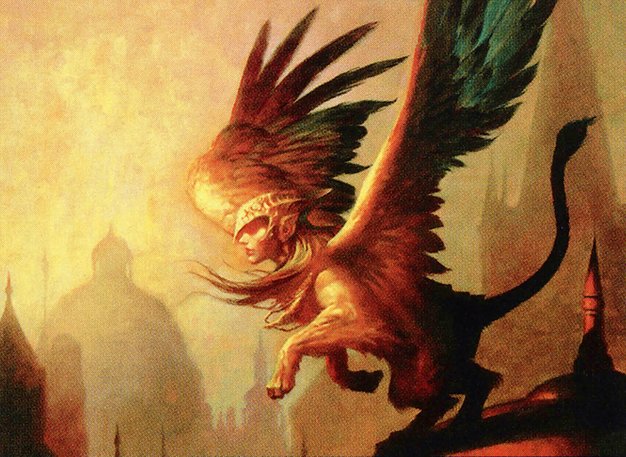
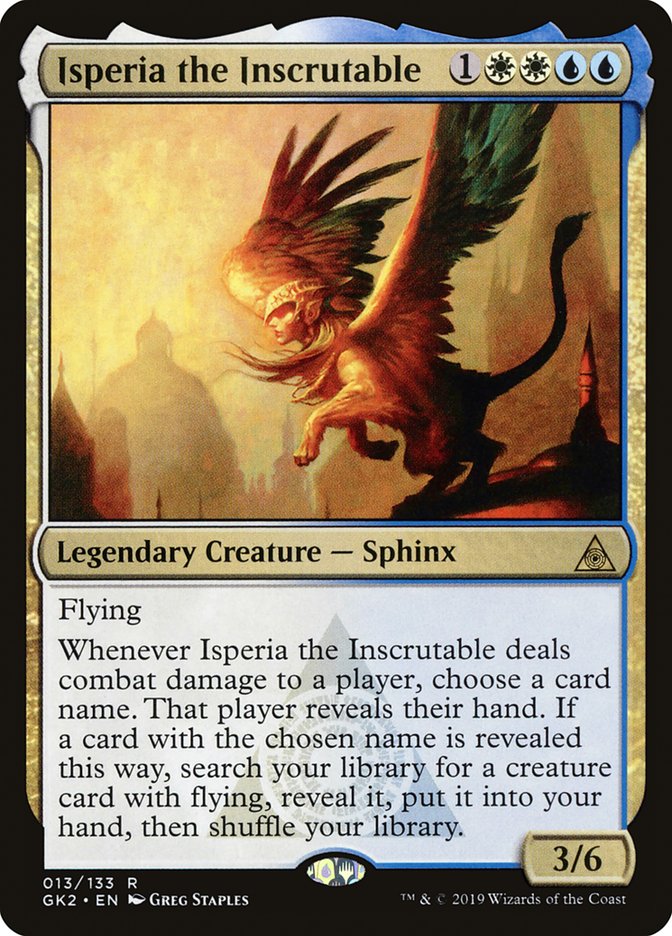
Isperia the Inscrutable


 Commander
An Azorius flying-beats commander that rewards clean combat connections with hand reads and a steady stream of tutored fliers.
Public decks: 1Bracket: 3
Card text
Legendary Creature — Sphinx
Flying
Whenever Isperia deals combat damage to a player, choose a card name. That player reveals their hand. If a card with the chosen name is revealed this way, search your library for a creature card with flying, reveal it, put it into your hand, then shuffle.
Overview
- Game plan is to land Isperia, connect in the air, and turn each hit into information plus a flying-creature tutor if you call the right card name.
- Plays like a tempo-control deck: keep the board manageable, pick safe attack windows, and snowball off repeated combat damage triggers.
- Leans on evasive threats and incremental advantage rather than explosive setup; you often win by building a superior board of flyers and riding it home.
- Because the trigger asks you to name a card, effects that let you see hands or deduce likely interaction can meaningfully improve hit rate.
- Closing turns typically involve turning a wide/tall air force into lethal over one or two combat steps, backed by protection or counters.
Common lines
- Develop mana and early blockers, then deploy Isperia once you can reasonably protect it or clear a path.
- Chip in with flying damage, use the reveal to confirm what interaction is up, and only then commit bigger fliers.
- If a board is getting cluttered, reset combat math with a bounce spell and immediately resume attacking in the air.
- When you have multiple flyers, set up a single decisive combat step with a pump/protection effect and force through lethal.
- Hold up permission on key turns to defend Isperia, stop sweepers, or win counter wars before your big swing.
Strengths
- Evasion-based pressure that naturally dodges many ground stalls.
- Card-quality advantage over time: hand information plus conditional tutoring can let you plan turns precisely.
- Strong at playing at instant speed with permission and reactive interaction.
- Resilient to creature swarms when you can punish overextension with reset effects.
- Can pivot between beatdown and control depending on the table state.
Weaknesses
- Isperia’s engine is combat-damage dependent; fogs, flying blockers, and pillow-fort style defenses can shut off the trigger.
- The tutor is conditional and involves guessing; without good information, you can whiff and fall behind on velocity.
- Five-mana commander in Azorius can be tempo-negative if repeatedly removed.
- Flying-centric threat base can be soft to dedicated anti-evasion tech or repeated sweepers.
- May struggle to close quickly if the table stabilizes at high life totals and you can’t line up a big finishing combat.
Rule zero notes
- This commander can involve repeated hand reveals; confirm the table is comfortable with frequent hidden-information checks.
- The build can reasonably run a noticeable permission suite (for example Counterspell, Disallow, or An Offer You Can't Refuse).
- Some lists may include taxing/tempo creatures (for example Archangel of Tithes, Kinjalli's Sunwing, or Elite Spellbinder), which can slow combat and development.
- Board resets via bounce can be a recurring pattern (for example Aetherize, Consuming Tide, or Flood of Tears).
- Finishes can be combat-based burst turns (for example Akroma's Will) rather than deterministic combos.
Matchups
Best into
- Creature-heavy midrange pods that gum up the ground but can’t meaningfully contest the air.
- Decks that rely on a few key noncreature spells you can disrupt with permission and hand knowledge.
- Tables that overextend into bounce/sweeper-style resets.
Struggles against
- Turbo-combo tables that can win before combat triggers matter.
- Dedicated control shells that trade one-for-one efficiently and keep the commander off the board.
- Strategies with abundant fog effects, pillow-fort, or dense flying reach that prevent clean combat hits.
FAQ
How do I actually hit with Isperia consistently?
You typically need a clear air lane, a way to punish blocks, or a reset that reopens combat; protecting Isperia for the first connection matters a lot.
What should I name with the trigger?
Most of the time you name what you believe they’re holding based on earlier plays, revealed cards, or table context; if you have hand-peak effects (for example Glasses of Urza), you can name with much higher confidence.
Is this more control or more aggro?
It tends to sit in the middle: you apply steady evasive pressure while using counters and reactive spells to keep opponents from stabilizing.
How does the deck close games?
Usually by assembling a critical mass of flyers and taking one or two decisive combat steps, sometimes aided by a burst finisher like Akroma's Will.
Do I need a lot of flyers besides the commander?
Yes, because the payoff searches for a creature with flying; the deck generally wants a meaningful portion of its threats and utility creatures to have flying so the trigger always has live targets.