

Jin Sakai, Ghost of Tsushima Commander Deck Guide



 Commander9
An Esper combat commander that rewards clean, one-on-one attacks with evasion or double strike and converts hits into steady card draw.
Public decks: 3Bracket: 3

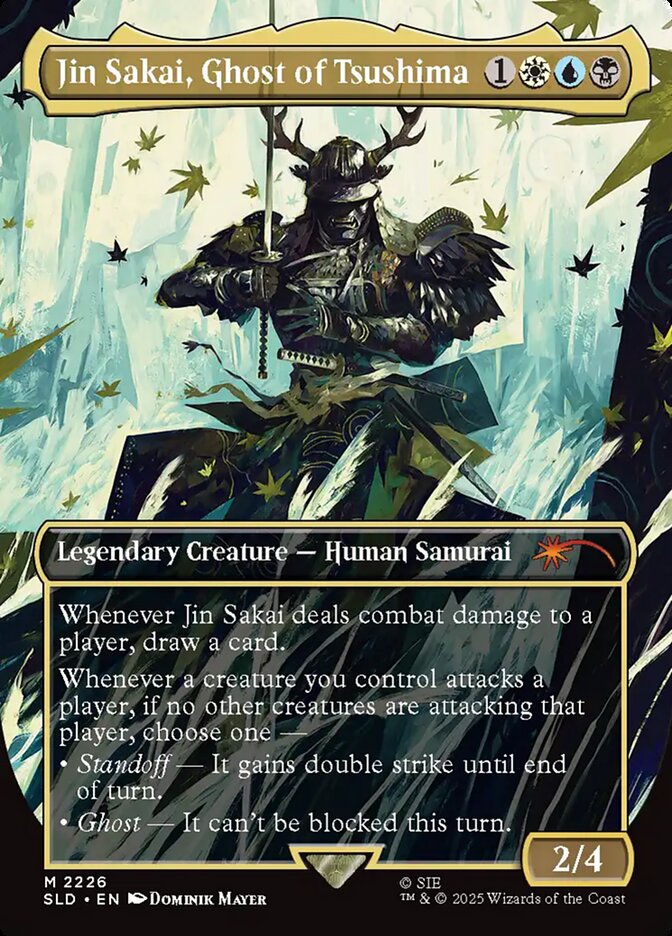
Card text
Legendary Creature — Human Samurai
Whenever Jin Sakai deals combat damage to a player, draw a card.
Whenever a creature you control attacks a player, if no other creatures are attacking that player, choose one —
• Standoff — It gains double strike until end of turn.
• Ghost — It can't be blocked this turn.
Building around this commander?
Use MTG Master to build or analyze a Commander deck around this card, check consistency, and find weak spots before your next game.
Overview
- Set up Jin to connect in combat and keep your hand full with the on-hit draw trigger.
- Pressure opponents with “solo attacker” lines: send exactly one creature at a player to turn on Ghost (unblockable) or Standoff (double strike).
- Play a tempo-leaning combat game where you pick favorable attacks rather than swinging wide into blockers.
- Use selective attacks to spread damage intelligently, forcing awkward blocks and keeping key attackers alive.
- Close games by repeatedly landing high-impact hits while maintaining enough interaction and protection to keep combat lanes open.
Common lines
- Attack with a single creature at the player who is best set up to be hit, choosing Ghost when you need a guaranteed connection.
- Attack with a single, meaningful threat and choose Standoff to convert one clean hit into a big damage swing.
- Sequence combat so Jin keeps connecting turn after turn, using the extra cards to find more protection, removal, or additional threats.
- Split attacks across players only when it doesn’t dilute your “one creature per player” triggers and doesn’t expose key attackers to trades.
Strengths
- Consistent card advantage if you can keep connecting in combat.
- Flexible combat mode selection: evasion when needed, damage when the lane is open.
- Naturally good at punishing opponents who rely on blockers rather than instant-speed interaction.
- Encourages efficient, low-commitment attacks that can reduce blowout risk from sweepers.
- Can pivot between a Jin-focused plan and using other attackers as the primary closers.
Weaknesses
- Heavily combat-dependent; fogs, pillow-fort effects, and repeated removal can stall your engine.
- Needs board presence to leverage the attack trigger meaningfully; empty boards make the second ability moot.
- Vulnerable to instant-speed interaction during combat, especially when committing to a single attacker plan.
- Can struggle into wide token boards that can still interact via sacrifice effects or combat tricks despite Ghost.
- Three-color mana plus a combat-centric plan can make early turns feel slow if you miss development.
Rule zero notes
- This is a combat-first commander that can snowball card advantage if it keeps hitting players.
- Expect lots of targeted interaction and protection to force through attacks and keep threats alive (exact mix varies).
- Game plan tends to focus on repeated, selective attacks rather than full go-wide alpha strikes.
- If your build leans into extra combat steps, heavy evasion, or lock-style combat prevention, mention that up front (not inherent to the commander).
Matchups
Best into
- Creature-midrange pods that try to block and trade in combat
- Slower value decks that give you time to connect and draw
- Tables light on instant-speed interaction and edict effects
Struggles against
- Pillow-fort and fog-heavy strategies that blank combat steps
- Fast combo pods that don’t care about combat pressure
- Removal-dense control shells that can repeatedly answer a single key attacker
Recent public decks
Staples
Browse all public decksFAQ
Do I have to play Voltron with Jin?
Not necessarily. Jin rewards connecting, but the solo-attacker trigger also works with any creature you send alone at a player, so you can win with multiple threats.
When should I choose Ghost versus Standoff?
Ghost is typically for ensuring damage and the draw trigger through blockers; Standoff is for converting an already-safe attack into a much bigger damage swing.
Does the solo-attacker ability care about how many creatures I attack with overall?
It checks per player: a creature gets the bonus when it attacks a player that no other creatures are attacking.
What kind of interaction matters most for this commander?
You usually want ways to keep key attackers alive and clear the one blocker or effect that stops a clean connection, since the deck’s engine is tied to combat damage.
How does this deck typically close games?
It often closes by repeatedly landing high-value hits over multiple turns, sometimes turning a safe lane into a lethal clock with double strike while staying fueled by card draw.