
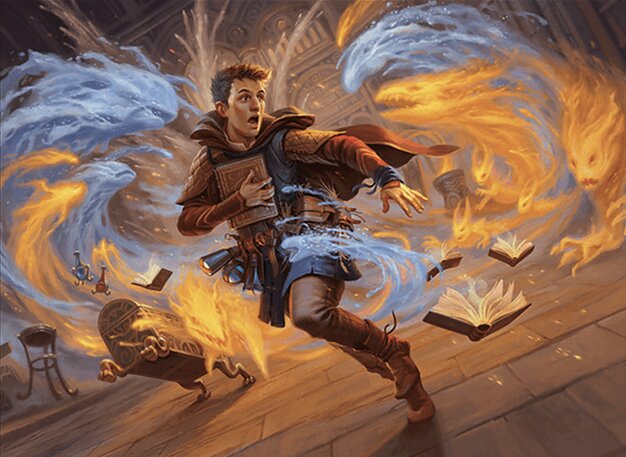
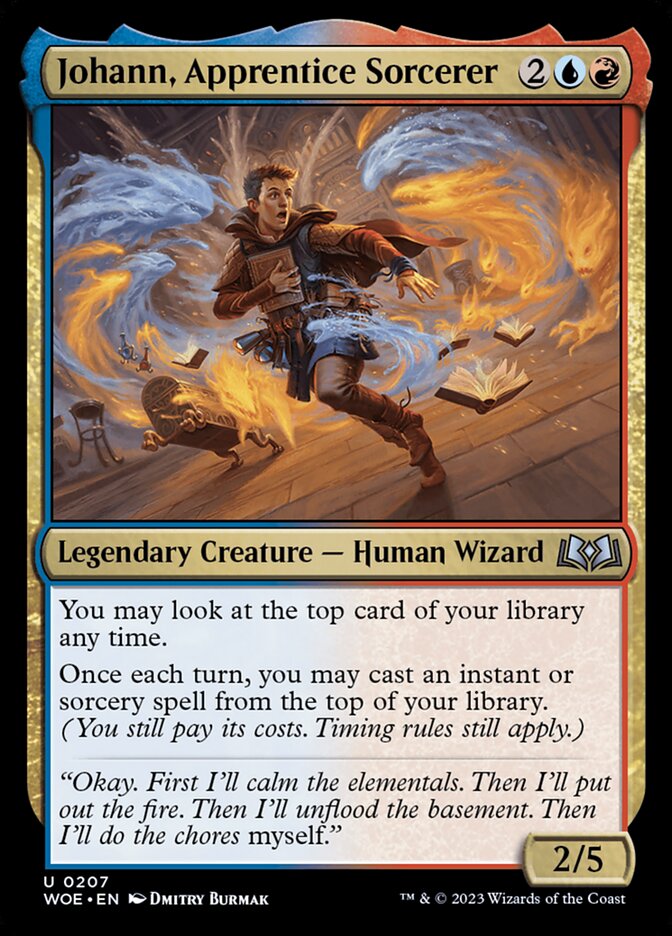
Johann, Apprentice Sorcerer



Johann, Apprentice Sorcerer plays like an Izzet spellslinger engine that turns topdeck manipulation into a steady stream of extra instants and sorceries each turn cycle.
Public decks: 1Bracket: 4
Overview
- Leans on information advantage: you always know your top card, which helps planning and bluffing interaction.
- Wants a high instant/sorcery density so the top of your library is “live” as often as possible.
- Typically uses cheap cantrips and filtering to set up the top card, then converts that into one extra spell per turn.
- Plays well as a reactive deck: you can often hold up mana, then use Johann to “draw” a spell off the top at the right moment.
- Closes by turning a long game of incremental value into a decisive swing turn, often backed by countermagic and tempo plays.
Common lines
- Develop mana, land Johann, then spend turns casting a normal spell from hand plus one instant/sorcery off the top each turn.
- Use topdeck manipulation to fix an awkward top card and keep Johann’s once-per-turn cast turned on (e.g., Brainstorm or Brainstone as examples).
- Pass with mana open, interact on an opponent’s turn, then use your own turn to cash in the top card and keep pace on resources.
- Stabilize a pressured board, then pivot into a big tempo reset or extra-turn sequence when the table is tapped low (e.g., Cyclonic Rift or Capture of Jingzhou as examples).
Strengths
- Consistent incremental advantage: Johann effectively turns the top card into an extra “virtual card” each turn when set up.
- Plays an efficient, instant-speed game and tends to use mana well across the full turn cycle.
- Naturally supports a high interaction count (e.g., Arcane Denial, Counterspell, An Offer You Can't Refuse as examples).
- Good at pivoting between defense and offense once it has mana and information control.
Weaknesses
- Once-per-turn limitation means it’s more about sustained advantage than explosive storming without additional engines.
- Can stumble if the top of the library isn’t an instant/sorcery and you can’t easily clear or reorder it.
- Commander-centric value: removing Johann can noticeably slow down the deck’s throughput.
- Creature pressure can force you to spend your “top-cast” on defense instead of advancing your own game plan.
- Grindy pods can tax your interaction density; you may run out of clean answers if you fall behind on raw card draw.
Rule zero notes
- This can be built as a fairly interactive control/spellslinger deck with lots of stack interaction (e.g., Counterspell effects as examples).
- Some builds may include big tempo resets (e.g., Cyclonic Rift as an example), which can swing games hard.
- Extra-turn effects may be present depending on build choices (e.g., Capture of Jingzhou as an example).
- There may be light land disruption packages depending on preferences (e.g., From the Ashes or Cleansing Wildfire as examples).
- Because the commander plays from the top, turns can include a bit of “top-of-library management” decision time; I’ll play quickly and reveal intent when needed.
Matchups
Best into
- Midrange pods where games go long and incremental value plus countermagic matters.
- Spell-based or combo-leaning tables where holding up interaction is rewarded.
- Board-centric decks that overextend into sweepers or tempo resets (e.g., Blasphemous Act as an example).
Struggles against
- Very fast aggro openings that demand multiple early blockers rather than stack interaction.
- Heavy tax/disruption that constrains repeated spellcasting in a turn cycle.
- Decks that repeatedly remove the commander and keep you off stabilizing mana.
FAQ
Do I have to build all-in spellslinger for Johann to work?
Not strictly, but Johann’s trigger is only instants and sorceries, so the deck typically wants enough of them that your top card is often castable.
How do I avoid getting stuck with a dead top card?
You generally want frequent filtering and topdeck manipulation so you can clear lands or non-spells off the top when Johann is online.
Is Johann more proactive or reactive?
It often plays reactive, because casting from the top once each turn rewards keeping mana open and using the turn cycle efficiently.
What does Johann usually use as a finisher?
Many builds aim to turn sustained advantage into a single swing turn, either with a big tempo play (e.g., Cyclonic Rift as an example) or by chaining high-impact spells with protection.
How important is protecting the commander?
Pretty important: Johann is the engine that converts topdeck setup into real resources, so keeping it on the table usually improves your consistency a lot.