
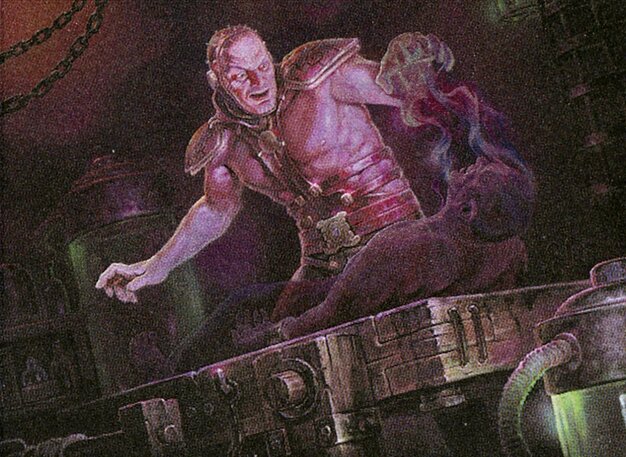
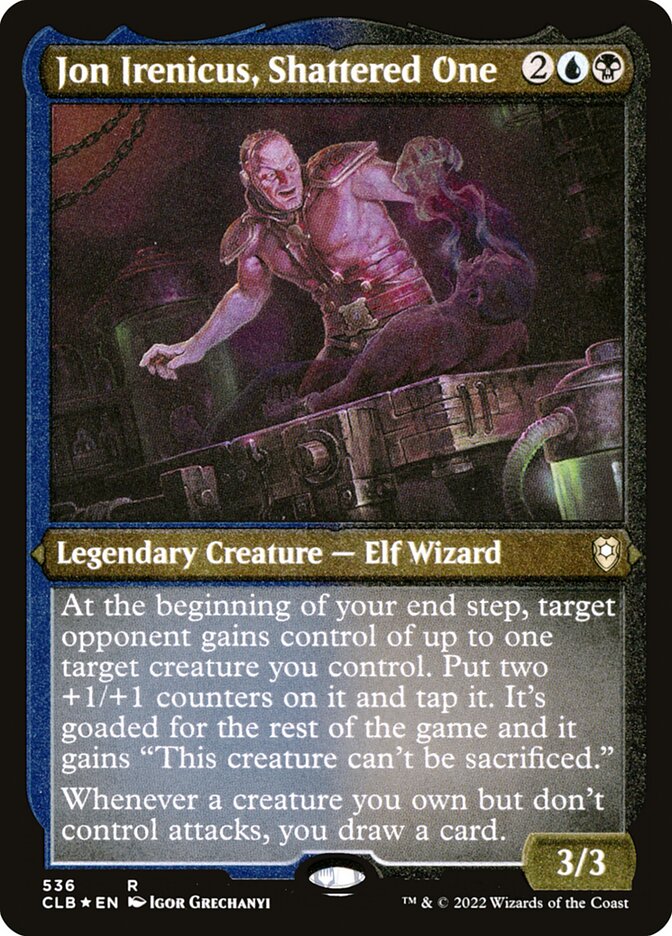
Jon Irenicus, Shattered One


 Commander
Jon Irenicus turns your creatures into forced attackers for other players, then pays you back in cards when they swing.
Public decks: 1Bracket: 3
Card text
Legendary Creature — Elf Wizard
At the beginning of your end step, target opponent gains control of up to one target creature you control. Put two +1/+1 counters on it and tap it. It's goaded for the rest of the game and it gains "This creature can't be sacrificed." (It attacks each combat if able and attacks a player other than you if able.)
Whenever a creature you own but don't control attacks, you draw a card.
Overview
- Play creatures you’re happy to donate, then hand one off each end step to keep the table pointed away from you.
- The gifted creature gets bigger, gets goaded forever, and can’t be sacrificed, making it hard for the recipient to cash it in safely.
- You draw cards whenever a creature you own but don’t control attacks, so the deck tends to snowball through combat steps.
- Games often revolve around choosing the right opponent to gift to: ahead enough to pressure others, but not so far ahead that they run away with it.
- You generally win by converting repeated attack triggers and table damage into an endgame where opponents are low on life and low on resources.
Common lines
- Establish a creature you’re willing to give away, then donate it at end step to create immediate pressure on a third player.
- Cycle donations between opponents to keep attacks flowing and spread the damage while you draw cards off the swings.
- Use the “can’t be sacrificed” clause to make your gifts awkward to remove or exploit, forcing more combat and more draw.
Strengths
- Strong political leverage: you can aim pressure where it matters while staying out of the red zone yourself.
- Card advantage tied to combat that can trigger across multiple turns, not just yours.
- Naturally disruptive to sac-based lines because donated creatures can’t be sacrificed.
- Encourages faster games by incentivizing and enforcing attacks.
Weaknesses
- Needs creatures worth donating; hands without suitable bodies can be clunky.
- Relies on opponents being able to attack; fogs, pillowfort, or combat shutdown effects can blunt your engine.
- Gifts can backfire if you donate something that ends up enabling an opponent’s plan or survives too long.
- Commander-centric: losing Jon repeatedly can slow your ability to convert creatures into ongoing card draw.
Rule zero notes
- Clarify whether your list is mostly political combat value or built to donate especially punishing creatures.
- Mention how much of your plan depends on forcing attacks (goad) versus other win conditions.
- Call out if you run effects that strongly restrict combat choices or create repetitive board states around forced attacking.
Matchups
Best into
- Creature-combat tables where players are incentivized to turn sideways
- Midrange pods that win through incremental board pressure
- Decks that lean on sacrifice outlets as a key utility
Struggles against
- Hard control pods that can repeatedly answer your commander or your creatures
- Pillowfort or combat-denial strategies that make attacking difficult
- Fast combo tables that don’t care about combat damage or goad pressure
FAQ
Do I have to give away a creature every end step?
No. Jon targets up to one creature you control, so you can choose to donate none if it’s better to hold back.
Why does the creature being unable to be sacrificed matter?
It prevents the recipient from trivially cashing in your gift to a sacrifice outlet, which helps keep the forced-attacking pressure (and your draw) online.
Who should I give creatures to?
Typically the opponent who can most reliably attack other players while being least likely to turn that gifted body into a bigger advantage for themselves.
How does Jon generate card advantage?
Whenever a creature you own but don’t control attacks, you draw a card, so each gifted attacker can pay you every combat it participates in.
How does this deck usually win?
It often wins by leveraging repeated forced attacks to grind life totals down while you pull ahead on cards, then finishing once opponents are depleted.