

Karametra, God of Harvests


 Commander
Creature-casting ramp engine in Selesnya that turns every body you cast into extra lands and a steady march toward a big-board finish.
Public decks: 7Bracket: Varies

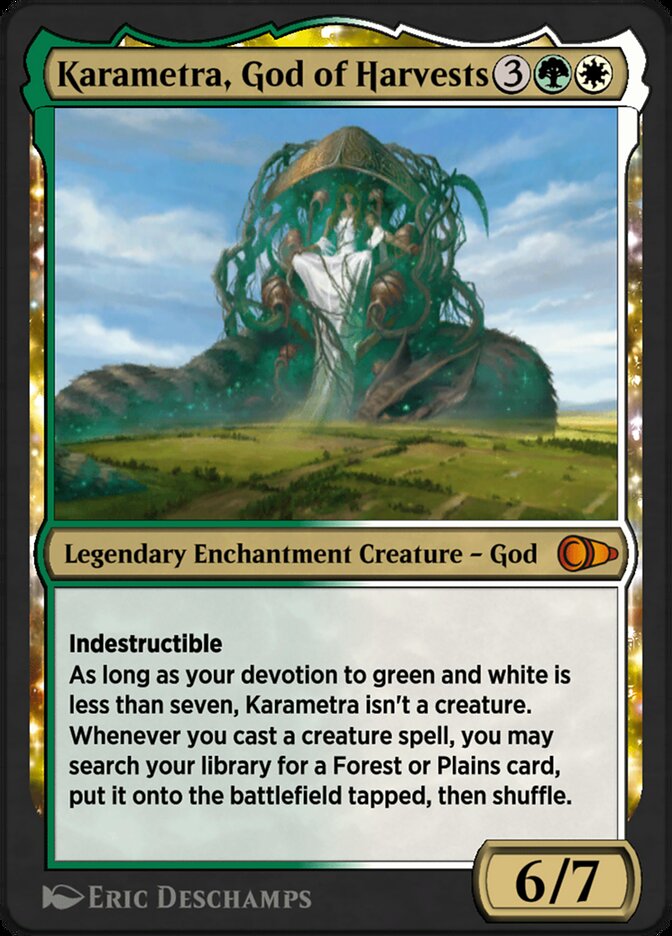
Card text
Legendary Enchantment Creature — God
Indestructible
As long as your devotion to green and white is less than seven, Karametra isn't a creature.
Whenever you cast a creature spell, you may search your library for a Forest or Plains card, put it onto the battlefield tapped, then shuffle.
Building around this commander?
Use MTG Master to build or analyze a Commander deck around this card, check consistency, and find weak spots before your next game.
Overview
- Wants a high creature count so Karametra converts your curve into ramp and color fixing.
- Plays like a value-midrange deck early: develop mana with small creatures, then start double-spelling as your land count snowballs.
- Often uses the ramp to jump from “fair board” to “overwhelming board” with large creatures and/or token makers.
- Karametra is hard to remove (indestructible) and can stay an enchantment for much of the game, which can make it resilient to creature wipes.
- Typically closes by going wide/tall and leveraging a mass pump effect (for example, Craterhoof Behemoth or End-Raze Forerunners as finishers).
Common lines
- Cast Karametra, then follow up with multiple cheap creatures to chain land searches and get ahead on mana.
- Use the extra lands to hold up interaction while continuing to add creatures each turn.
- After a sweeper, rebuild quickly by recasting creatures to immediately restock lands and redeploy threats.
- Transition from ramp/value to a single explosive combat step once you have a critical mass of bodies.
Strengths
- Consistent mana growth that doesn’t rely on noncreature ramp resolving after Karametra is online.
- Strong recovery: recasting creatures both rebuilds the board and advances your mana base.
- Commander resiliency: indestructible and often not a creature makes Karametra tricky to answer cleanly.
- Plays well into longer games where land count and repeated value matter.
Weaknesses
- Can be slower to interact on the stack; fast combo decks may get under you if you don’t draw the right answers.
- Relies on repeatedly casting creatures; heavy tax effects or frequent counterspells can blunt the engine.
- Creature sweepers can reset your pressure, forcing you to spend time rebuilding (even if your ramp sticks).
- If you don’t convert mana into a decisive finish, you can flood and give the table time to stabilize.
Rule zero notes
- This commander naturally creates a lot of shuffling and game actions due to repeated land searching; confirm pace-of-play expectations.
- Finishes may include a single-turn lethal combat pump (for example, Craterhoof Behemoth/End-Raze Forerunners); disclose if your list aims for abrupt kills.
- If you run hatebears or anti-cheat effects (for example, Containment Priest), mention how disruptive the build is intended to be.
- Clarify whether the deck is mainly fair combat/value or if it includes any deterministic combo lines (if applicable to your exact list).
Matchups
Best into
- Grindy midrange pods where extra land drops translate into inevitability.
- Removal-heavy tables where a resilient commander and strong rebuild matter.
- Creature-combat metas that can be pressured by bigger boards and larger creatures.
Struggles against
- Fast combo tables that win before your ramp turns into a kill.
- Stack-heavy control pods that can repeatedly stop your key turns and payoff creatures.
- Stax/tax strategies that punish creature casting or searching libraries.
Recent public decks

Staples
Browse all public decksFAQ
How does Karametra actually generate advantage?
Every creature spell can turn into an extra Forest or Plains, so your normal development also ramps you and fixes colors.
Do I need Karametra to be a creature for the deck to work?
Not usually; the trigger works whether or not devotion turns Karametra on, and staying an enchantment can make it harder to remove with creature-only answers.
What does the deck do after it ramps a lot?
It typically pivots into big battlefield payoffs and then ends the game through combat, sometimes via an overrun-style finisher.
Is this more of a combo deck or a fair deck?
From the available snapshot it reads more like fair creature value into a combat finish, but exact speed and combo presence depend on your build choices.
What kind of interaction fits the plan?
Flexible removal and a few protective pieces tend to complement the creature-casting engine, letting you keep developing while answering problem permanents.