

Kefka, Court Mage // Kefka, Ruler of Ruin



 Commander
A Grixis hand-pressure commander that can pivot into a transformed, turn-based draw engine once you start reliably making opponents lose life.
Public decks: 2Bracket: 4

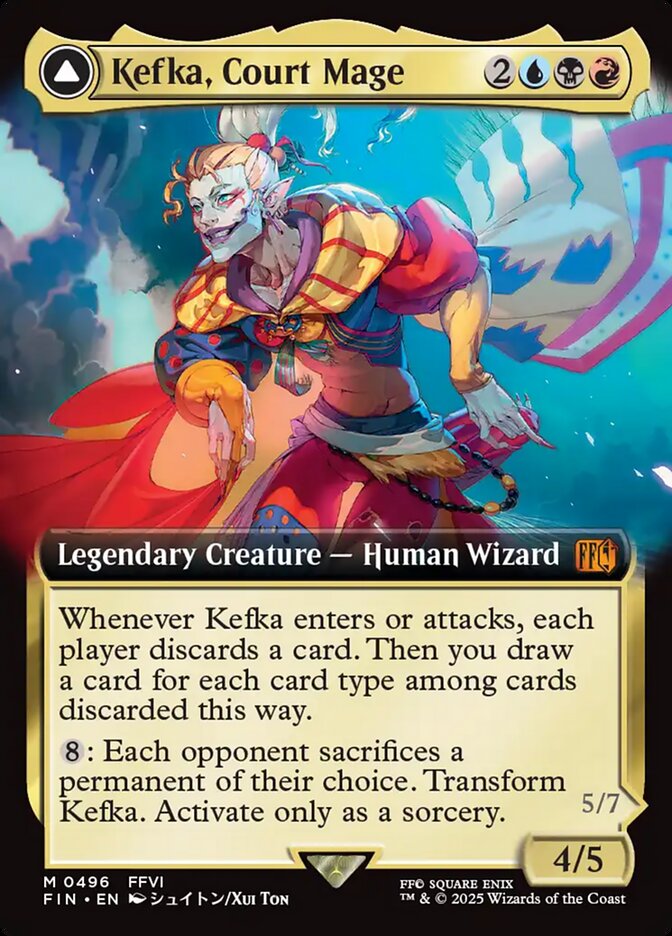
Card text
Legendary Creature — Human Wizard // Legendary Creature — Avatar Wizard
Whenever Kefka enters or attacks, each player discards a card. Then you draw a card for each card type among cards discarded this way.
 : Each opponent sacrifices a permanent of their choice. Transform Kefka. Activate only as a sorcery.
//
Flying
Whenever an opponent loses life during your turn, you draw that many cards.
Building around this commander?
Use MTG Master to build or analyze a Commander deck around this card, check consistency, and find weak spots before your next game.
Overview
- Leans on Kefka’s enter/attack trigger to force table-wide discards while turning the discarded card types into your own card advantage.
- Often plays like a disruptive midrange/tempo deck early: deploy Kefka, keep mana up, and keep hands awkward with repeated discard triggers.
- Can be built to multiply triggers via blink lines, turning every combat step into both pressure and refuel.
- The {8} sorcery-speed activation is a big inflection point: it taxes opponents’ boards via sacrifice, then flips Kefka into a high-ceiling draw engine.
- Once transformed, any life loss you cause during your turn (combat, pings, burn) can snowball into overwhelming hand size and velocity.
Common lines
- Cast Kefka, then look for safe attack windows to repeatedly trigger the table discard while you stay ahead on cards.
- Use blink effects (for example, Essence Flux or Conjurer's Closet) to re-trigger Kefka’s enter ability without needing to connect in combat.
- Protect a key turn with cheap interaction (for example, Dispel, Arcane Denial, Counterspell, or An Offer You Can't Refuse) before committing to a big sequence.
- After flipping, convert small chunks of on-turn damage (for example, Lightning Bolt or Glint-Horn Buccaneer triggers) into large bursts of card draw.
Strengths
- Naturally pressures resources: repeated forced discards can keep faster or greedier decks off key pieces.
- High card-flow potential, especially if you can vary card types discarded or reliably deal life loss after transforming.
- Plays well at interactive tables: holding up counters while advancing your commander plan is a clean fit.
- Multiple angles of attack are available (combat-trigger discard, blink value, transformed draw engine), making it harder to shut off with a single piece of hate.
Weaknesses
- Symmetrical discard can draw table aggression, especially from players who rely on sculpting hands or sandbagging interaction.
- Kefka wants to enter/attack to matter; repeated removal or a clogged board can slow the engine down.
- The transform activation is expensive and sorcery-speed, so it can be hard to justify tapping out without protection.
- If opponents can avoid taking meaningful life loss on your turn, the back face can underperform compared to its ceiling.
- Fueling opponents’ graveyards via discard can be risky into recursion strategies.
Rule zero notes
- This commander forces each player to discard on Kefka’s enter/attack; confirm the table is okay with repeatable hand disruption.
- Some builds can lean into punishing discard (for example, Megrim or Liliana's Caress) which can feel like a fast clock once it sticks.
- Blink-heavy builds can create frequent discard triggers (for example, Displacer Kitten or Ghostly Flicker), which may be oppressive for lower-power pods.
- Lists may include dense cheap interaction and ritual acceleration (for example, Dark Ritual or Desperate Ritual), affecting pacing and threat perception.
Matchups
Best into
- Creature-light spellslinger pods that struggle to keep blockers back while protecting their hand
- Greedy midrange/value decks that rely on holding specific answers and incremental advantage
- Slow control tables where repeated discard triggers and on-turn life loss can force action
Struggles against
- Dedicated graveyard decks that turn discarded cards into a benefit
- Go-wide creature decks that can both block profitably and pressure you before you stabilize
- Decks with heavy commander removal that can keep Kefka off the table or make attacks unsafe
FAQ
How many cards do I draw from Kefka’s front face trigger?
After everyone discards, you draw a number of cards equal to the number of distinct card types among the cards discarded that way. Mixed discards across players tend to increase the count.
Do I draw on the back face from any life loss, or only combat damage?
It’s any life loss during your turn, not just damage. Combat damage and burn spells are common ways to turn it on, but the key is that it has to happen on your turn.
Does Kefka’s discard happen when it attacks even if it gets blocked or removed?
The trigger happens when it attacks, so you’ll get it as soon as it’s declared as an attacker. If it’s removed after that, the trigger still resolves.
Is the {8} transform ability a win condition by itself?
It’s usually more of a setup and swing turn: it strips a permanent from each opponent and turns on the back-face draw engine. You typically still need a way to convert the extra cards into a close.
What kinds of cards tend to play well with Kefka’s plan?
Effects that repeatedly trigger enter/attack, protect your commander, or translate on-turn life loss into snowballing advantage are natural fits. Example inclusions from one list include Lightning Greaves, Conjurer's Closet, and cheap counterspells.