

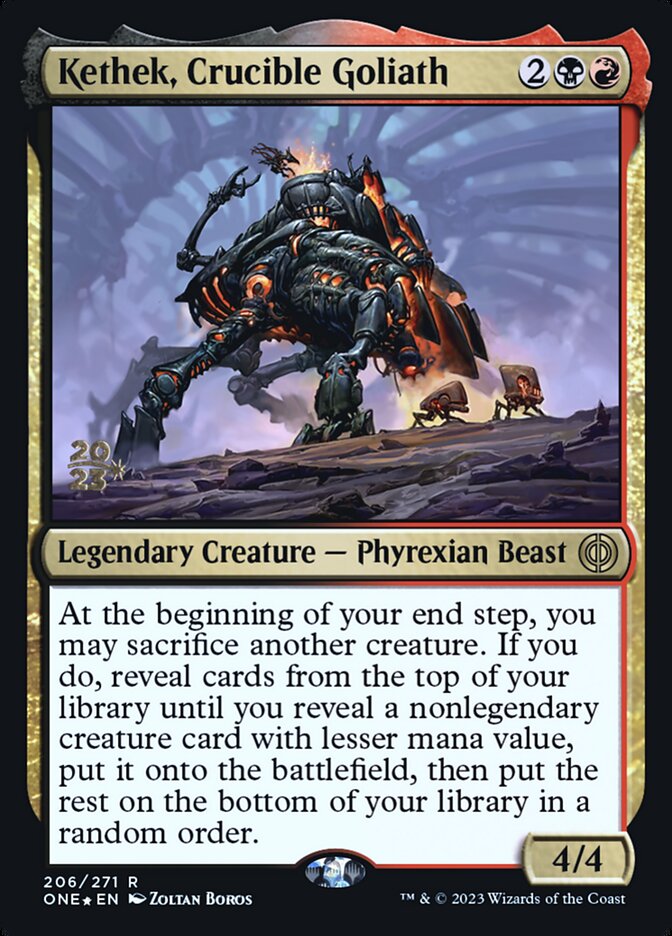
Kethek, Crucible Goliath


 Commander
Kethek, Crucible Goliath turns your end step into a sacrifice-driven creature chain, trading bodies for a steady stream of smaller nonlegendary threats.
Public decks: 1Bracket: 1
Card text
Legendary Creature — Phyrexian Beast
At the beginning of your end step, you may sacrifice another creature. If you do, reveal cards from the top of your library until you reveal a nonlegendary creature card with lesser mana value, put it onto the battlefield, then put the rest on the bottom of your library in a random order.
Overview
- Game plan: stick a creature you can afford to lose, then use Kethek each end step to convert it into a cheaper nonlegendary creature from your library.
- Plays like a Rakdos value engine: you’re happy when creatures die, and you often want disposable bodies or temporary steals to feed the trigger.
- Because the hit is library-based and random, decks often lean into dense creature counts and a smooth mana-value curve to make flips reliable.
- You typically pressure the table by accumulating incremental board presence rather than assembling one deterministic combo line.
- Closing the game often comes from combat backed by sacrifice payoffs and occasional direct-damage finishes (for example, effects like Fling).
Common lines
- Develop early board, cast Kethek, then start end-step sacrifices to “chain” down your curve and rebuild after trades.
- Use a temporary control effect (for example, Act of Treason or Hijack) to borrow an opposing creature, attack with it, then sacrifice it to Kethek before giving it back.
- Cash in a creature at instant speed for resources (for example, Deadly Dispute), then still plan to feed Kethek on your end step if you have another body.
- When opponents stabilize, pivot from value to damage by turning a large attacker into reach (for example, Fling) or forcing awkward blocks and trades.
Strengths
- Consistent end-step value if you can keep a steady stream of creatures to sacrifice.
- Naturally grinds through removal and combat by turning dying creatures into fresh board presence.
- Plays well with “borrow-and-sac” patterns, converting opposing creatures into your own advantage.
- Makes your mana-value curve matter in a rewarding way, often letting you sculpt a steady chain of threats.
Weaknesses
- Commander-dependent engine; if Kethek is removed repeatedly, the deck can stall as a fair Rakdos creature pile.
- Requires sacrifice fodder; hands with too few creatures (or boards swept clean) can leave Kethek doing nothing.
- The reveal is inherently high-variance, especially if your creature curve is clunky or contains many legendary creatures.
- Struggles into pods where opponents present few worthwhile creatures to steal or where combat is largely irrelevant.
- Instant-speed interaction aimed at your sacrifice fodder can sometimes deny the trigger at the key moment.
Rule zero notes
- This commander encourages frequent sacrificing; confirm the table is okay with grindy value loops and lots of end-step triggers.
- If you’re running many temporary steal effects (for example, Act of Treason, Hijack, Captivating Crew, or Enthralling Victor), mention the “take your creature, attack, then sacrifice it” play pattern up front.
- Expect some randomness from the library-reveal hit; games can swing based on what you flip.
- Power level can vary a lot depending on how aggressively you tune the curve and fast mana (for example, Dark Ritual).
Matchups
Best into
- Creature-heavy midrange pods where trading bodies is normal
- Battlefields that gum up and reward incremental value engines
- Decks that lean on a few big creatures you can punish with temporary steals
Struggles against
- Fast combo tables that ignore combat and outpace incremental value
- Control-heavy pods with lots of removal for your commander and key enablers
- Creature-light or spell-centric decks that don’t give you good steal targets
FAQ
Do I have to sacrifice every turn?
No; Kethek is a “may” trigger. You can skip when the board state or your creature mix makes the flip unattractive.
What kind of curve works best with Kethek?
You generally want a smooth spread of nonlegendary creatures across mana values so each sacrifice has multiple reasonable hits.
Can I sacrifice the creature I stole for the trigger?
Yes, if you control it at your end step you can sacrifice it to Kethek. Builds sometimes include temporary steals (for example, Act of Treason) specifically to turn opponents’ threats into fuel.
How does this deck usually win?
Most wins come from snowballing board presence into combat damage, with some lists adding sacrifice-to-damage reach (for example, Fling) to finish players who stabilize.
What’s the biggest thing to protect?
Kethek itself and your ability to keep creatures on board. If you can’t maintain fodder, the engine shuts off and you’re forced into a much fairer game.