
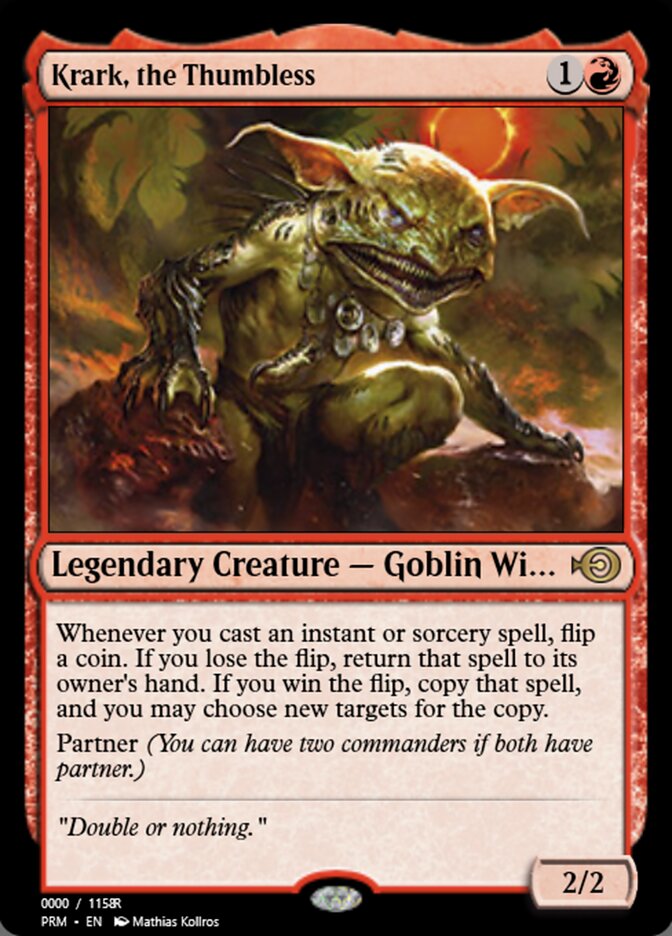
Krark, the Thumbless


Krark, the Thumbless turns every instant and sorcery into a high-variance value engine that can snowball into explosive turns, especially with a partner to broaden your spell suite.
Public decks: 1Bracket: 5
Overview
- Game plan revolves around casting lots of instants and sorceries to either copy them or rebuy them to hand off a lost flip.
- Typically plays like a spellslinger deck that can pivot between grindy value (recasting key spells) and sudden burst turns (multiple copies).
- Because Krark is only {1}{R}, you can often deploy your commander early and start generating advantage immediately if it survives.
- Partner choice heavily shapes the deck: staying mostly red leans into burn/token finishes, while adding other colors can open up more interaction and card flow.
- Expect swingy outcomes: even “failed” flips can be useful by effectively turning spells into repeatable resources.
Common lines
- Cast Krark, then start chaining cheap instants/sorceries; a lost flip returns the spell to hand so you can try again when you have mana.
- Hold up interaction and use Krark triggers to potentially double up on key answers or reuse them if the flip goes against you.
- Set up a big turn where you cast multiple spells in sequence and let copies pile up to generate a decisive advantage or lethal output.
- When the table is pressuring you, prioritize protecting Krark so your engine stays online.
Strengths
- High ceiling turns: copying spells can create huge swings in tempo, cards, or damage output.
- Resilience to some counterplay: losing flips can function as built-in recursion back to hand for instants/sorceries.
- Low commander cost makes rebuilding after removal more feasible than many engine commanders.
- Flexible interaction profile when paired into additional colors (often enabling stronger stack play).
Weaknesses
- Variance is real: key turns can fizzle or underperform depending on flips and sequencing.
- Commander-centric: removing Krark repeatedly can blunt the deck’s velocity and force fair play.
- Can generate long, non-deterministic turns that test table patience and clock management.
- Struggles to convert advantage into a clean win if the deck lacks a dedicated finisher package.
Rule zero notes
- Be upfront that Krark can create long turns with many triggers, copies, and decision points.
- Clarify your partner choice and resulting color identity; it dramatically changes interaction and combo potential.
- Discuss whether the deck is trying to storm/combo off quickly or is built for grindy value and incremental wins.
- Call out any high-density free/cheap interaction you’re running (examples from one list include Fierce Guardianship, Deflecting Swat, and Flusterstorm).
- If you use coin-flip manipulation (example: Krark's Thumb), mention it since it reduces variance and raises the deck’s consistency.
Matchups
Best into
- Midrange pods that give you time to set up a protected engine
- Creature-based tables where repeated spell copies can control the board
- Slower battlecruiser metas that can’t punish setup turns quickly
Struggles against
- Fast combo pods that demand immediate, consistent interaction
- Heavy removal tables that repeatedly answer small commanders
- Stax/Tax shells that choke mana and make recasting spells inefficient
FAQ
Do I have to be all-in on coin flips?
Not necessarily; Krark rewards volume and sequencing more than “coin-flip tribal,” but coin-flip support can push consistency if you want it.
How does Krark actually generate advantage when I lose flips?
Returning the spell to your hand can effectively turn mana into repeatable attempts, letting you reuse a key spell later in the turn or on a future turn.
What do games usually look like with Krark on board?
You often spend the early turns establishing Krark, then transition into chaining spells while managing the stack and picking spots to surge ahead.
How does this deck typically win?
Krark decks commonly close via a single explosive spell-chain turn that produces enough copied effects to end the game, or by building overwhelming advantage and converting it into a finisher.
Is this commander suitable for casual tables?
It can be, but the play pattern can involve long turns and swingy outcomes; it’s worth a quick Rule Zero chat so expectations match.