

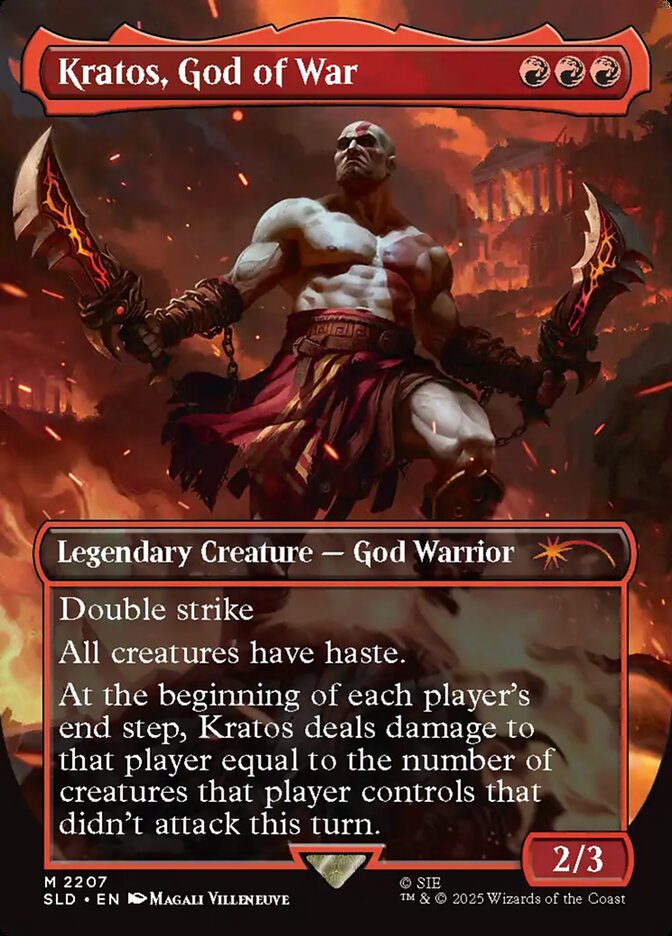
Kratos, God of War
 Commander
Kratos, God of War speeds the whole table into combat and taxes anyone who leaves creatures back, turning stalled boards into a steady life-total squeeze.
Public decks: 1Bracket: 1
Card text
Legendary Creature — God Warrior
Double strike
All creatures have haste.
At the beginning of each player's end step, Kratos deals damage to that player equal to the number of creatures that player controls that didn't attack this turn.
Building around this commander?
Use MTG Master to build or analyze a Commander deck around this card, check consistency, and find weak spots before your next game.
Overview
- Mono-red, combat-centric commander with built-in double strike and a global haste anthem that changes table pacing immediately.
- Leans into constant attacking: opponents who try to hold up blockers, sandbag creatures, or play pillowfort-style boards get punished at end step.
- Often plays like group-slug via combat math: life totals drop even when attacks don’t connect, because the trigger counts non-attackers.
- Can pivot between Voltron pressure (Kratos as a fast clock) and table-wide pressure (forcing or incentivizing everyone to swing).
- Games tend to snowball once boards are wide; the end-step trigger scales with creature count and can close without a dedicated combo finish.
Common lines
- Land Kratos, then immediately swing thanks to haste (and double strike), while tracking who is “leaving creatures home” for the end-step hit.
- Use forced-combat or “must attack” effects to keep opponents from stabilizing behind blockers and to keep the trigger aimed at the right players.
- Punish token swarms that can’t profitably attack, or control decks that deploy utility creatures but prefer to keep mana up.
- Set up a board state where opponents either take bad attacks or take large end-step chunks, then finish with combat damage or accumulated trigger damage.
Strengths
- Global haste creates immediate tempo and reduces the window for opponents to untap with new creatures safely.
- End-step damage scales naturally in multiplayer and can punish defensive postures without needing to connect in combat.
- Double strike makes Kratos a credible threat in combat and a strong carrier for equipment-based power boosts.
- Pressures “durdle” turns and encourages the table to interact through combat instead of sitting back.
- Plays well into messy board states where everyone has creatures but nobody has clean attacks.
Weaknesses
- Symmetrical haste helps opponents too; if you’re behind on board, you can enable faster crack-backs.
- Creature-light or spell-combo decks can often ignore the end-step tax by simply not committing creatures.
- If opponents can attack with most or all of their creatures (or have vigilance-style play patterns), the trigger’s impact drops sharply.
- Reliant on the combat step and board presence; repeated removal or sweepers can reset your pressure.
- Table politics can turn on you quickly because the commander changes how everyone’s turns play out.
Rule zero notes
- Kratos gives all creatures haste, including opponents’ creatures; disclose this up front because it changes the whole table’s pace.
- The end-step trigger hits every player on their own end step (including you), so the deck can play like group-slug rather than pure aggro.
- If you run forced-combat tools (for example Disrupt Decorum or Angel's Trumpet), mention that the deck pushes mandatory attacks and can create chaotic turns.
- If you include prison-ish combat limiters (for example Crawlspace or Ensnaring Bridge), call out that you may restrict combat while still taxing non-attackers.
- If you plan to lean on equipment-based commander kills (for example Grafted Exoskeleton), note that some games can end abruptly via commander damage-style pressure.
Matchups
Best into
- Creature-heavy midrange pods that want to develop boards and hold creatures back to block.
- Token and go-wide decks that can end up with lots of creatures unable to make profitable attacks.
- Pillowfort-leaning strategies that try to stall combat while accumulating value via creatures.
Struggles against
- Spell-based combo/control decks that win with minimal creatures on board.
- Decks that can consistently attack with their whole team while still defending profitably.
- Heavy board-wipe tables that keep resetting creature counts and combat pressure.
FAQ
Does Kratos deal damage to me too?
Yes. It triggers at the beginning of each player's end step, so you’ll take damage on your end step equal to your creatures that didn’t attack that turn.
If a creature entered the battlefield this turn, does it count if it didn’t attack?
Yes. The trigger counts creatures that player controls that didn’t attack that turn, regardless of when they entered.
Do tapped creatures or creatures that can’t attack still count as “didn’t attack”?
Typically, yes—if they didn’t attack that turn for any reason, they’ll be counted by Kratos’s end-step check.
What’s the usual way Kratos actually wins the game?
Most games close through a mix of steady end-step damage and combat damage, with Kratos’s double strike making commander-based pressure a realistic finisher.
Is this more of a Voltron deck or a forced-combat deck?
It can be either, but Kratos’s text naturally supports a hybrid plan: pressure with the commander while using the end-step tax to punish players who don’t engage in combat.