
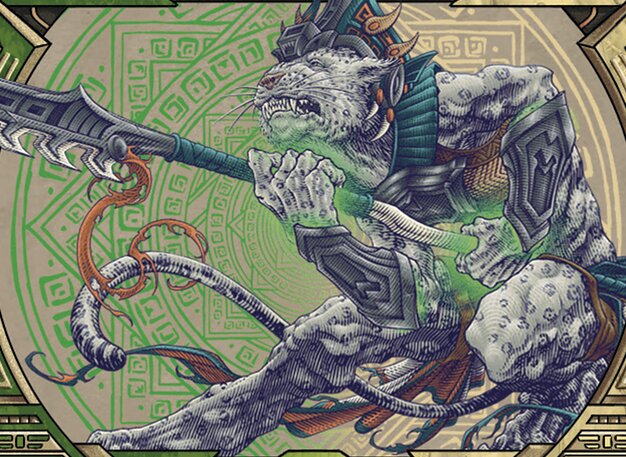
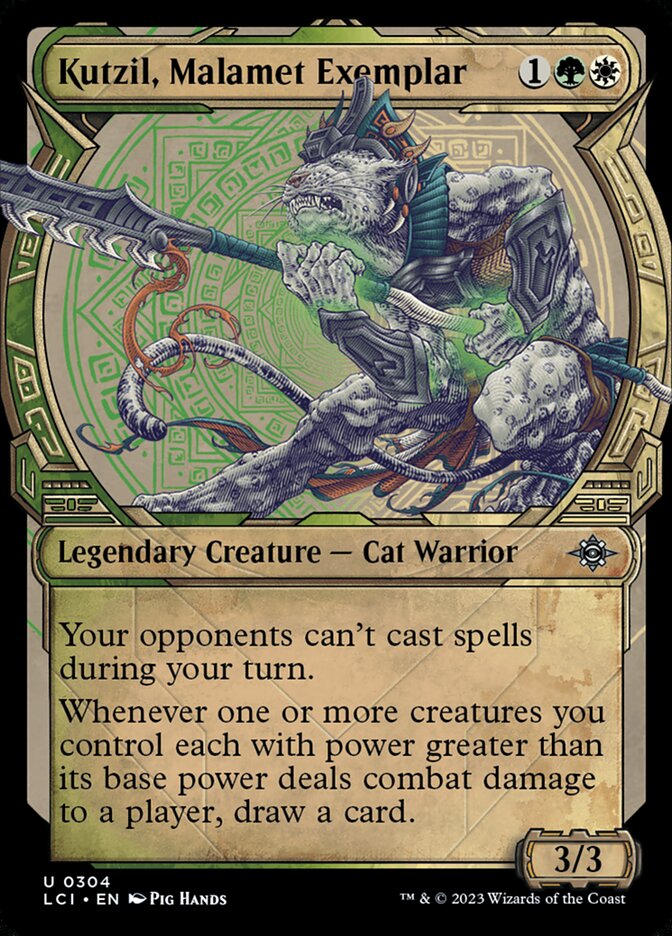
Kutzil, Malamet Exemplar


 CommanderPauper Commander
Kutzil, Malamet Exemplar is a Selesnya combat commander that turns “pump my team” turns into safe, interactive-free attacks and steady card draw.
Public decks: 1Bracket: Varies
Card text
Legendary Creature — Cat Warrior
Your opponents can't cast spells during your turn.
Whenever one or more creatures you control each with power greater than its base power deals combat damage to a player, draw a card.
Overview
- Leans on creatures that can get above their printed power (counters, auras, Equipment, and temporary pumps) to turn combat damage into cards.
- The “no spells during your turn” clause makes your attacks and key main-phase plays much harder to disrupt with counters or instant-speed removal.
- Typically wants to develop a board, then start connecting with one or more powered-up creatures to snowball advantage.
- Often plays like proactive midrange: pressure life totals, keep cards flowing, and force opponents to answer you on their own turns.
- Closes games by turning a growing board into overwhelming combat steps rather than by setting up a deterministic combo.
Common lines
- Cast Kutzil, then follow up with a +1/+1 counter or pump effect and immediately start drawing by connecting in combat.
- Suit up one or two evasive or hard-to-block threats so your card-draw trigger is reliable each turn cycle.
- Use your turn as the “safe window” to commit a big aura/Equipment or a key protection spell, then swing while opponents are locked out of casting.
- Transition from value attacks to lethal by stacking multiple power boosts and sending wide attacks to draw and pressure simultaneously.
Strengths
- Excellent at forcing through your own turn: opponents can’t counter, remove, or trick you mid-combat on your turn.
- Card advantage stapled to the main game plan (attacking), so you’re rewarded for doing what you already want to do.
- Naturally punishes reactive decks that rely on holding up interaction during your turn.
- Scales well from early chip damage into late-game refills if you can keep connecting.
Weaknesses
- Needs combat damage to players to function; pillowforts, fogs, and clogged boards can shut off the draw engine.
- Vulnerable to board wipes and sorcery-speed answers on opponents’ turns; Kutzil doesn’t protect you outside your turn.
- Can be forced into overcommitting to the board to keep cards flowing, which increases wipe risk.
- Creature removal aimed at your key “modified” attackers can strand your draw trigger.
Rule zero notes
- Be clear that Kutzil stops opponents from casting spells during your turn, which can feel like a partial lock on interaction.
- Mention whether you’re leaning hard into protection and “can’t interact with me on my turn” gameplay, or keeping it mostly as a combat enabler.
- If you’re playing lots of aura/Equipment-based snowballing, note that games may revolve around one or two must-answer threats.
- If your list includes infect-style kills or other polarizing combat finishes, flag that before the game.
Matchups
Best into
- Reactive control pods that want to interact on your turn with counters and instant-speed removal
- Value-midrange tables that give you time to build a board and win via combat
- Decks that struggle to block profitable attacks (limited blockers or limited reach)
Struggles against
- Pillowfort and fog-heavy defenses that prevent combat damage to players
- Board-wipe-dense metas that repeatedly reset creature boards
- Fast, noncombat combo decks that don’t care about combat pressure
FAQ
What does Kutzil want you to build around?
Creatures that can get above their base power, plus enough ways to ensure they actually connect with players so the draw trigger keeps firing.
Does Kutzil protect my stuff from everything?
Only on your turn, and only from spells. Opponents can still cast spells on their own turns, and they can still use activated abilities during your turn.
How do you usually start drawing cards?
Get at least one attacker to have power greater than its base power (often via counters, auras, Equipment, or a pump spell), then prioritize attacks that safely hit a player.
Is this more of a go-tall or go-wide commander?
It can do either, but it tends to reward whichever plan most reliably creates modified attackers that can connect; many builds mix a tall threat with a wider board for pressure.
How does the deck typically win?
By converting repeated safe combat steps into enough cards and board presence to overwhelm the table with damage, often after one or two big swing turns.