
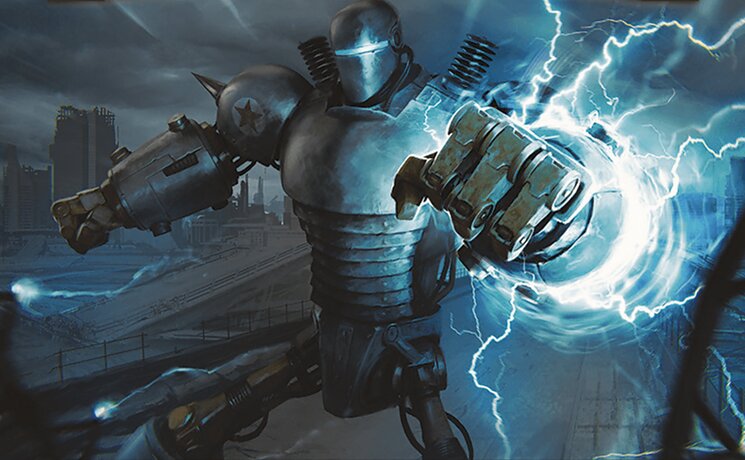
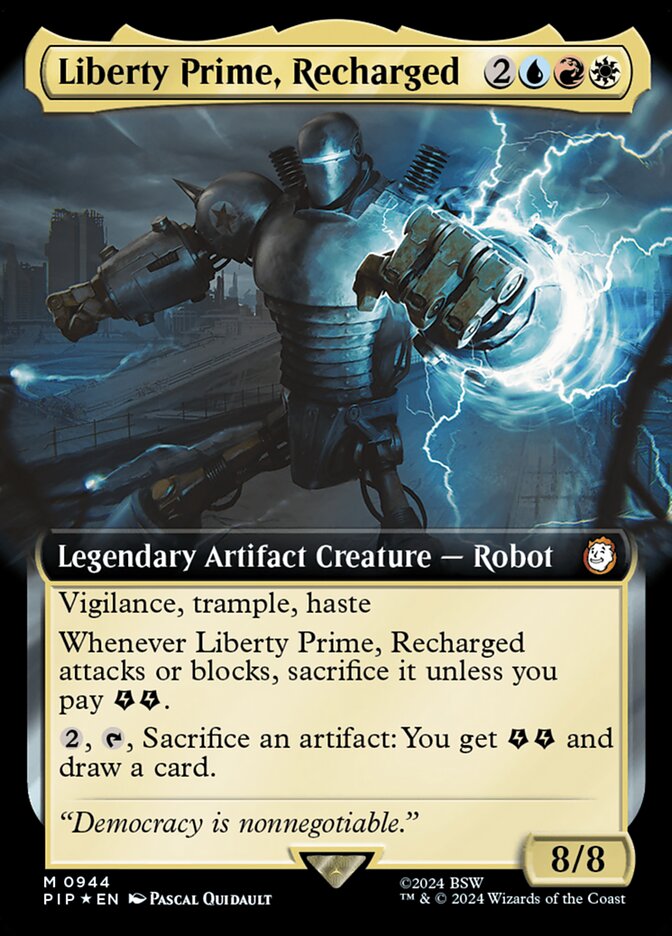
Liberty Prime, Recharged




A Jeskai artifact beater that turns spare artifacts into energy and cards so it can keep attacking and blocking without self-destructing.
Public decks: 1Bracket: Varies
Overview
- Leans on Liberty Prime’s built-in haste, vigilance, and trample to apply immediate combat pressure.
- The core tension is energy: every attack or block asks for {E}{E}, so your game plan often revolves around producing and conserving energy counters.
- Uses the commander’s {2}, {T}, sacrifice-an-artifact ability as both an energy engine and a card-advantage tool.
- Often plays like artifact-based midrange/Voltron: suit up, swing, and use the draw/energy activation to stay fueled.
- Typically wants a steady stream of expendable artifacts so your sac outlet isn’t forced to eat your important mana or equipment.
Common lines
- Develop with cheap artifacts and mana rocks, then land Liberty Prime and immediately pressure life totals thanks to haste.
- Attack while paying {E}{E}, then convert a spare artifact into {E}{E} plus a card to keep the loop going next turn.
- Hold Liberty Prime back as a vigilant blocker when needed, but plan ahead so you can still pay the {E}{E} on blocks.
- Pivot into a more equipment/auras-focused plan when you can protect the commander and start threatening commander-damage kills.
Strengths
- Fast clock for a five-mana commander: haste plus trample makes early hits matter.
- Vigilance lets you pressure and still represent blocks, which plays well in combat-heavy pods.
- On-board card advantage: the activated ability can turn excess artifacts into real resources.
- Naturally synergizes with a wide range of artifact shells (ramp, equipment, token artifacts), depending on how you build it.
Weaknesses
- Energy is a hard constraint; missing {E}{E} at the wrong time can force you to sacrifice your commander.
- Reliant on having spare artifacts to feed the engine; if the board is light, the draw/energy ability can be awkward.
- Artifact hate and exile removal can line up well against your plan and limit both mana development and staying power.
- The draw/energy activation is tapped and mana-gated, so you can fall behind if you’re forced to hold up interaction or keep recasting.
Rule zero notes
- Mention up front that the commander has a built-in self-sacrifice clause tied to energy, so your lines can look unusual (attack/block decisions matter a lot).
- If you’re running any alternate win conditions (for example, Mechanized Production), call that out before the game.
- If your list is leaning hard into a Voltron kill plan (for example, All That Glitters plus equipment), tell the table you can threaten commander-damage kills quickly.
- If you include proliferate payoffs (for example, Inexorable Tide), flag that you may scale energy and other counters faster than expected.
Matchups
Best into
- Creature-heavy midrange pods where combat math and blocking matter.
- Slower tables where incremental card advantage from sacrificing artifacts can take over.
- Decks that struggle to answer a hasty trampling threat repeatedly.
Struggles against
- Artifact-removal-heavy pods that can tax your mana rocks and sac fodder.
- Exile-based spot removal that keeps Liberty Prime from sticking around long enough to leverage energy.
- Fast combo tables where a combat-centric plan doesn’t get enough time.
FAQ
How do you keep Liberty Prime from sacrificing itself?
You need reliable energy production so you can pay {E}{E} on each attack or block. The commander’s own sacrifice-an-artifact activation is a built-in way to restock energy while drawing cards.
What does the deck usually do to win?
Most wins are through combat, often by repeatedly connecting with a hasty trampling commander and scaling its damage through artifact/Voltron-style buffs. Some builds may also include an alternate win like Mechanized Production as a backup plan.
Do you have to attack every turn?
Not always; vigilance means you can play a controlling combat posture when needed. The key is planning your energy so a defensive block doesn’t unexpectedly cost you your commander.
What kind of cards tend to support the plan?
You generally want cheap artifacts you don’t mind sacrificing, protection for the commander, and ways to keep cards flowing. Examples seen in at least one snapshot include Lightning Greaves, Arcane Signet, and Everflowing Chalice.
Is this a combo commander?
It doesn’t read as a dedicated combo engine on its own; it’s more of a value-and-combat centerpiece. It can be built in different directions, but the default play pattern is usually pressure plus resource conversion.