

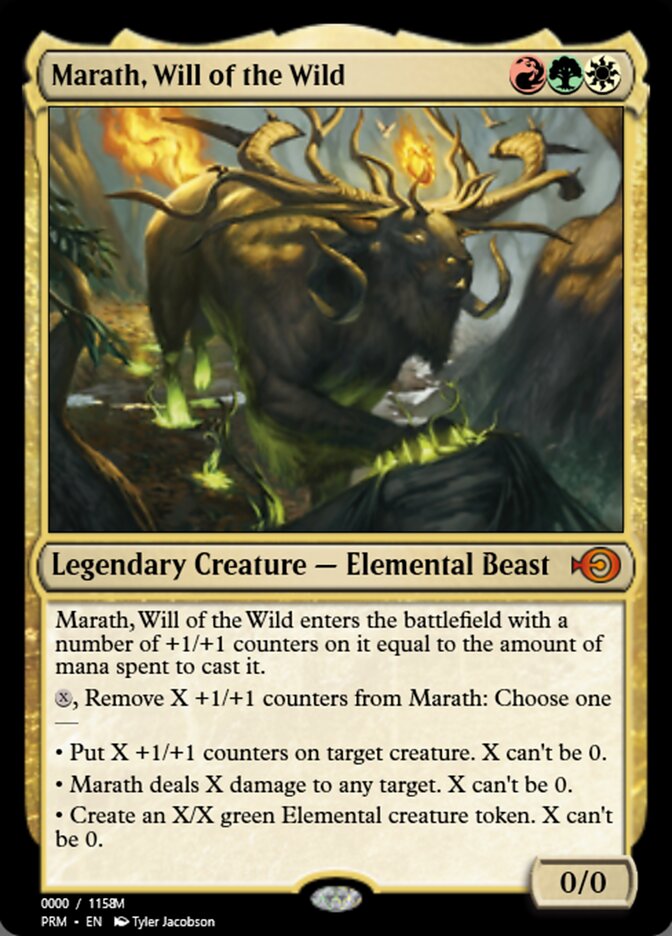
Marath, Will of the Wild


 Commander
A flexible Naya counter engine that turns extra mana into damage, creature growth, or token swarms.
Public decks: 0Bracket: Varies
Card text
Legendary Creature — Elemental Beast
Marath enters with a number of +1/+1 counters on it equal to the amount of mana spent to cast it.
 , Remove X +1/+1 counters from Marath: Choose one —
• Put X +1/+1 counters on target creature. X can't be 0.
• Marath deals X damage to any target. X can't be 0.
• Create an X/X green Elemental creature token. X can't be 0.
Overview
- Marath scales with how much mana you invest, and naturally reloads as commander tax pushes later casts higher.
- Acts as a repeatable mana sink: convert +1/+1 counters into spot removal, board presence, or permanent stat boosts.
- Often plays a midrange game where Marath controls small creatures early, then pivots into token pressure or big counter payoffs.
- Rewards careful resource management: choosing when to spend counters versus keeping Marath large matters a lot.
- Can close games either through wide boards of Elementals, direct damage over time, or enabling oversized attackers.
Common lines
- Cast Marath early for a modest size, then use small X activations to pick off utility creatures or chip planeswalkers/players.
- Use leftover mana on end steps to convert counters into tokens, then untap into a wider board.
- Recast Marath after it dies; the increased mana spent often makes the next Marath a bigger engine immediately.
- Shift modes as needed: grow a key attacker in combat-heavy pods, or stay in control mode by holding counters for damage.
Strengths
- Highly flexible: one commander provides removal, token production, and creature buffing on demand.
- Excellent mana-sink potential; extra mana in the mid/late game rarely goes to waste.
- Commander tax can be an upside, making recasts meaningfully stronger.
- Plays well into creature-centric tables by pressuring small threats and building a board at the same time.
Weaknesses
- Can be mana-hungry; low-mana games make the engine feel small and slow.
- Relies on having counters available; being forced to spend them defensively can stall your proactive plan.
- Vulnerable to repeated removal or effects that limit activated abilities, which can shut off Marath’s flexibility.
- May struggle to keep up with very fast, noncombat combo decks if the table can’t apply early pressure.
Rule zero notes
- Share whether your list leans more toward combat/token swarms or direct-damage finishes.
- Clarify if you’re running dedicated +1/+1 counter synergies versus a more generic Naya goodstuff shell.
- Mention how interactive the build is (e.g., lots of creature control via Marath versus mostly proactive).
Matchups
Best into
- Creature-heavy midrange pods with lots of utility creatures
- Combat-focused tables where board presence matters
- Grindy games where mana sinks and recasting a commander are valuable
Struggles against
- Fast combo pods that win before Marath can accrue value
- Heavy control shells that repeatedly answer the commander and key board pieces
- Strategies that blank activated abilities or invalidate small-ball damage
Recent public decks
No public decks are available yet.
FAQ
How does Marath scale over a long game?
Because Marath enters with counters based on mana spent, later recasts often come down larger and immediately fuel bigger activations.
What role does Marath usually play at the table?
Marath tends to play as a flexible midrange engine, switching between removal, token-making, and buffing depending on what the pod demands.
How do Marath decks typically win?
Common finishes involve going wide with Elemental tokens, building a huge attacker with counters, or converting counters into repeated damage to close.
Should I spend counters aggressively or hold them up?
It often depends on the pod: against creature decks, keeping counters for instant-speed damage can be key, while slower tables reward turning mana into tokens and pressure.