

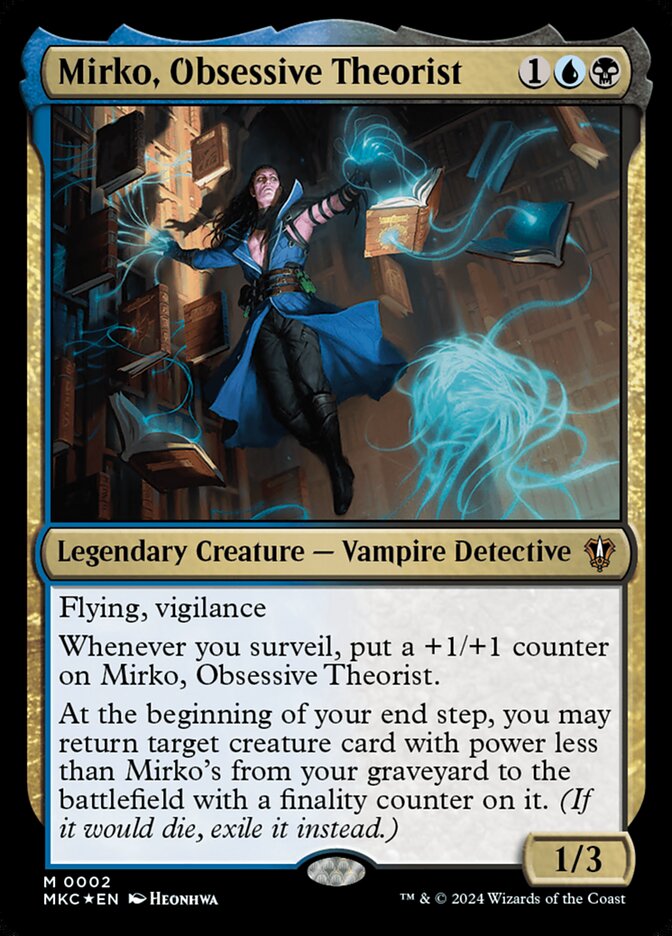
Mirko, Obsessive Theorist



A Dimir graveyard value commander that grows through surveil and reanimates smaller creatures each end step as Mirko scales up.
Public decks: 0Bracket: Varies
Overview
- Leans on surveil triggers to both stock the graveyard and steadily grow Mirko with +1/+1 counters.
- Plays a value-reanimator game: each end step can bring back a creature whose power is currently below Mirko’s power.
- Finality counters mean your recursion is more like temporary-but-reliable bodies; plan to get value immediately rather than loop deaths.
- Mirko’s flying and vigilance make it easier to chip in while still holding up blocks, and the growing power matters directly for what you can reanimate.
- Games often revolve around protecting Mirko, managing your graveyard, and picking the best creature to re-buy for the current board state.
Common lines
- Early: cast Mirko, start surveilling to grow him while binning creatures you want to bring back later.
- Midgame: use end-step reanimation to stabilize boards or rebuild after trades, choosing creatures that generate immediate value.
- As Mirko grows, your reanimation range increases, turning each end step into a steady stream of threats or utility bodies.
- If Mirko is removed repeatedly, you often pivot to playing a more normal Dimir value plan until you can re-establish the engine.
Strengths
- Consistent incremental advantage: surveil improves draw quality and fuels the graveyard at the same time.
- Repeatable end-step reanimation can keep you ahead in attrition-heavy games.
- Mirko scales naturally, expanding the range of creatures you can return over time.
- Flying plus vigilance lets Mirko contribute to pressure without fully giving up defense.
Weaknesses
- Reliant on the commander: removal or commander tax can slow your primary engine significantly.
- Graveyard disruption can shut off the end-step reanimation and reduce surveil’s payoff.
- Finality counters limit long-term looping; reanimated creatures are easier to permanently answer via exile-on-death.
- Often needs time to set up; faster tables can pressure you before the engine is online.
Rule zero notes
- This commander naturally plays as a graveyard-centric value/reanimation engine; call out how much graveyard recursion your build runs.
- Finality counters mean recursion is often about immediate ETB/attack value rather than infinite sacrifice loops; mention if you include any dedicated combo finishes anyway.
- If you run lots of counterspells or permission to protect Mirko and force through engines, set expectations for interaction density.
- Let the table know if your plan is mostly grindy value or if you’re aiming to close quickly once Mirko gets large.
Matchups
Best into
- Midrange pods that trade resources and play to the board over many turns
- Creature-combat tables where repeated blockers and value bodies matter
- Removal-heavy games where rebuilding incrementally is rewarded
Struggles against
- Graveyard-hate-heavy pods that can consistently exile yards or key targets
- Fast combo tables that end games before your end-step value adds up
- Exile-based interaction suites that cleanly answer reanimated bodies and Mirko
Recent public decks
No public decks are available yet.
FAQ
What is Mirko trying to do each game?
Surveil to grow Mirko and fill the graveyard, then use the end-step trigger to reanimate the best creature you can based on Mirko’s current power and the board state.
How do finality counters change the gameplay?
They make your reanimated creatures more disposable: you want immediate value because if they die they get exiled instead of looping back.
Do I need to attack with Mirko?
Often yes, but selectively; flying and vigilance let you apply pressure while staying back on defense, and keeping Mirko alive usually matters more than damage.
What kinds of creatures work best to reanimate?
Creatures that generate value right away tend to shine, since they may only stick around briefly and you’re reanimating on your end step.
What’s the easiest way for opponents to stop this plan?
Removing Mirko repeatedly or attacking the graveyard can cut off your reanimation engine and force you into a slower, fairer Dimir game.