
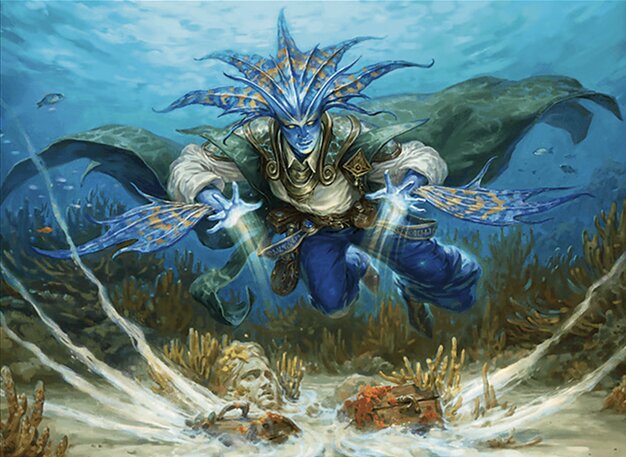
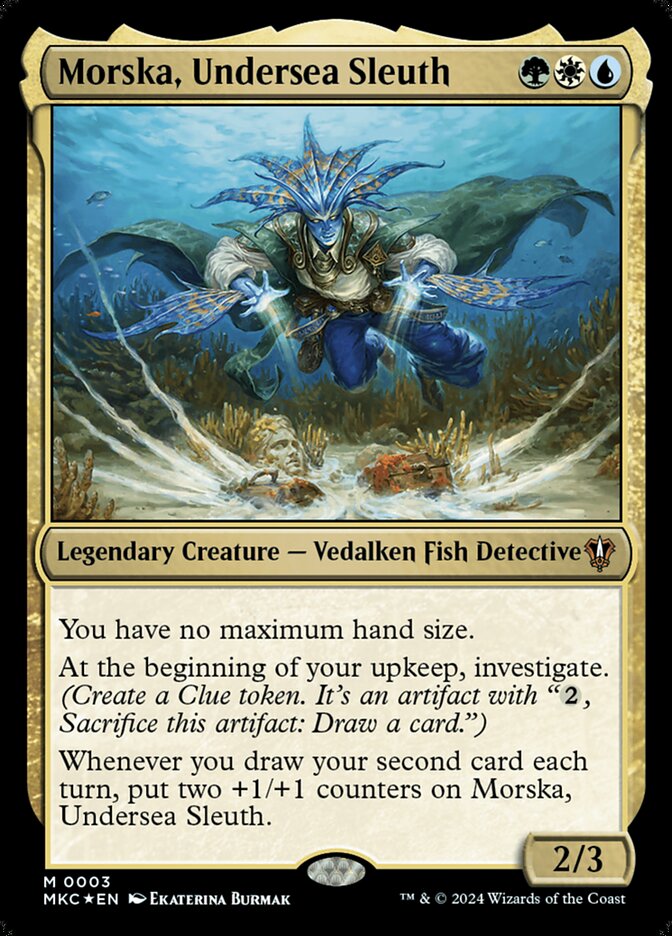
Morska, Undersea Sleuth



A Bant value commander that turns steady card draw and Clue production into a growing threat you can leverage over a long game.
Public decks: 0Bracket: Varies
Overview
- Generates a Clue every upkeep, giving you a built-in source of card flow and artifact material over time.
- Rewards consistent two-cards-per-turn play patterns by stacking +1/+1 counters on Morska.
- Often plays like a slow-burn engine: set up, draw extra each turn cycle, then pivot into combat with a large commander.
- No maximum hand size encourages you to hoard resources and hit land drops while keeping interaction up.
- Wins commonly come from commander damage or pressure backed by a sustained card advantage engine.
Common lines
- Develop mana and early interaction, then let the upkeep Clue accumulate while you plan future turns.
- On key turns, convert Clues into your second draw to trigger counters, then attack with an increasingly large Morska.
- Use end-step or opponent-turn draw to trigger Morska on multiple turns in a cycle when your deck supports it.
- Bank cards in hand thanks to no max hand size, then spend them in a single swing turn to protect a lethal attack.
Strengths
- Reliable, commander-provided value that doesn’t require other pieces to function.
- Excellent long-game scaling: Clues stockpile and Morska grows naturally with normal draw patterns.
- Flexibility from Bant colors to mix interaction, ramp, and incremental advantage around the core engine.
- Threat + engine in one card: Morska can become a legitimate clock while you keep drawing.
Weaknesses
- Clues are mana-hungry to cash in; the deck can feel slow if you’re pressured early or short on mana.
- Morska’s growth depends on consistently drawing a second card each turn; disruption to your draw plan can stall your clock.
- Can be vulnerable to artifact hate that incidentally sweeps up Clues and reduces your card flow.
- If the table can repeatedly answer Morska, your primary combat close can get delayed.
Rule zero notes
- This commander naturally leans toward longer, value-oriented games; mention if your list is tuned for faster wins.
- Disclose if you’re running a high density of extra draw effects to trigger Morska repeatedly each turn cycle.
- Call out if your build is primarily commander-damage focused versus a broader value-control plan.
- If you include strong artifact-token synergies or lock pieces that punish artifacts, mention it up front since you also rely on Clues.
Matchups
Best into
- Midrange pods that give you time to accrue Clues and turn the corner.
- Grindy value tables where extra cards and inevitability matter.
- Creature-light control games where a single large attacker can be a clean win condition.
Struggles against
- Fast combo tables where incremental Clue value is too slow to matter.
- Early aggression that forces you to spend mana stabilizing instead of cracking Clues.
- Heavy artifact-hate metas that frequently remove tokens and incidental artifacts.
Recent public decks
No public decks are available yet.
FAQ
Is Morska mainly a card-draw commander or a combat commander?
It’s both: you get steady Clues for cards, and the second-draw trigger turns those cards into real combat pressure.
Do I need to draw two cards on my turn specifically?
No. Morska triggers whenever you draw your second card each turn, so you can often set up triggers on opponents’ turns too.
How does the Investigate trigger usually matter?
It gives you a guaranteed resource each upkeep; even if you don’t crack Clues immediately, they represent future cards and tempo flexibility.
What are the typical win conditions?
Morska can become large enough to threaten commander damage, and the ongoing card advantage helps you maintain pressure and protection.