

Ms. Bumbleflower



 Commander
A Bant politics engine that turns every spell into a favor, a flying counter, and (with the right pacing) a burst of card draw for you.
Public decks: 5Bracket: Varies

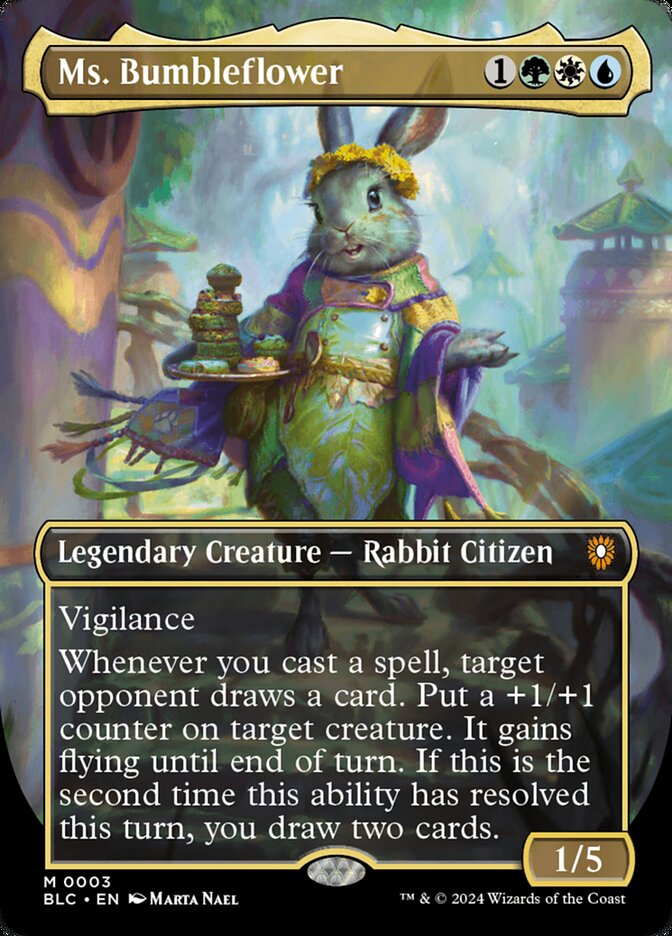
Card text
Legendary Creature — Rabbit Citizen
Vigilance
Whenever you cast a spell, target opponent draws a card. Put a +1/+1 counter on target creature. It gains flying until end of turn. If this is the second time this ability has resolved this turn, you draw two cards.
Building around this commander?
Use MTG Master to build or analyze a Commander deck around this card, check consistency, and find weak spots before your next game.
Overview
- Plays a steady, spell-heavy game where each cast advances your board while buying goodwill by feeding an opponent a card.
- Leans on timing and turn structure: resolving the trigger twice in a turn converts the “gift” into real advantage by drawing you two.
- Uses +1/+1 counters and temporary evasion to turn small creatures into credible attackers and to pressure planeswalkers and life totals.
- Often prefers instant-speed interaction and flexible spells so you can line up a second trigger on key turns without overcommitting.
- Your target choice matters a lot; the deck tends to reward table awareness and careful threat assessment.
Common lines
- Deploy Ms. Bumbleflower, then start chaining low-commitment spells to generate counters and force favorable combat via surprise flying.
- Use the trigger politically: give cards to the least-threatening opponent while you build a protected, growing attacker.
- Engineer “two triggers in a turn” by casting on your turn and then again on an opponent’s turn to turn on the two-card draw.
- Pivot from value to pressure once you’ve stacked counters on one or two creatures that can reliably connect in the air.
Strengths
- Consistent incremental value from simply casting spells, without needing to attack or tap the commander.
- Strong political positioning: you can aim the draw at the player you want to keep friendly or behind.
- Combat flexibility from surprise flying plus counters, letting you create profitable attacks or unexpected blocks.
- Can play a reactive game well if built with lots of cheap, flexible spells to trigger on multiple turns.
Weaknesses
- You are giving an opponent extra cards every time you play the gameplan, which can backfire if you pick the wrong target.
- Needs repeated spellcasting to reach peak output; if taxed, disrupted, or forced to play at sorcery speed, the engine slows down.
- Closing speed can be inconsistent if your counter targets get removed or if the table stabilizes against incremental combat damage.
- Commander removal can be tempo-negative, especially if you’ve shaped your deck around frequent triggers.
Rule zero notes
- This commander inherently gives opponents card draw; clarify whether your build is more “politics/value” or trying to convert that into a quick kill.
- Mention how interactive your list is, since frequent spellcasting can look like you’re sandbagging answers or sculpting a turn-cycle burst.
- If your deck focuses on stacking counters onto one evasive threat to end games, call out the potential for sudden commander-damage-style kills.
- Because targeting matters, discuss expectations about kingmaking and how you choose who gets the cards.
Matchups
Best into
- Creature-heavy midrange pods where flying pressure and growing bodies can dominate combat math.
- Slower tables where politics and incremental advantage have time to compound.
- Decks that struggle to punish extra card draw immediately, letting you “pay” with cards without dying for it.
Struggles against
- Fast combo pods where gifting cards accelerates the wrong player into a quick win.
- Heavy removal/board-wipe tables that repeatedly reset your counter investment.
- Stax/tax strategies that constrain spell volume and prevent you from reliably triggering twice per turn.
Recent public decks
Staples
Browse all public decksFAQ
How do you actually come out ahead if you’re drawing an opponent cards?
You often aim the draw at the least-likely player to convert it into safety while your triggers build a threat, and you can recoup with the “second resolution” draw-two clause when you plan your spells across a turn cycle.
What kind of game plan does Ms. Bumbleflower usually reward?
A spell-dense, tempo/value plan where you cast multiple spells per round, keep the board manageable, and grow one or two creatures into evasive finishers.
Do you need to target the same opponent every time?
No; changing targets is often correct to manage table politics and avoid supercharging the player who is closest to winning.
Is this a group hug commander?
It can play like “selective hug,” but it typically works best when the card-gifting is a tool to manipulate the table rather than a symmetrical generosity plan.
How does the deck usually win?
Most wins tend to come from combat after stacking +1/+1 counters and using flying to force through damage, sometimes concentrating power on a single protected attacker.
What’s the biggest gameplay trap with this commander?
Casting spells mindlessly and feeding the strongest deck at the table; the commander’s trigger is powerful, but only if you control who benefits and when.