

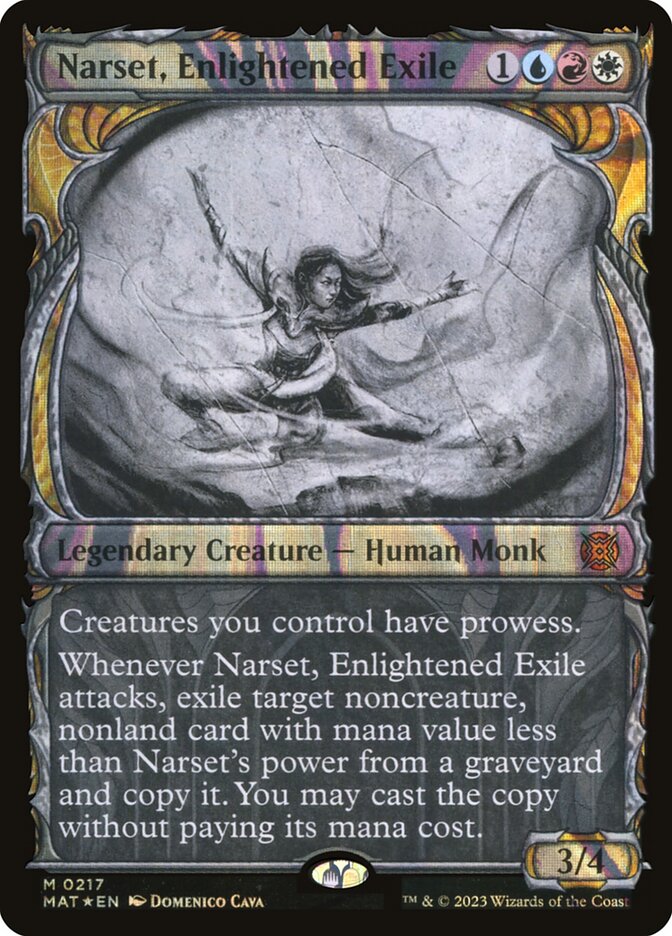
Narset, Enlightened Exile




A Jeskai combat-spells commander that turns every attack into a free cast from any graveyard while your whole team scales with prowess.
Public decks: 1Bracket: Varies
Overview
- Play like a proactive spellslinger: develop Narset, then leverage cheap noncreature spells to grow your board mid-combat.
- Narset rewards attacking by copying and casting a low-mana-value spell from a graveyard for free, often letting you double-spell without spending mana.
- Because the spell can come from any graveyard, your lines often pivot based on what opponents have used or discarded.
- Your combat step is the engine: attacks translate into both damage (wide prowess triggers) and velocity (free spell copy).
- Wins commonly come from snowballing combat damage, using copied interaction to keep lanes clear, and chaining multiple spells in key turns.
Common lines
- Cast Narset, then follow up with a turn where you can attack immediately and still hold up a noncreature spell to trigger multiple prowess instances.
- Attack with a small board, copy a relevant graveyard spell for free, and use it to either clear blockers or add more bodies/pressure before damage.
- Spend early turns trading resources, then let Narset turn those traded spells in graveyards into tempo on your attacks.
- Sequence spells pre- and post-combat to maximize prowess math and ensure Narset’s attack trigger has a worthwhile target.
Strengths
- Strong tempo turns: attacking can generate a free spell while your team scales in combat.
- Naturally flexible: access to a wide range of effects depending on what’s available in graveyards.
- Plays well from parity: trading early can make later Narset attacks more potent.
- Can pressure life totals while still representing interaction through instant-speed noncreature spells.
Weaknesses
- Heavily combat-dependent; fog effects, pillow-fort tools, or clogged boards can blunt the engine.
- Relies on having good graveyard targets and a safe attack; graveyard hate can significantly reduce output.
- Commander-centric: repeated removal or commander tax can slow the deck’s ability to convert turns into advantage.
- Often needs to tap into combat to get paid, which can make shields-down turns riskier at higher power tables.
Rule zero notes
- Narset can copy and cast spells from any graveyard for free; clarify how swingy you expect those attack triggers to be.
- Disclose if your build leans into extra turns, mass extra combat steps, or other high-leverage noncreature spells (if any).
- Mention your expected interaction density (light, medium, or heavy), since Narset can turn graveyards into repeatable tempo.
- If you run many effects that lock out combat or repeatedly clear boards to force through attacks, flag that upfront.
Matchups
Best into
- Midrange pods where combat matters and games involve lots of trading and interaction.
- Tables that naturally fill graveyards with useful noncreature spells over time.
- Creature-light control decks that struggle to block wide prowess boards.
Struggles against
- Pillow-fort or heavy fog strategies that deny profitable attacks.
- Dedicated graveyard-hate tables that keep exile effects online consistently.
- Fast combo pods where combat engines come online too late without specific interaction timing.
FAQ
Do I need my own graveyard stocked for Narset to work?
Not necessarily; Narset can target any graveyard, so you can often use opponents’ spent spells as fuel if the table is trading resources.
How does the deck usually win?
It typically closes with combat damage by stacking multiple prowess triggers across a board, backed by free copied spells to clear blockers or protect the push.
Is this more of a spellslinger deck or an aggro deck?
It tends to play like a hybrid: you’re incentivized to cast lots of noncreature spells, but the payoff is primarily winning through combat.
What should I protect most: Narset or the board?
Often Narset is the engine that turns attacks into real advantage, but protecting a critical mass of creatures can matter because prowess scales best with a wider board.
What shuts Narset down the hardest?
Consistent graveyard hate and effects that prevent or punish attacking are the most direct ways to cut off the commander’s primary value line.