

Nevinyrral, Urborg Tyrant




Nevinyrral, Urborg Tyrant leans into board wipes and death triggers, turning messy combat steps into a Zombie army and resetting the table when it’s time to take over.
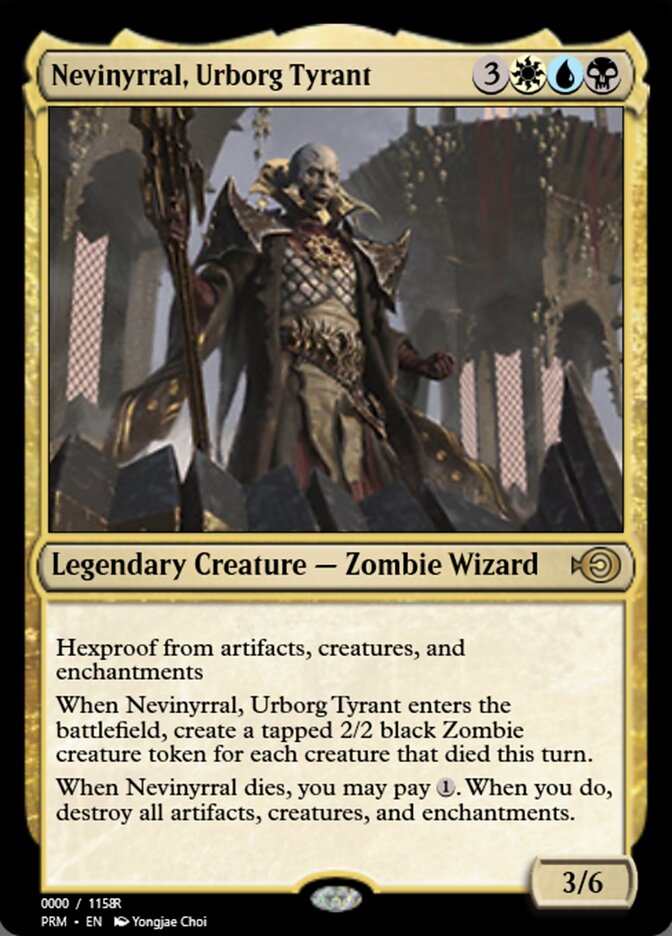
Public decks: 1Bracket: Varies
Overview
- Plays a grindy Esper game where creature deaths are a resource, not a liability.
- Often sets up sacrifice fodder and payoffs, then engineers big “everything died” turns to maximize Nevinyrral’s enter-the-battlefield Zombie burst.
- Keeps opponents honest with sweepers and edict effects, then rebuilds faster using recursion and token production.
- Threatens a commander-based reset: if Nevinyrral dies, you can pay {1} to wipe artifacts, creatures, and enchantments.
- Typically closes by draining the table with death triggers or by overwhelming with Zombies after a reset.
Common lines
- Develop mana and small bodies, then trade aggressively so a later Nevinyrral entry produces a meaningful Zombie board.
- Use sacrifice outlets plus aristocrat-style payoffs to turn every exchange into incremental life drain and cards.
- Time a board wipe, then land Nevinyrral post-wipe to convert the turn’s deaths into a tapped Zombie squad.
- Let Nevinyrral die on your terms to threaten the {1} full wipe, then rebuild via reanimation effects.
Strengths
- Excellent at breaking parity on sweepers and attrition-heavy turns.
- Resilient into creature combat: deaths can translate into tokens and/or drain.
- Commander doubles as both payoff (Zombie burst) and emergency reset button (death trigger wipe).
- Esper colors give access to interaction, recursion, and grind tools.
Weaknesses
- Nevinyrral is six mana; getting it answered repeatedly can be a tempo sink.
- The death-trigger wipe can be politically dangerous and may paint a target on you early.
- Tapped Zombies mean the immediate payoff is delayed; fast decks can punish the setup window.
- Graveyard dependence (recursion and mass reanimation lines) can be vulnerable to graveyard hate.
Rule zero notes
- Call out whether you’re built to repeatedly wipe artifacts/creatures/enchantments off Nevinyrral’s death trigger.
- Disclose any heavy sacrifice/edict packages (for example effects like Dictate of Erebos/Butcher of Malakir can feel oppressive).
- Mention if you run mass reanimation swings (e.g., Living Death-style turns) that can abruptly reverse the game.
- Flag any land-denial elements if present (a card like Global Ruin changes expectations at many tables).
Matchups
Best into
- Creature-heavy midrange pods that rely on building a board over multiple turns.
- Token and go-wide strategies that overextend into sweepers.
- Attrition mirrors where repeatable death value matters.
Struggles against
- Fast combo tables that don’t care about the battlefield and punish six-mana setups.
- Control-heavy pods with lots of stack interaction that can stop the key rebuild turn.
- Decks packed with graveyard hate that shut off reanimation and death-value loops.
FAQ
Do I usually want Nevinyrral to die?
Often yes, but on your terms. The {1} death trigger can function like a one-sided plan if you’re ready to rebuild faster than the table.
How do I get a big Zombie burst on ETB?
You typically want Nevinyrral to enter after a turn where many creatures died (combat, edicts, or a wipe). The Zombies enter tapped, so plan for the next turn’s pressure.
What are the main win conditions?
Common finishes are aristocrat-style draining from repeated deaths (e.g., Blood Artist/Cruel Celebrant/Bastion of Remembrance as examples) or turning a post-wipe Zombie army into lethal over a couple turns.
Is this a stax deck?
Not inherently; it tends to be more of a board-control and attrition commander. It can feel “locky” if you lean hard on repeatable edicts and frequent resets, so it’s worth discussing up front.
What kind of interaction should I expect to play a lot of?
You’ll usually lean on sweepers and sacrifice-based removal to inflate the death count, backed by spot interaction as needed. The deck tends to reward careful timing more than constant trading.